
A team is standardizing model-driven telemetry across 300 IOS XE routers. The subscription must ship inside the config template pushed to every device, must keep streaming after a reload, and must push a sample every 60 seconds on a fixed schedule driven by the router. Which telemetry subscription design meets all three requirements?
Select an answer to reveal the explanation.
Short Explanation
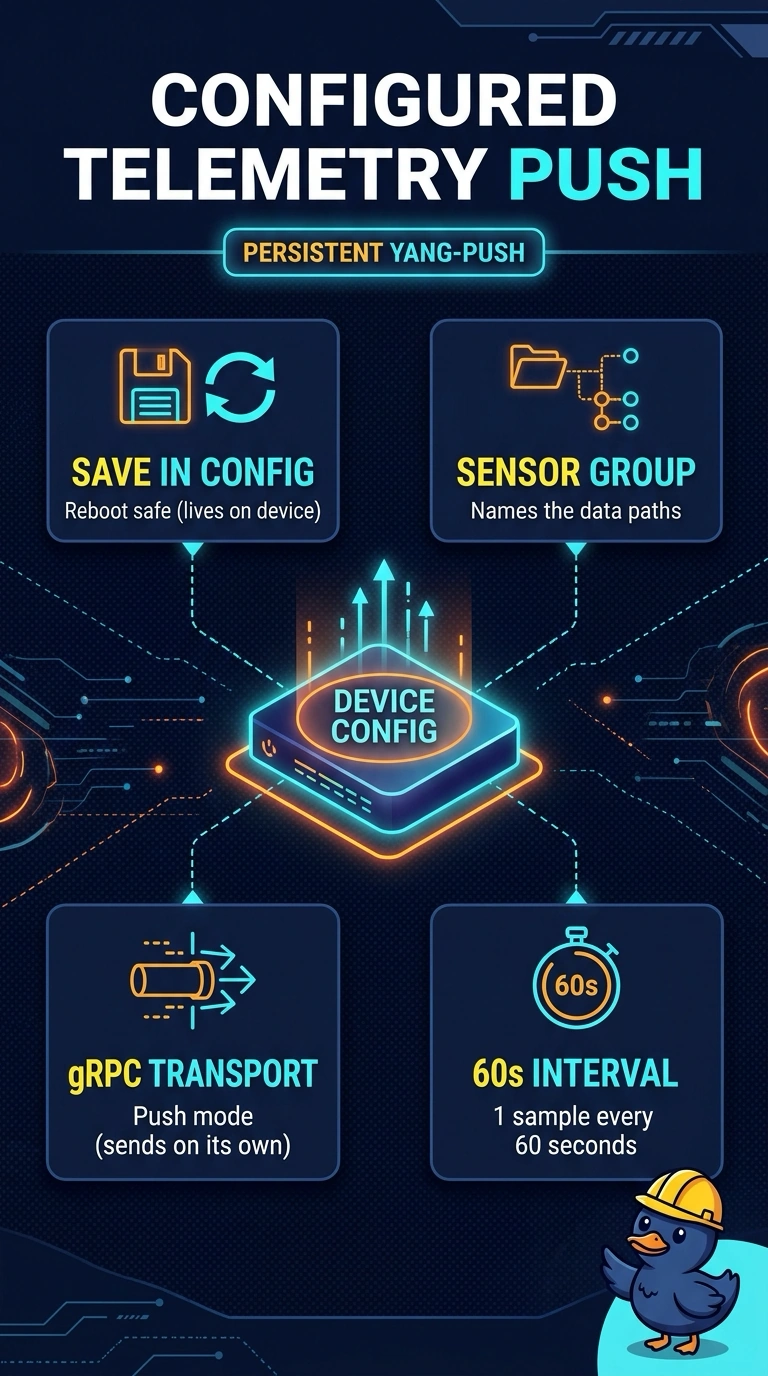
A persistent subscription lives in the device configuration, so it starts again after a reload and pushes samples on the interval you set. It's a standing order the router keeps filling without being asked. Dynamic subscriptions end the moment the session that created them closes.
Full Explanation
On IOS XE, model-driven telemetry lets you define a YANG-Push subscription in configuration: a sensor group names the YANG paths to stream, the subscription sets the encoding and periodic trigger, and the receiver configuration specifies the gRPC transport and destination. Because the definition is saved in the running configuration, it is reactivated after a reload and can stream when the destination is reachable, which covers both the template and reboot requirements. A dynamic subscription established over a live NETCONF or gRPC session suits ad hoc debugging, but it is transient and ends when that session drops, so the stream stops until a new session is established. An on-change trigger with the periodic option omitted sends data only when a value moves, so a steady counter produces silence and the fixed-interval requirement goes unmet. Polling with NETCONF get requests rebuilds the old request-response model, where the collector sets the timing and the device never pushes anything on its own. The exam caveat is that sensor-group and subscription syntax varies across IOS XE releases, so remember the structure rather than the exact command. As a practical check, reload a router and watch the collector resume within the expected interval.