
A three-person team runs 60 IOS XE switches across two sites. The host list lives in a CSV file, and today every change means editing a one-off Python script for each switch. The lead wants reusable playbooks driven by that inventory so every switch converges on the same declared configuration. Which inventory-and-playbook design fits their IOS XE automation?
Select an answer to reveal the explanation.
Short Explanation
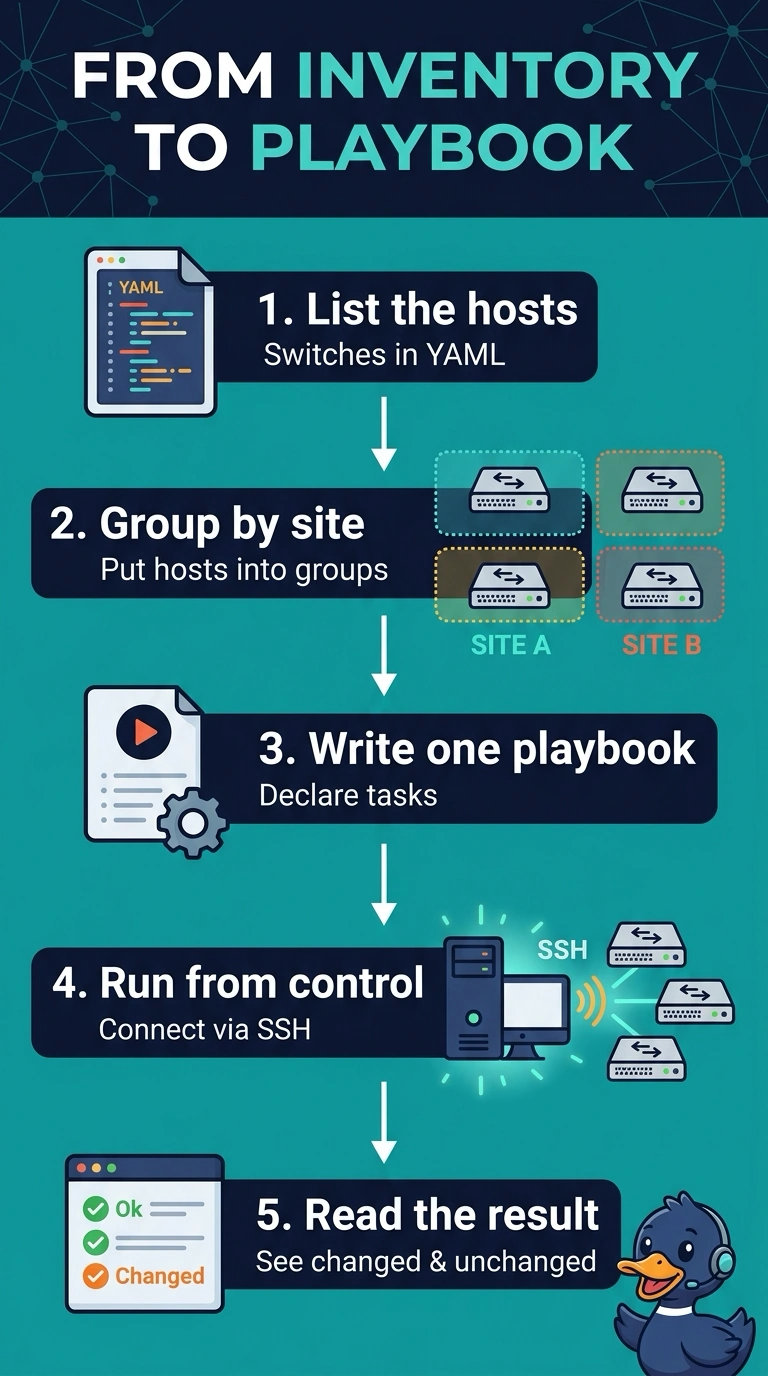
You can turn the CSV into a YAML inventory so Ansible knows which switches to target, then use one playbook to apply the same declared tasks to every switch in a group. It’s like using one recipe for the whole team instead of writing separate instructions for each switch.
Full Explanation
The correct design uses an Ansible inventory to identify and group the IOS XE switches, then applies reusable playbook tasks to the selected group. That replaces one-off per-device scripts with a common, repeatable workflow and lets the team declare the intended configuration once so the switches converge consistently. A dynamic inventory sourced from NetBox is a sound way to keep device records current, but it changes the stated source of truth: the team’s host list is in a CSV, and the workflow is meant to be driven by that inventory. Ansible can consume inventory from external sources, but adopting NetBox would require maintaining or importing the host data there rather than using the CSV as requested. Running in check mode is useful for previewing proposed changes, yet it reports what would change without applying the configuration, so it cannot make the switches converge. Shared group variables with host-specific overrides are also a standard way to handle genuine device differences, but those overrides can produce different desired configurations, contrary to the requirement that every switch receive the same declared configuration. Exam caveat: a YAML inventory is not the only inventory format Ansible supports; the key is matching the inventory source and structure to the stated workflow. Practical check: verify that the inventory resolves all 60 switch names and that the playbook targets the intended group before running it against the devices.