
An engineer is investigating a WAN link that degraded last Tuesday between 14:00 and 16:00. The SD-WAN Manager monitoring API must return the recorded interface statistics for one branch router across that whole window in a single request that carries the time range in a JSON body. Which monitoring API request retrieves those historical statistics?
Select an answer to reveal the explanation.
Short Explanation
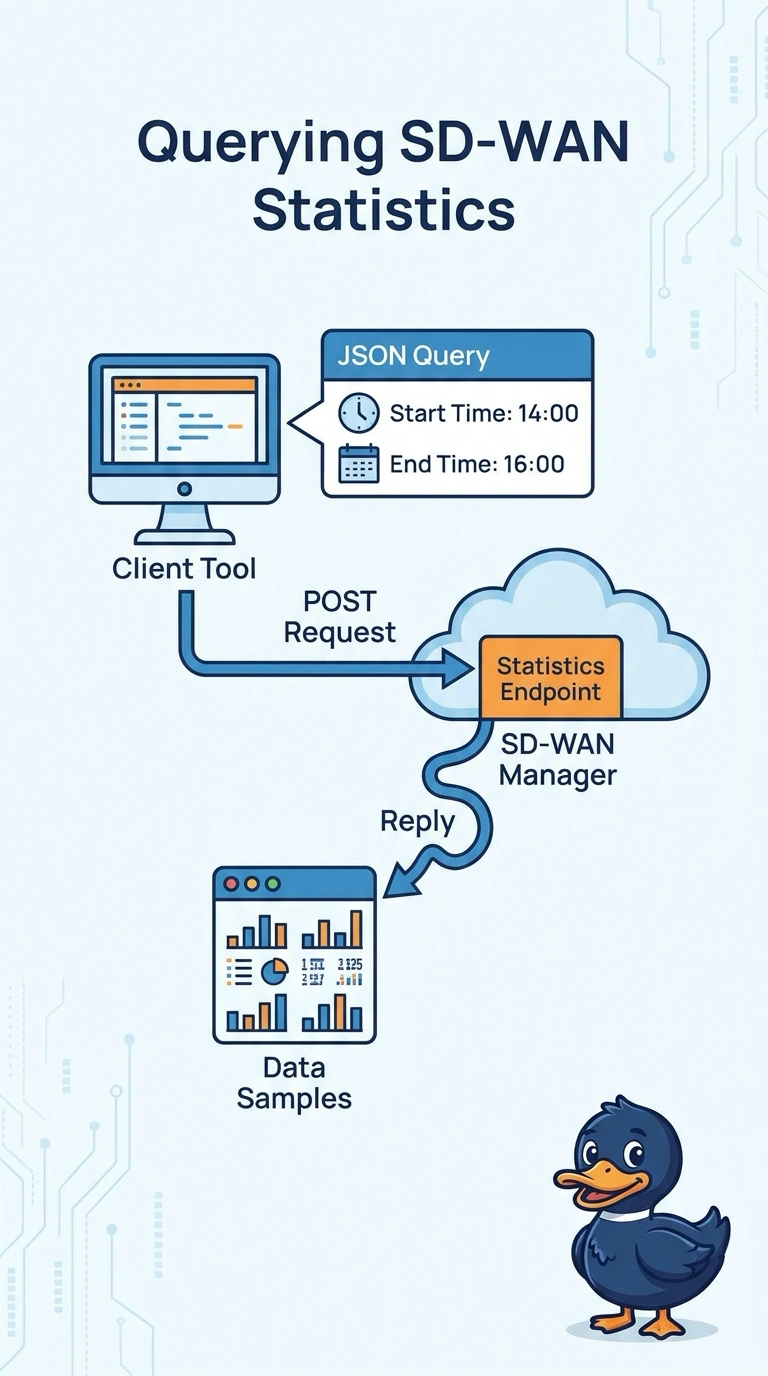
You’ll send a POST request to the statistics endpoint with the start and end times in a JSON body to retrieve the branch’s recorded interface stats. It’s like selecting a slice from a recording, so you get historical data rather than just the current status.
Full Explanation
The required request is a POST to the SD-WAN Manager statistics endpoint with a JSON query containing the window's start and end. That lets the API retrieve recorded interface statistics for the branch across the complete historical interval in one request. A GET request with the branch and time bounds in URL parameters is a familiar way to query many APIs, and it may retrieve the same historical data, but it does not satisfy the explicit requirement that the time range be carried in a JSON body. A POST with a JSON range and separate requests for successive slices uses the right method and payload, but it fails the one-request requirement; splitting a long interval can be useful for limits or pagination, yet does not answer this scenario as specified. A one-request POST returning branch-level WAN totals has the right method, body, scope, and time window, but aggregate totals are not the recorded interface statistics requested. Exam caveat: API versions may differ in endpoint paths, accepted time formats, and pagination behavior, so do not infer the request schema from the HTTP verb alone. Practical check: inspect the request body and response for the exact branch, both time bounds, per-interface records, and coverage of the entire interval.