
A NOC script polls Meraki Dashboard every five minutes for organization-wide appliance status and wireless client counts. It must authenticate correctly against the current API version endpoint and behave politely when requests are throttled. Which request pattern should the script follow?
Select an answer to reveal the explanation.
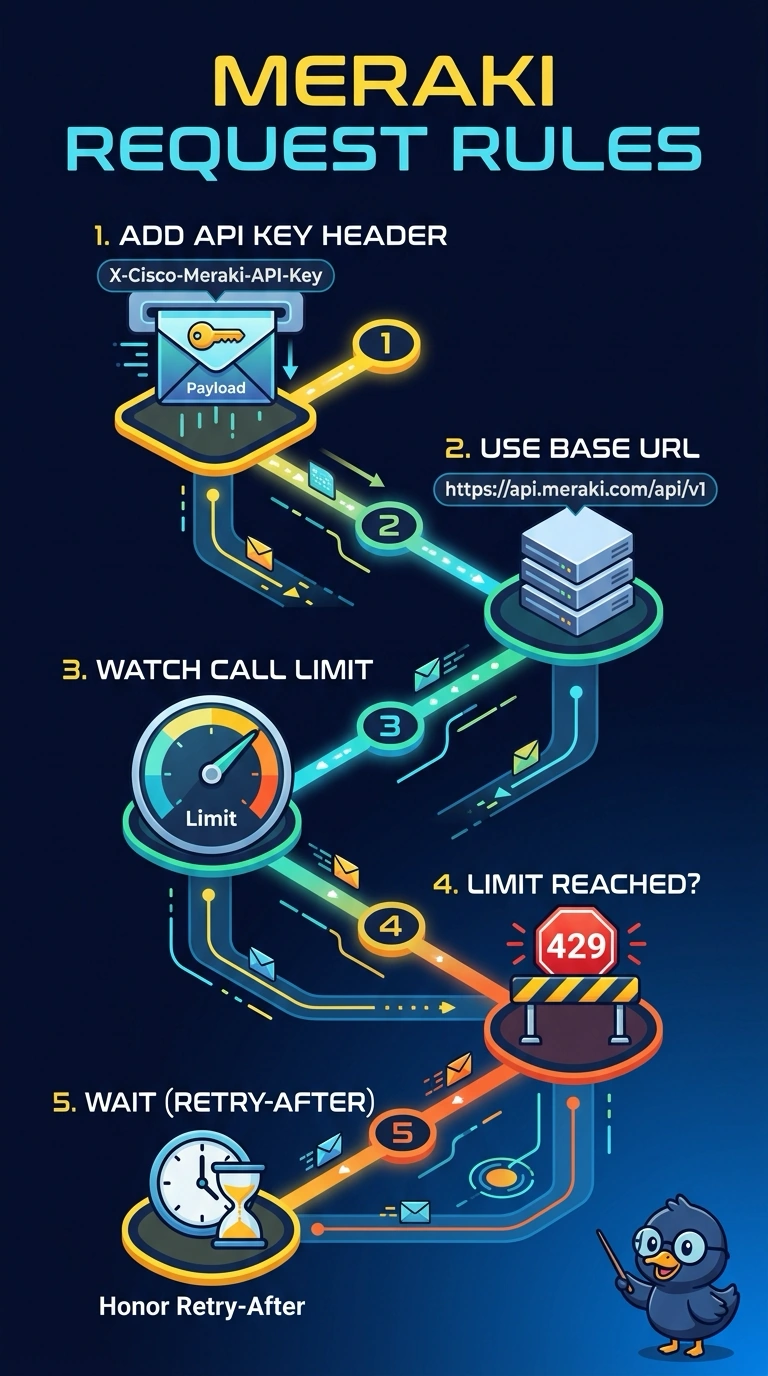
Short Explanation
The key rides in the X-Cisco-Meraki-API-Key header and every call goes to the current base URL, and a 429 means the API wants you to slow down. Read the Retry-After header so you're waiting as long as it asked for. Miss that signal or use the wrong host and your wallboard may come back empty.
Full Explanation
The Meraki Dashboard API authenticates with a single API key placed in the X-Cisco-Meraki-API-Key header, and requests go to the current base URL, https://api.meraki.com/api/v1. The service also rate limits callers, answering a request that exceeds the budget with HTTP 429 and a Retry-After header that tells you how long to wait before the next attempt. Authenticating with HTTP Basic credentials uses a username and password scheme that the Dashboard API does not accept for this key, so the call will fail authentication. Addressing the bare meraki.com host instead of the api subdomain does not use the documented API endpoint. Retrying immediately after a 429 ignores both the throttle and the wait hint, so later requests may also be throttled. Exam caveat: rate budgets and endpoint coverage change over time, so trust the status codes you receive instead of a memorised figure. Practical check: log the status code, the Retry-After value, and the response time for one full poll cycle.