
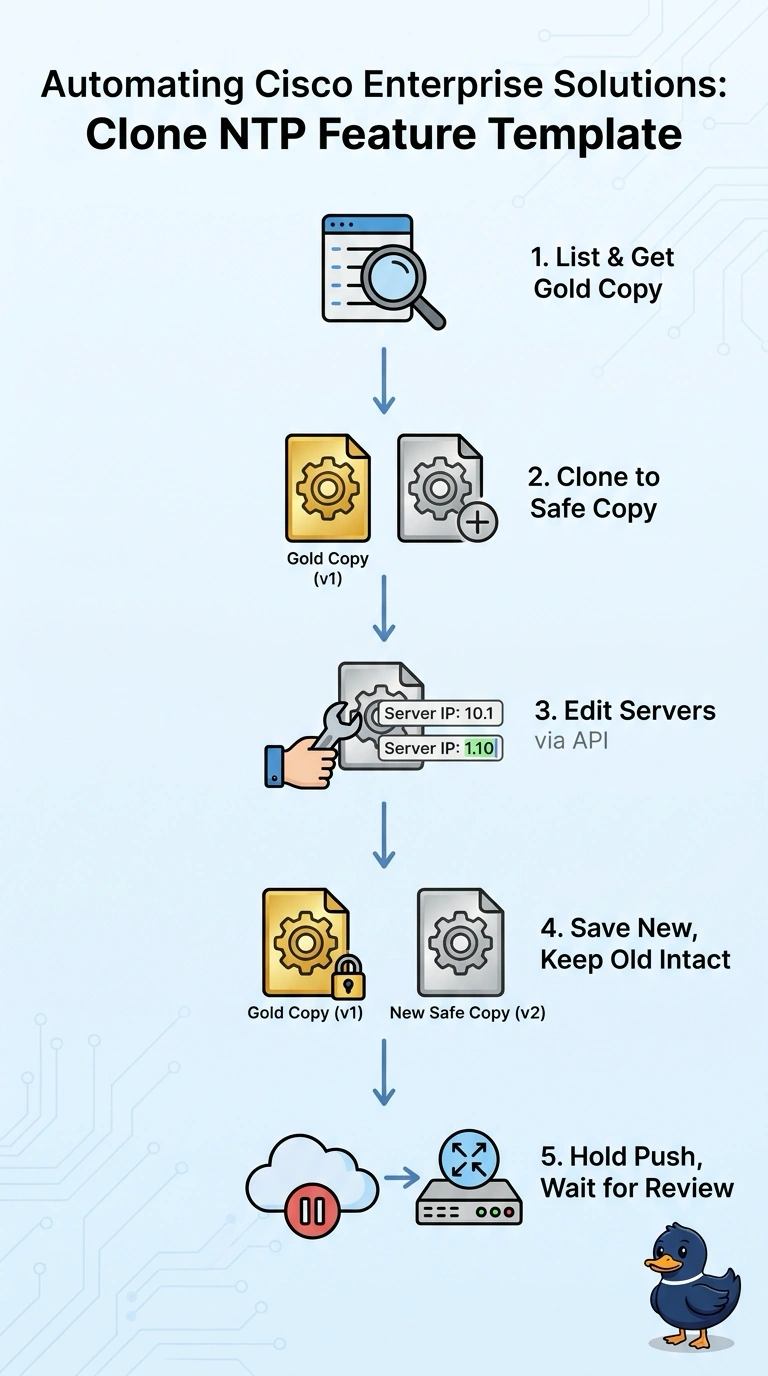
A regional retailer with 40 SD-WAN branches needs a Python script to standardize NTP servers across all VPN feature templates. The script must list existing feature templates, clone the gold NTP template, update servers to 10.1.1.10, and leave device templates untouched until change review. Which Template and feature template API operation should the script perform to implement the standardized NTP change?
Select an answer to reveal the explanation.
Short Explanation
You nailed the layering here — feature templates hold the actual config blocks. Cloning keeps you safe like saving a new draft instead of scribbling over the original.
Full Explanation
The correct workflow uses the Template and feature-template APIs to enumerate existing feature templates, clone the gold NTP feature template, set its server addresses to 10.1.1.10, and retain the resulting feature-template version for the reviewed change. This preserves the gold template and avoids modifying device templates before approval. Updating the gold template in place is a familiar way to revise a shared configuration, but it fails the explicit requirement to clone the gold template and can alter the baseline used by other deployments. Cloning and editing the feature template is appropriate, but assigning it through device templates immediately changes those templates and violates the review constraint. Creating a new feature template from scratch can produce the desired NTP settings while leaving device templates alone, but it does not clone the specified gold template, so it may omit inherited settings or metadata. Exam caveat: feature-template creation or editing is distinct from attaching a feature template to a device template; an API workflow that performs both may cross the stated change boundary. As a practical check, inspect the API response and resulting template configuration to confirm the clone has the requested NTP servers and that no device-template records were updated.