
A network team automates 40 IOS XE routers from a CI runner whose security group may open only TCP 443 to the devices, and its Python libraries already parse JSON. The job must both read operational state and change configuration on every router. Which protocol and payload format should the team standardize on?
Select an answer to reveal the explanation.
Short Explanation
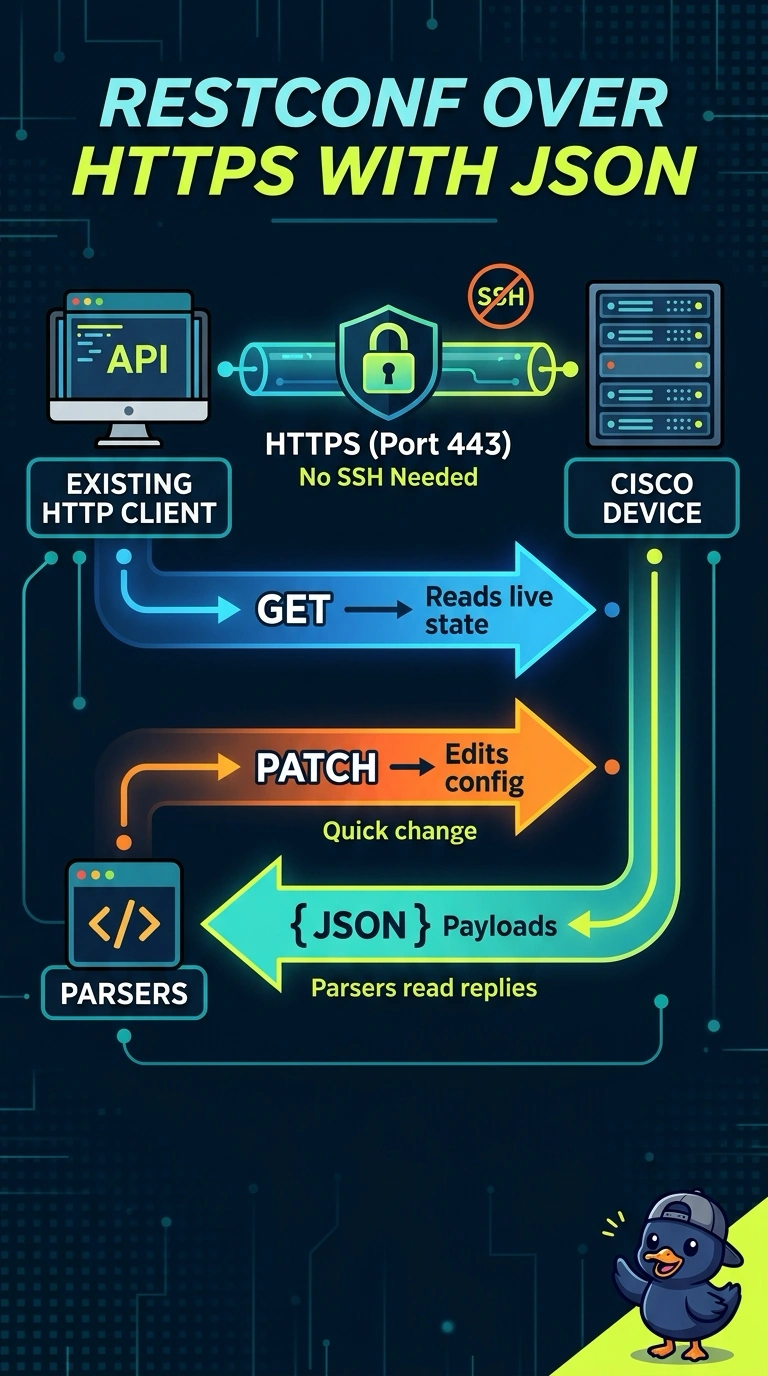
Your JSON parsers and the 443-only firewall point straight at RESTCONF, which serves YANG data over ordinary HTTPS. A GET reads state and a PATCH edits configuration, so the HTTP client you already own does the work. That's the draw of RESTCONF: web tooling in, YANG data out.
Full Explanation
RESTCONF over HTTPS with JSON is the best fit because it supports both retrieval of operational data and configuration changes, uses TCP 443, and lets the team reuse its existing HTTP client and JSON parsers. NETCONF over SSH is a well-established way to read state and change configuration through YANG-defined operations, but its SSH transport does not meet the runner's restriction to TCP 443. RESTCONF with XML retains the compatible HTTPS transport and supports the required operations, but it does not take advantage of the team's existing JSON parsing libraries. gNMI with JSON_IETF is also used for streaming telemetry and configuration management, but its standard gRPC service port is not TCP 443, so the stated security-group rule blocks the connection. An exam caveat is that protocol support and available YANG models can vary by IOS XE release and device configuration; a generally supported protocol is not a guarantee that every desired data path or edit is implemented. Before standardizing, verify the routers' RESTCONF enablement, TLS certificate and authentication setup, and model support, then test both an operational-data GET and a configuration change through the actual runner's TCP 443 path.