
A retailer is installing 150 factory-default access switches in stores without on-site staff. Each store has only a DHCP server and an HTTP server on the local subnet, and the branch segments cannot reach any controller during installation. Which Day 0 provisioning method meets these branch constraints?
Select an answer to reveal the explanation.
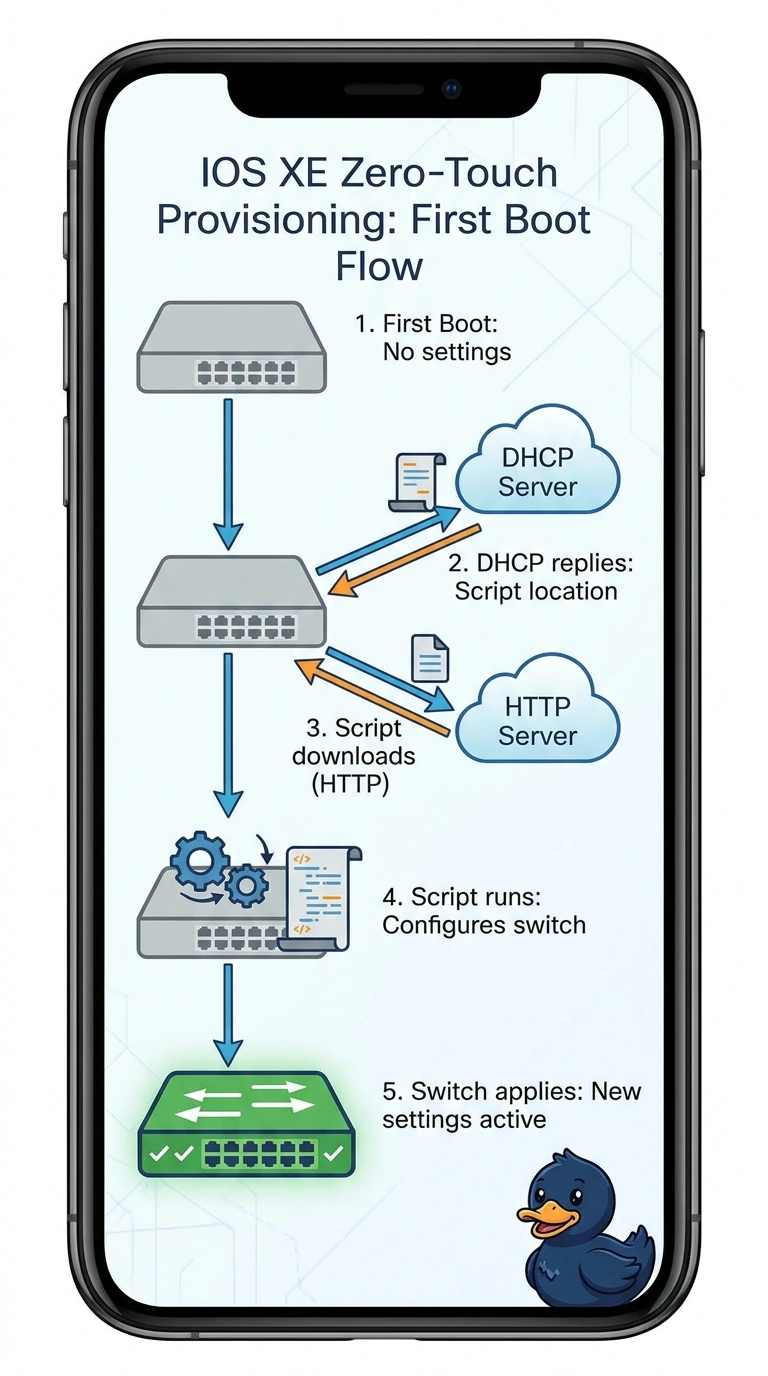
Short Explanation
You can use ZTP here: DHCP tells each switch where to find its provisioning script, and the switch retrieves it over the local HTTP server. Catalyst Center PnP cannot reach its controller, preconfigured switches would not arrive factory-default, and the TFTP method needs a server the stores do not have.
Full Explanation
IOS XE zero-touch provisioning fits the available branch infrastructure: DHCP can provide each switch with the location of a provisioning script, and the switch can retrieve that script from the local HTTP server. This supports unattended Day 0 deployment without requiring a controller connection or on-site staff. Catalyst Center PnP is a commonly used centralized provisioning method, but its controller-based workflow cannot complete because the branch segments cannot reach a controller during installation. Staging switches with site-specific startup configurations before shipment is also a practical deployment technique, but it does not meet the stated factory-default condition: the switches would no longer arrive at the stores in that state. DHCP boot parameters can direct devices to network-based configuration resources, but the proposed TFTP workflow depends on a local TFTP server, which these branches do not have; their stated local file-transfer service is HTTP. Exam caveat: distinguish ZTP mechanisms by their bootstrap dependencies—DHCP may supply discovery information, but the delivery protocol and reachable service still matter. Practical check: verify that the DHCP scope supplies the correct script URL and that a factory-default switch can reach the HTTP server and retrieve the script on the local subnet.