
A morning health check must list every device managed by SD-WAN Manager with its serial number, site ID, system IP and reachability status. The engineer has Python and a valid auth token, and wants one printed line per device. Which request and parsing step produce that inventory?
Select an answer to reveal the explanation.
Short Explanation
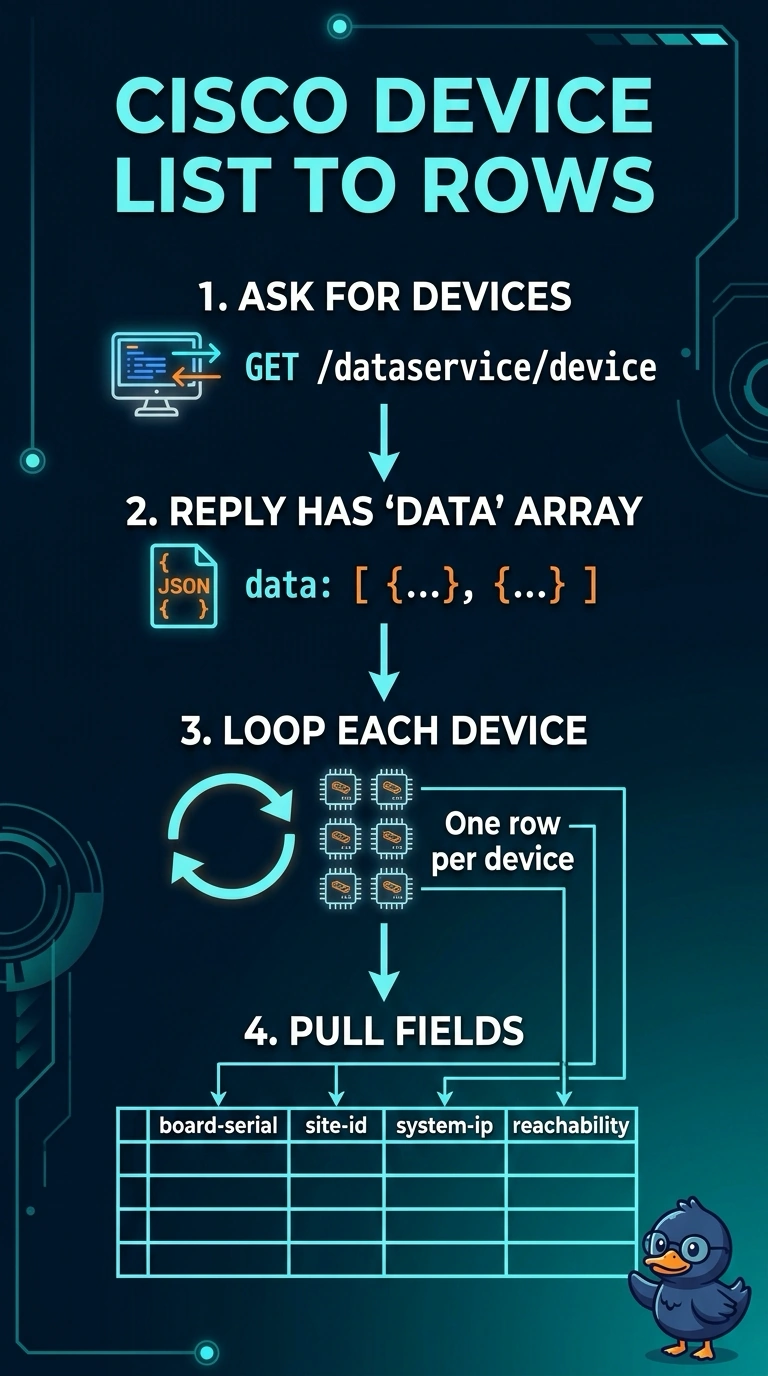
The inventory endpoint returns a JSON object with a data array, so the parsing step is a loop over that array, printing one device per line. A count endpoint only totals things, and skipping fields leaves gaps in your report. It's the iteration that turns the reply into a usable device list.
Full Explanation
SD-WAN Manager, the controller you may still know as vManage, exposes inventory through its device resource. A plain GET with your session token returns a JSON response object containing a data array of device objects, which include attributes such as board-serial, site-id and system-ip along with reachability information. Because the device entries are in an array, the parsing step is a loop that reads one entry at a time and pulls the fields you want, ideally with a safe accessor so a missing attribute never aborts the run. The count endpoint returns a total, so it cannot name a single device; printing a reduced set of fields drops the site and status information the report needs; and treating the body as a single object misreads the response shape instead of producing one row per device. Exam caveat: field spellings can vary between releases, so inspect a sample response before hard-coding names. Practical check: run one GET and inspect the data array length plus the keys of its first element before you build the loop.