
Your Meraki network already exists in Dashboard and you have its network ID. An API change must rename it and set its timezone for that one network only, without adding a second network to the organization. Which HTTP method and endpoint perform this update on the existing network?
Select an answer to reveal the explanation.
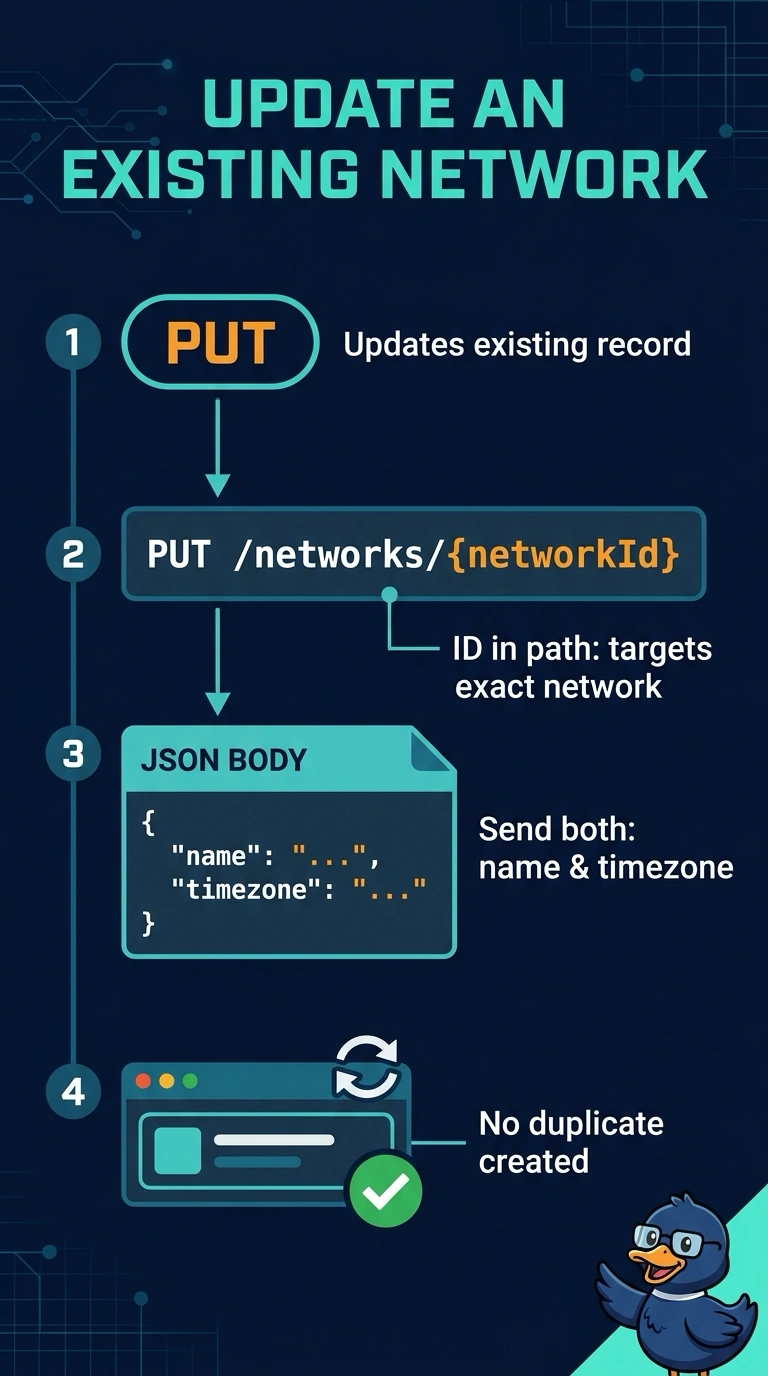
Short Explanation
You’re right to use PUT to update the existing network identified by its network ID. Send both the new name and timezone in the JSON body so you update the requested properties on that network.
Full Explanation
The existing network is identified by its network ID, and the Meraki Dashboard API updates that network with PUT /networks/{networkId}. Including both the new name and timezone in the JSON request body applies the two requested changes to that network. Sending only the name would rename it but leave its timezone unchanged, so it would not satisfy the full request. Putting the values in query parameters uses the correct method and resource, but does not supply the fields in the JSON body expected for this update; the server may reject or ignore them rather than apply the changes. A form-encoded body is also a format used by some APIs, but it is not the JSON payload format expected by this endpoint, so the values may not be parsed as network properties. Exam caveat: use the network ID for this network-specific update, and follow the endpoint’s documented request-body format rather than assuming that a familiar format will work. Practical check: inspect the API response, then retrieve the network by its ID and verify that both its name and timezone match the requested values.