
You are enabling model-driven telemetry on an IOS XE access switch. The collector at 10.10.5.20 must receive interface state samples every 30 seconds over gNMI with mutual TLS, as fixed-interval samples rather than change-triggered ones. Which subscription parameters should the telemetry subscription use?
Select an answer to reveal the explanation.
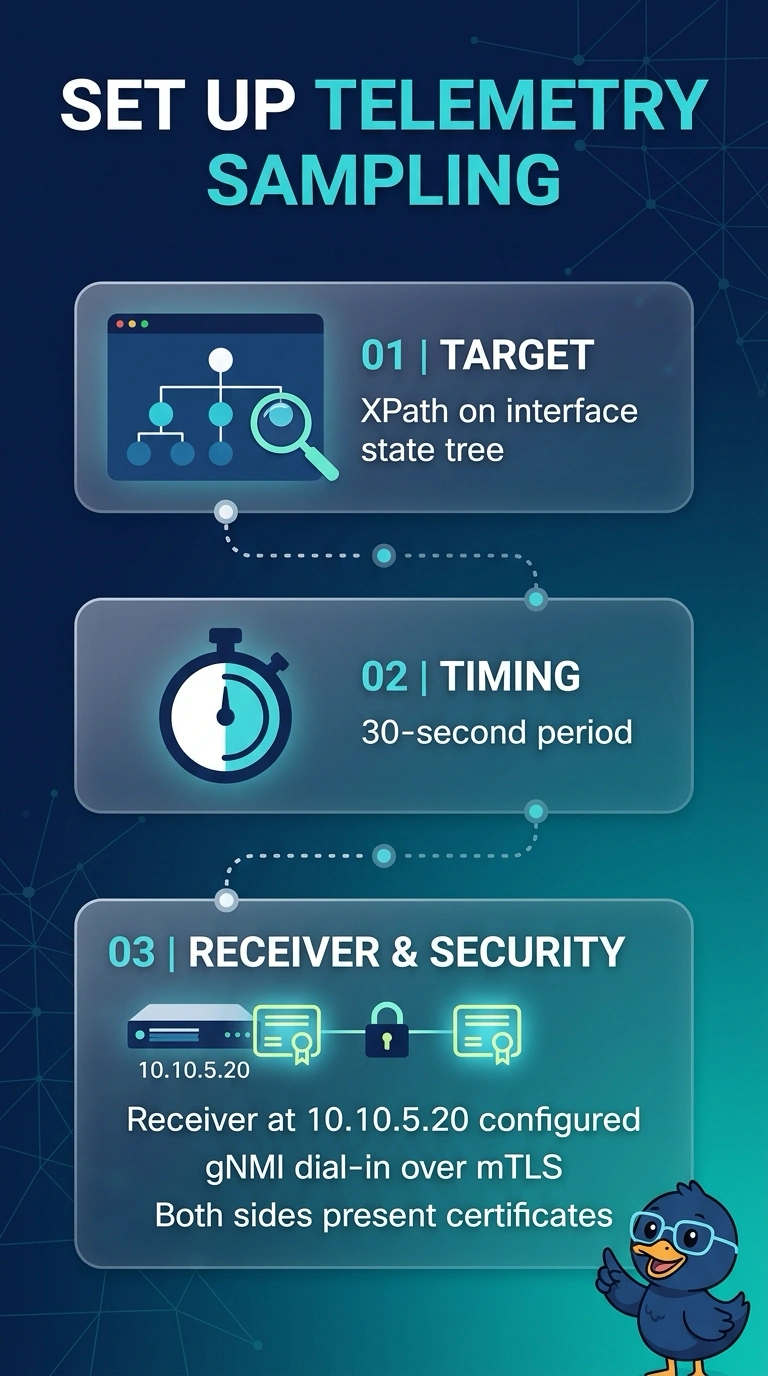
Short Explanation
You matched all three requirements in one subscription. The xpath scopes the stream to interface state, the period locks the cadence at 30 seconds, and the receiver uses mutual TLS. It's a metronome pointed at the right desk rather than a bell that only rings when something moves.
Full Explanation
A telemetry subscription is three decisions bundled together: which YANG path to read, how often to read it, and where the samples go. The xpath filter scopes the stream to the interface state subtree, so the collector gets exactly the operational state rows it expects rather than a broader sensor. The period imposes a fixed cadence, publishing a fresh sample every 30 seconds whether or not any value moved, which is what dashboards and capacity reports rely on. Naming the receiver at 10.10.5.20 and configuring mutual TLS provides a secure connection that authenticates both endpoints. Switching to change-triggered sampling keeps the path and destination right but breaks the promised cadence, since samples then appear only when a value moves and a quiet link looks frozen. Filtering on interface counters delivers the wrong sensor data for a state requirement, and a plaintext receiver fails because the collector expects a mutually authenticated TLS session. Exam caveat: xpath syntax and sensor path names shift between IOS XE releases, so learn the shape of the subscription instead of memorising one command line. Practical check: apply the subscription and watch the collector log a sample from the expected path roughly every 30 seconds.