
A single Python service drives SD-WAN Manager: it lists each edge device's model and serial, reports BFD tunnel history for the last 24 hours, edits and attaches a device template, and reads user roles for a quarterly audit. Which SD-WAN Manager API-family assignment matches those four operations?
Select an answer to reveal the explanation.
Short Explanation
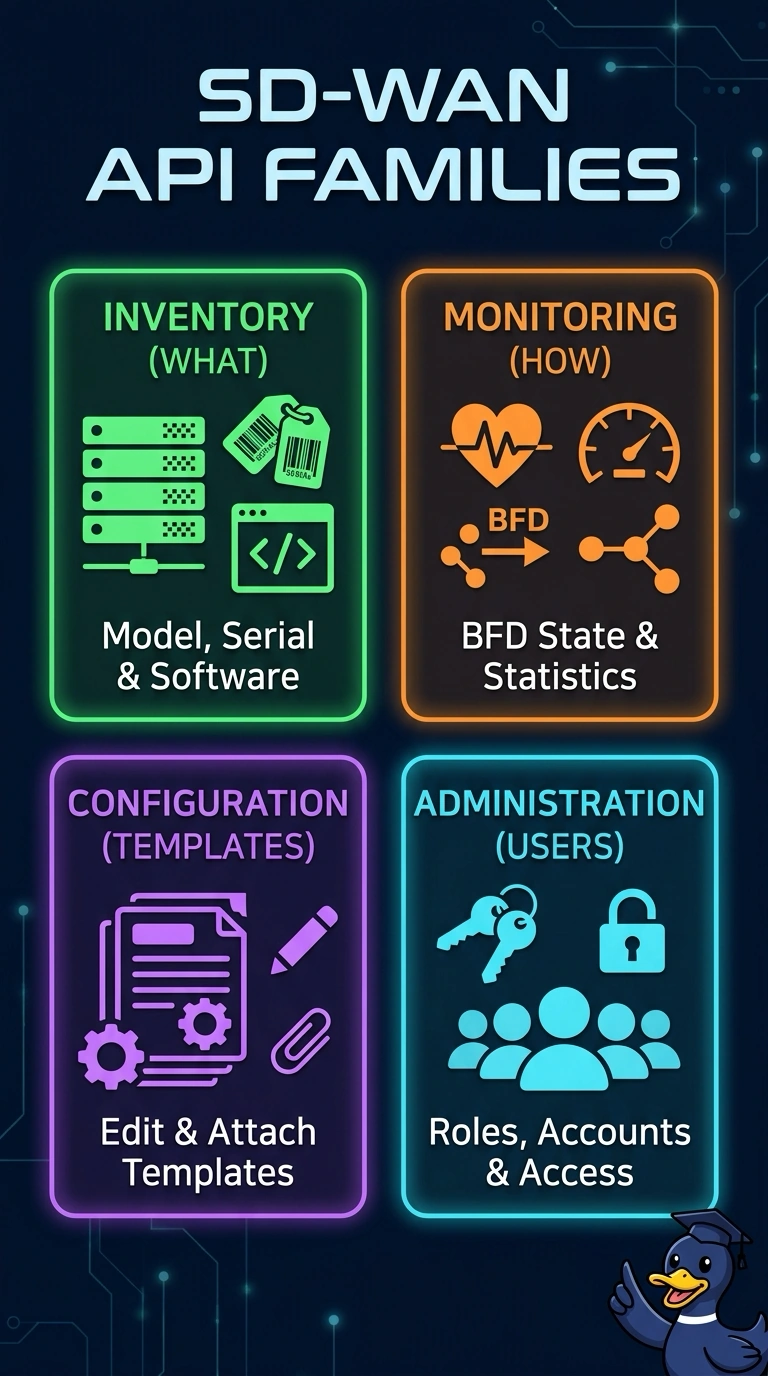
The four families split along what versus how: inventory says what a device is, monitoring says how it's behaving. Configuration owns templates and attachment, while administration owns users and roles. You match each family to the resource it owns and the mapping falls into place.
Full Explanation
SD-WAN Manager organizes its API into families that follow the job of the data. The device inventory family returns what each device is, such as model, serial number and software version, so the device list belongs there. The monitoring family returns how the network is behaving, including state and statistics like BFD session history over a window, so the health report belongs there. The configuration family owns device templates, their variables and attachment to devices, so the template edit lives there. The administration family manages users, roles and access, so reading roles for the audit belongs there. Swapping inventory with monitoring means pulling operational statistics where chassis facts are expected, while the other permutations blur the remaining jobs: template work is configuration rather than administration or monitoring, and BFD history is operational data rather than configuration data. Exam caveat: URL prefixes differ across releases and products, so identify the family by the resource being addressed rather than by the literal path text. Practical check: call the device list endpoint and a statistics endpoint with the same token so you can compare which payload answers what versus how.