
Your monitoring team wants interface and CPU sensor data pushed from 40 IOS XE switches into a time-series database. The subscription must be stored in the device configuration so the stream starts automatically after an upgrade reload, even while the collector is offline. Which telemetry subscription type keeps the sensor stream running after that reload?
Select an answer to reveal the explanation.
Short Explanation
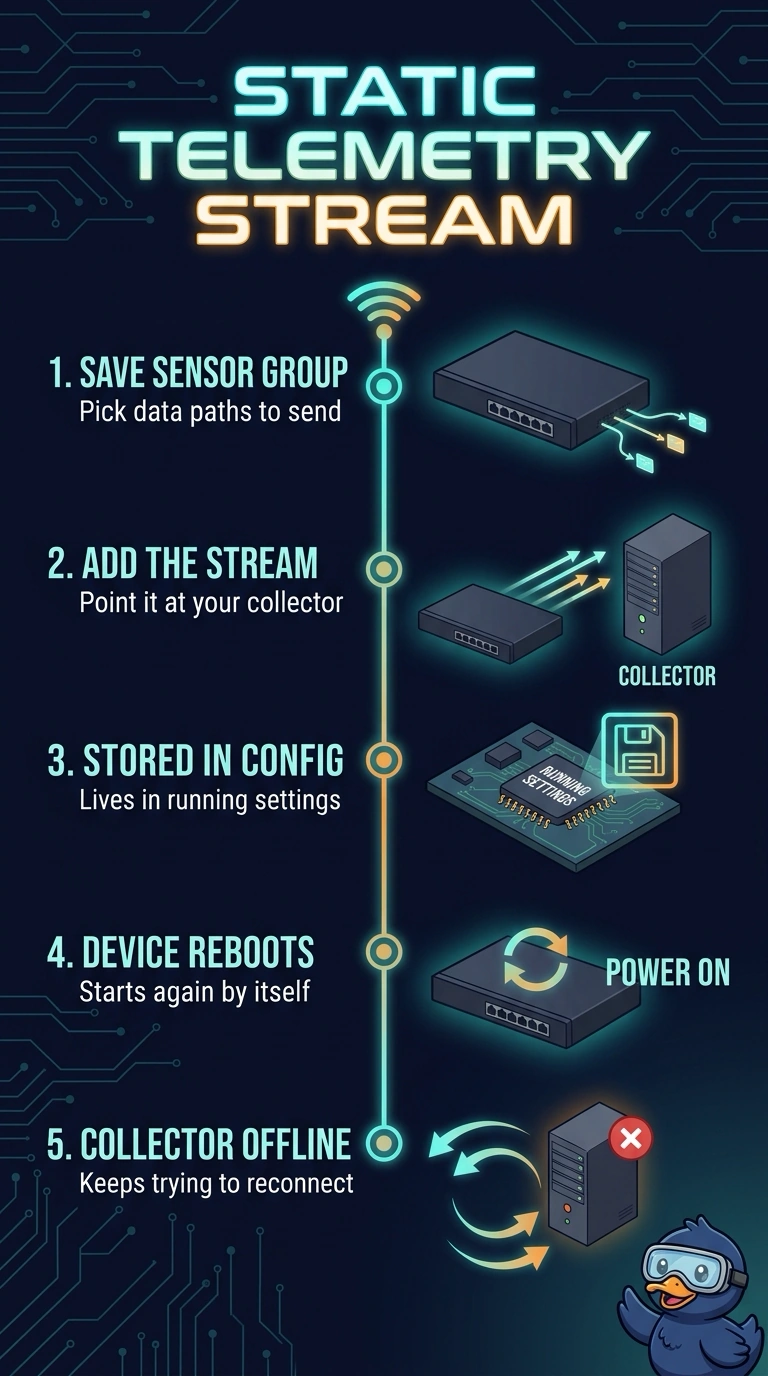
A static subscription sits in the switch's configuration, so it starts on its own after a reload. A dynamic subscription lives only while your collector holds the session open, so it ends when the connection closes. That's the requirement that rules it out.
Full Explanation
A configured subscription is part of the device configuration: you define a sensor group holding the YANG paths you want, bind a subscription to your collector's destination, and the device pushes samples on its own and repeats that after every reload because the configuration is replayed at boot. A dynamic gNMI subscription is an in-memory session that exists only while the collector holds the connection open, so it ends whenever the collector disconnects or the switch reboots and does not meet the self-starting stream requirement. RESTCONF polling is request-response reading of a datastore, so it does not provide the periodic push behavior described here and leaves gaps between queries. SNMP polling reads MIB objects rather than YANG sensor paths, so it does not provide the model-driven samples this pipeline expects. Exam caveat: releases phrase configured and dynamic differently and gNMI support varies by image, so read which transport and persistence the question names. Practical check: reload a switch and confirm the stream resumes without the collector initiating anything.