
You are syncing a Meraki organization from Python: the update to an existing wireless network must be idempotent so a second run cannot apply it twice, and the new Shenzhen network must be registered through the organization's network collection. Which HTTP method mapping should the script use?
Select an answer to reveal the explanation.
Short Explanation
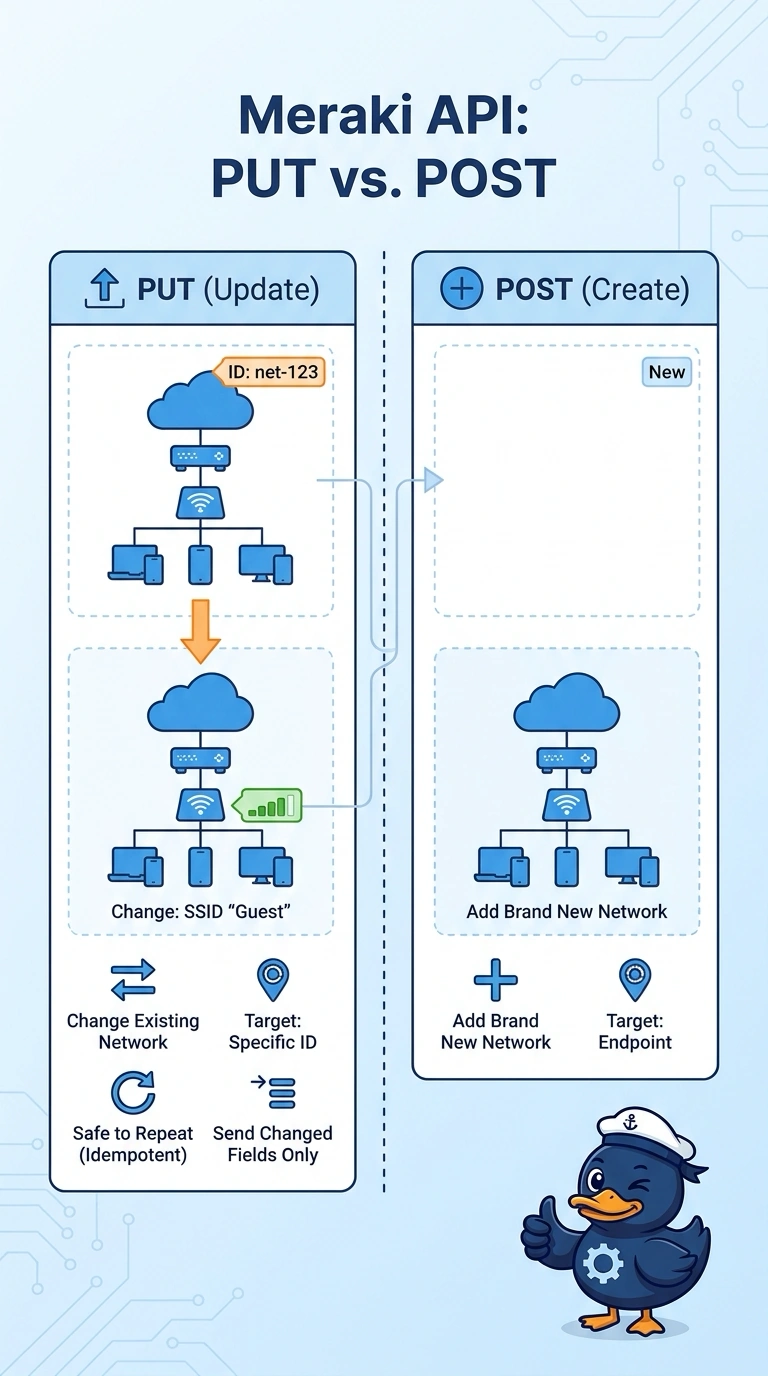
You've got it — the verb follows what you're doing to the object. An existing network takes PUT, which is idempotent for the same request, while a brand new network is added with POST through the organization's collection.
Full Explanation
Meraki's Dashboard API uses PUT on the specific network resource to update that network's settings. Repeating the same PUT request is idempotent: it leaves the network in the same configured state. POST to the organization's network collection is the create operation, so that is how the Shenzhen network is added. PATCH is not the documented update method for this network endpoint. POST is not the documented update method here and is not idempotent. PUT on both writes would not register the new network through the organization's collection; the documented create operation uses POST on that collection. Update payload fields are optional, so omitted fields are not necessarily overwritten; send the fields you intend to change. Practical check: compare the verbs and paths for one update call and one create call.