
A national bank runs IS-IS across 120 routers with a core mesh and 25 branch areas that must stay isolated from core churn, hide branch prefixes, and allow controlled expansion without full mesh flooding. The architects need clear hierarchy. Which IS-IS level 1 versus level 2 design creates a stable hierarchy for this network?
Select an answer to reveal the explanation.
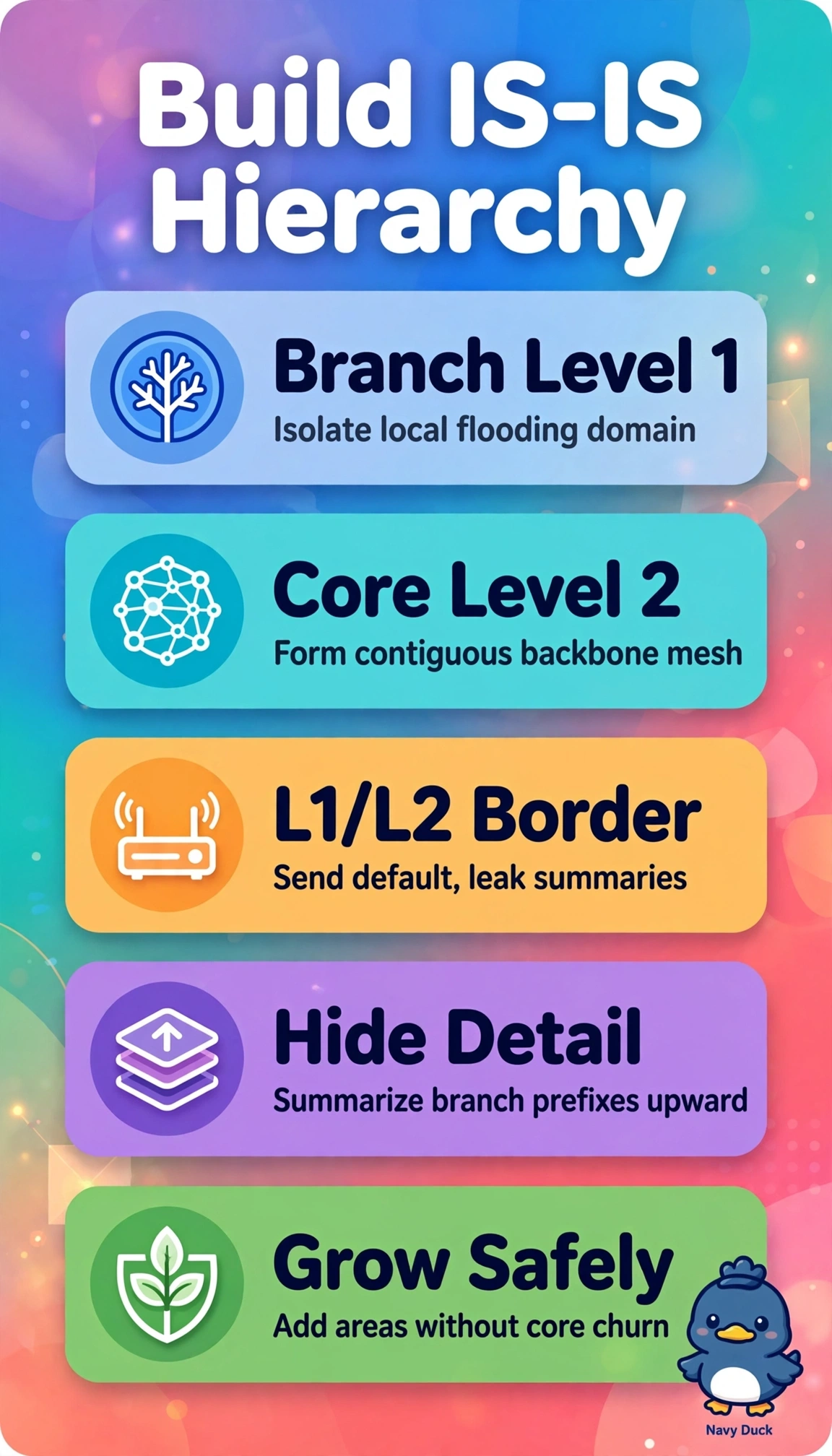
Short Explanation
You'll keep your network calmer when your branches live in Level 1 and your core runs Level 2, like quiet side streets feeding into a highway. Let your L1/L2 borders decide what gets advertised so churn stays contained behind Level separation.
Full Explanation
The correct design works because IS-IS uses Level 1 for intra-area flooding and Level 2 for backbone continuity, so isolating each of the 25 branches as Level 1 only keeps branch LSPs and flaps local while the meshed core as Level 2 carries backbone topology, with L1/L2 borders setting the attached bit so Level 1 routers use the nearest border as their default exit, and advertising only summarized aggregates up, which hides branch prefixes, shields branches from core churn, prevents full-mesh flooding into branches, and permits controlled expansion by adding new Level 1 areas behind borders. The Level 2-only with summarization approach is operationally sound for smaller seamless domains and does hide prefixes and help growth, but it fails containment because summarization does not stop LSP flooding, so core churn still floods all 120 routers and no true hierarchy exists. The unsummarized redistribution upward preserves levels and containment yet fails the hiding goal because leaking every specific violates aggregation principles, bloating core tables and churn and undermining scaling. The Level 1-2 branch attachment is widely used for redundancy and more optimal inter-branch paths, but it fails isolation because extending Level 2 into branches merges flooding domains, dragging core LSP churn into branch routers and increasing memory and convergence load. A key exam caveat is that default routing plus selective leaking is preferred over full visibility when stability and hiding outweigh perfect path optimality. For practical validation, compare Level 1 versus Level 2 database sizes on borders, confirm only aggregates appear in the core and branches follow the attached-bit default, and flap a branch link to confirm no core LSP storm.