
A manufacturing campus runs a sensor collaboration app where 80 endpoints in multiple VLANs both send and receive the same multicast groups, creating many small flows. RP registration overhead and source-tree state must stay low. Which Bidirectional PIM design choice addresses the many-to-many requirement?
Select an answer to reveal the explanation.
Short Explanation
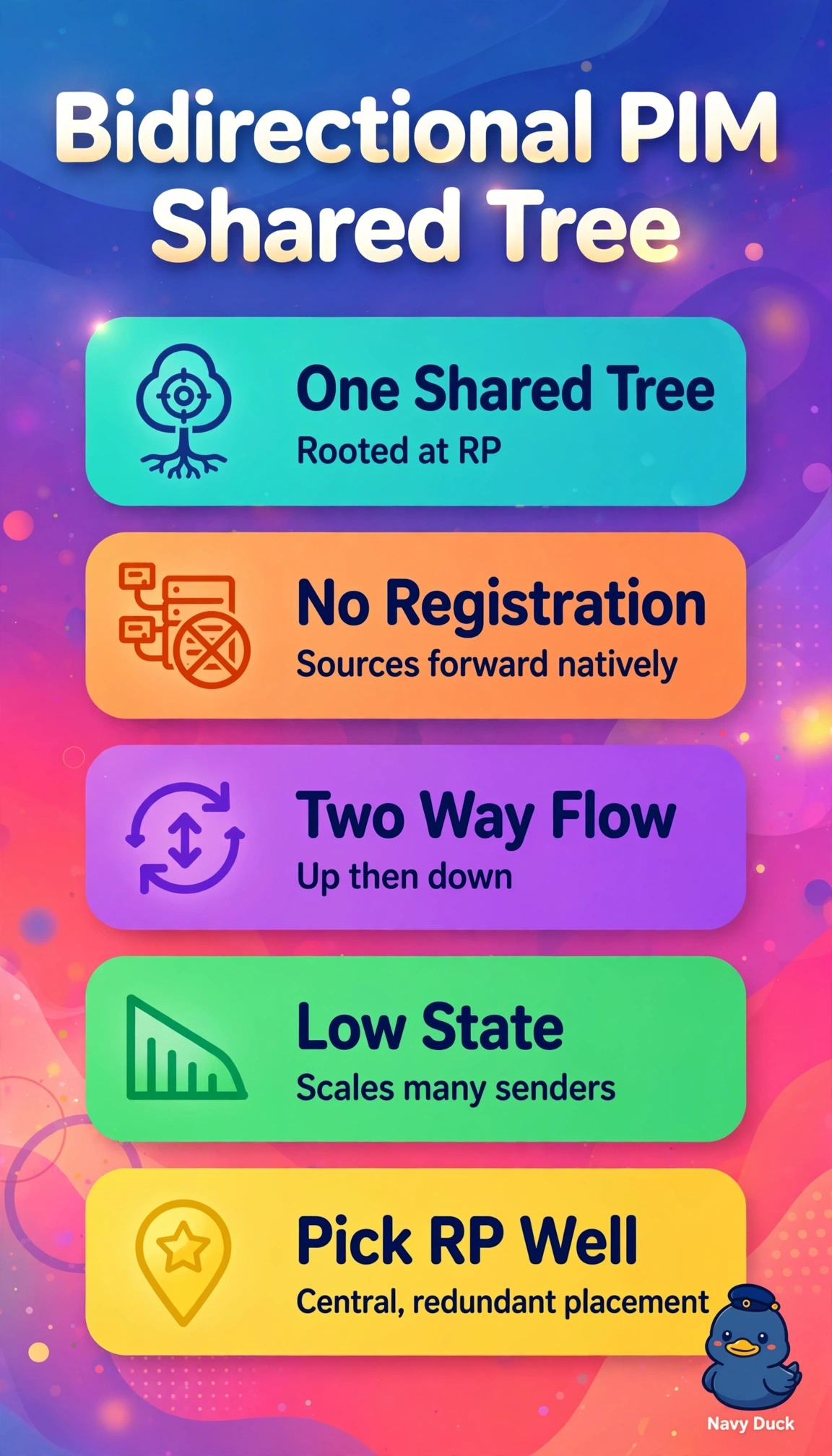
Plenty of senders changes everything for you. Bidirectional PIM is like a two-way main street, letting all 80 endpoints share one tree instead of building roads per sender.
Full Explanation
Bidirectional PIM builds a single shared, RP-rooted bidirectional tree where traffic can flow both up toward the RP and down toward receivers, eliminating source registration and per-source state, which is ideal for many-to-many applications with numerous small senders. Designing PIM Sparse Mode with shortest-path switchover optimizes path for few dominant sources by building per-source trees after threshold, but with 80 concurrent senders it multiplies state and registration load and misses the low-state requirement. Designing PIM Dense Mode with flood-and-prune avoids an RP initially, yet it floods everywhere then prunes, wasting bandwidth and control plane on a campus with sparse receivers and many groups. Designing PIM SSM with source-specific joins is highly efficient for one-to-many content delivery because receivers signal exact sources, but it requires receivers to know all senders in advance and maintains source-specific state, which does not scale for dynamic many-to-many collaboration. On the exam, link bidirectional PIM to many senders and shared-tree only forwarding, and in practice verify RP placement, DF election on each link, and that applications support shared-tree multicast.