
A 40-person startup manages six switches and two routers with no separate management cabling budget. The founder requires SSH and SNMP access to continue during normal operations while accepting that a major outage may block management, and wants minimal cost and complexity. Which network management access design best fits the budget and availability tradeoff?
Select an answer to reveal the explanation.
Short Explanation
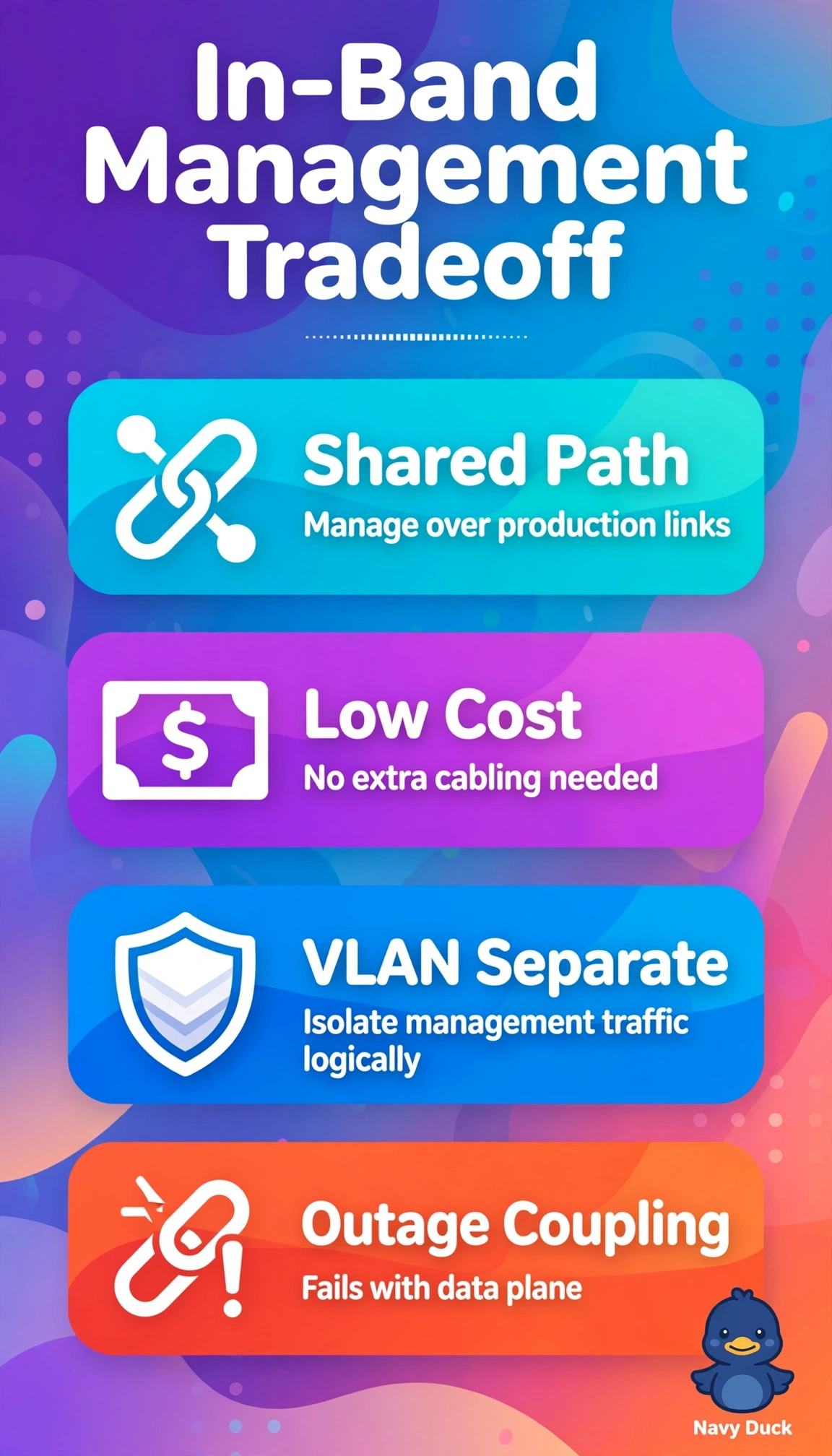
Cash is tight and the team lives lean, so riding the same wires makes sense. In-band management keeps costs low with a protected VLAN, and isolation comes from ACLs rather than cables. You accept outage coupling for simplicity.
Full Explanation
The correct design is right because in-band management uses existing production links so no new cabling is needed for the eight devices, while a dedicated management VLAN gives logical separation and ACLs limit SSH and SNMP to authorized sources, sustaining required access during normal operations at minimal cost with the accepted fate-sharing risk that a major outage can block management. The LTE cellular console design fails on economics because dedicated wireless console paths are a legitimate out-of-band pattern for high-value sites yet modem hardware, data plans and upkeep violate the zero separate budget and minimal-cost mandate. The SSH with syslog design fails on function because syslog is a widely used in-band telemetry method but push-based logging cannot substitute for SNMP polling and MIB-based monitoring explicitly required. The redundant failover uplink design fails on scope because extra links and failover engineering suit environments demanding management survivability, yet the scenario explicitly tolerates management loss during major outages to favor simplicity and low cost. As an exam caveat, distinguish logical isolation via VLAN plus ACLs from physical isolation and let budget and outage-tolerance phrases drive selection rather than assuming more redundancy is better. As a practical check, verify VLAN propagation, test SSH and SNMP polling from the admin host under normal load, review ACL hits, then simulate a production link failure to confirm expected fate-sharing behavior.