
A 400-bed hospital needs to monitor switches and collect NetFlow during normal operations but must still reach device consoles when a core routing fault isolates production VLANs. Which management access design addresses in-band versus out-of-band trade-offs for this hospital network?
Select an answer to reveal the explanation.
Short Explanation
You're balancing everyday efficiency with emergency access when the network itself is sick. Hybrid access gives you cheap daily visibility plus a lifeline, like having both hallways and a fire escape.
Full Explanation
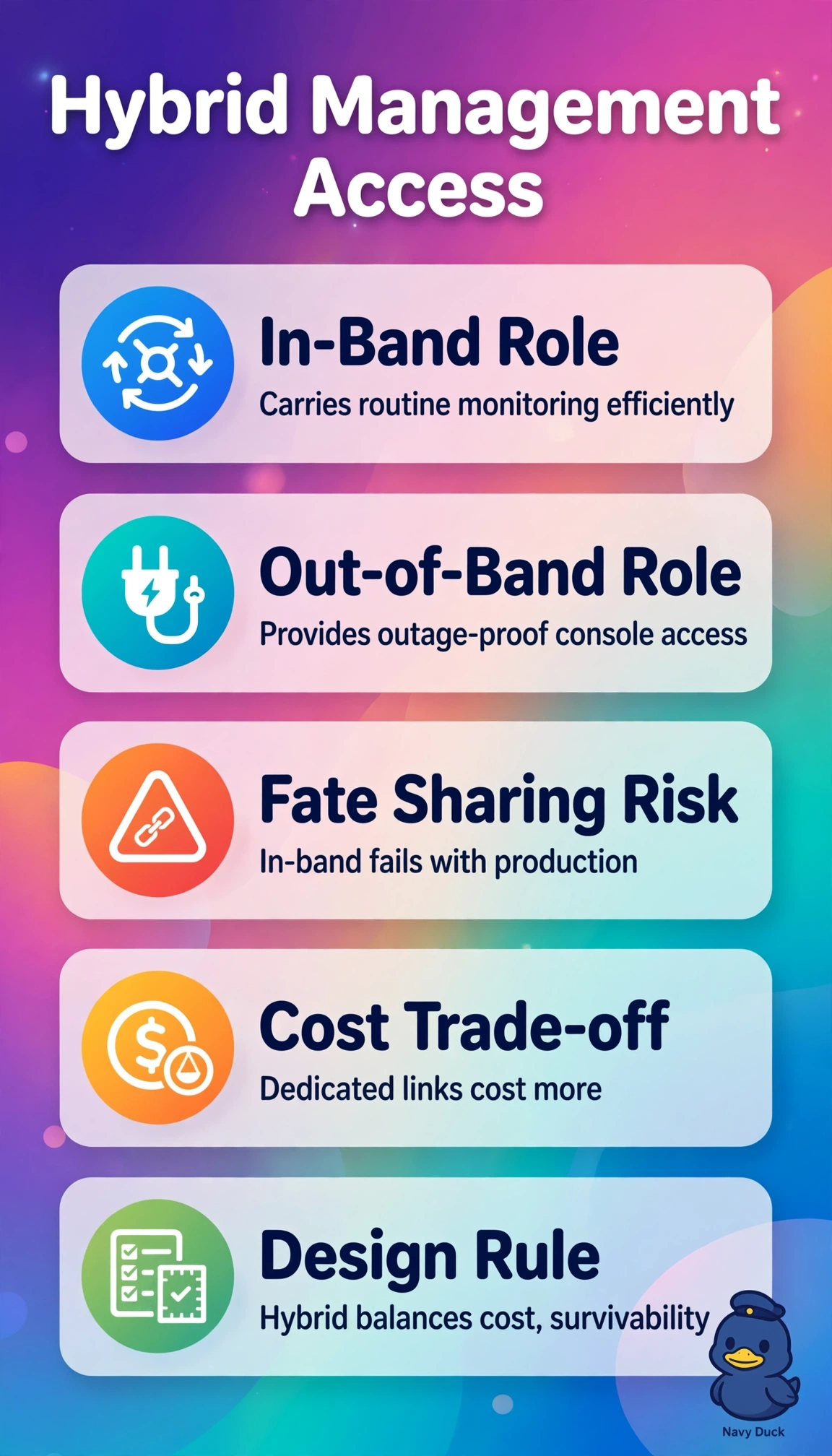
In-band management rides production links and is efficient for high-volume telemetry like syslog and NetFlow but shares fate with routing failures, while out-of-band management uses dedicated paths and console access that remains reachable when production is down but costs more to build. A hybrid design uses in-band for routine monitoring where bandwidth is plentiful and a separate out-of-band console network for break-glass access during core faults, satisfying both operational efficiency and survivability. Using in-band for all access fails the stated requirement to reach consoles when VLANs or routing isolate devices, because management fate-shares with the outage. Using out-of-band for all monitoring traffic meets survivability but wastes dedicated low-bandwidth console links on bulk telemetry and misses the cost and capacity trade-off. Using in-band wireless backhaul does not provide true isolation and depends on the same impaired infrastructure during a core fault. Exam caveat is to associate out-of-band with survivability and in-band with scale and cost. Practical check is to confirm console cabling and terminal server reachability independent of production routing.