
A university has two large campus blocks linked to a routed core over dual 10G fibers. The design must keep sub-second failure detection, use both links for traffic at all times, and avoid spanning-tree or FHRP dependency between blocks. Which convergence and load-sharing design best meets these inter-block requirements?
Select an answer to reveal the explanation.
Short Explanation
You've got two pipes and you want water in both, plus an alarm if one bursts. ECMP spreads flows across both routed links while BFD spots a failure in milliseconds.
Full Explanation
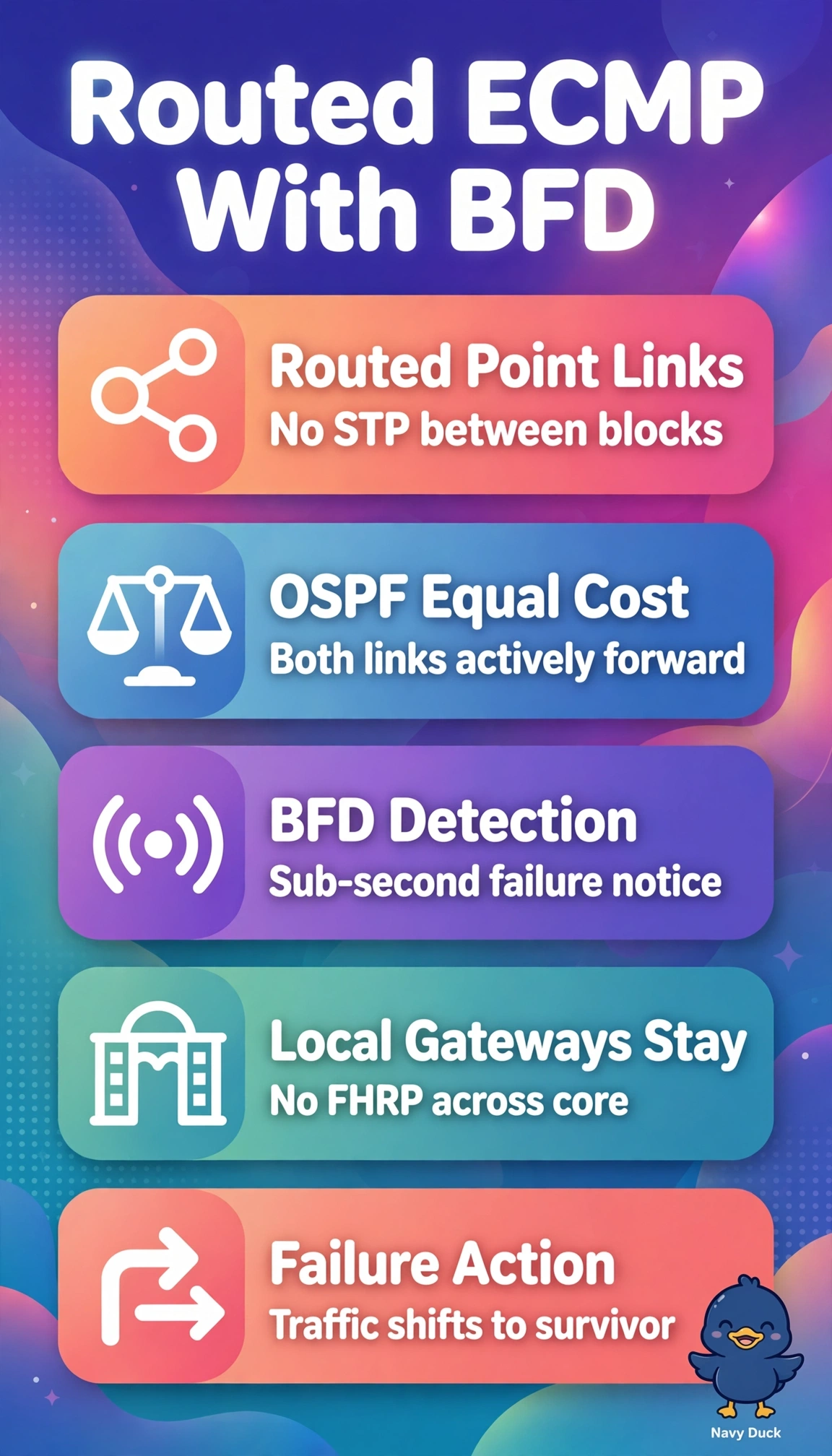
Routed point-to-point links with an IGP remove Layer 2 fate-sharing between campus blocks, allowing each block to retain local gateway and spanning-tree domains while the core handles inter-block routing, and equal-cost multipath installs both parallel paths in the routing table for active-active load sharing with deterministic hashing. BFD provides lightweight sub-second liveness independent of IGP hello scaling, triggering rapid reconvergence onto the surviving path without waiting for dead timers. Switched trunks with Rapid PVST+ and HSRP keep a single active Layer 2 path and a standby gateway, violating the active-active and routed requirements while extending failure domains. A single routed link cannot provide load sharing or survive fiber failure regardless of tuning, and longer hello timers slow convergence. Dual routed links with static routes lack dynamic reconvergence and VRRP still implies a shared subnet that reintroduces Layer 2 adjacency needs. For the exam, remember routed core with ECMP plus BFD is the textbook answer for fast, load-shared campus interconnects, and in practice verify both paths show equal cost and BFD sessions are up before testing link failure.