
A logistics IS-IS backbone flaps when warehouse links bounce, unauthenticated adjacencies were spoofed in a lab test, and LSP floods cause CPU spikes. Stability must improve without hiding real failures. Which IS-IS authentication and stability tuning approach should the designer specify for secure steady operation?
Select an answer to reveal the explanation.
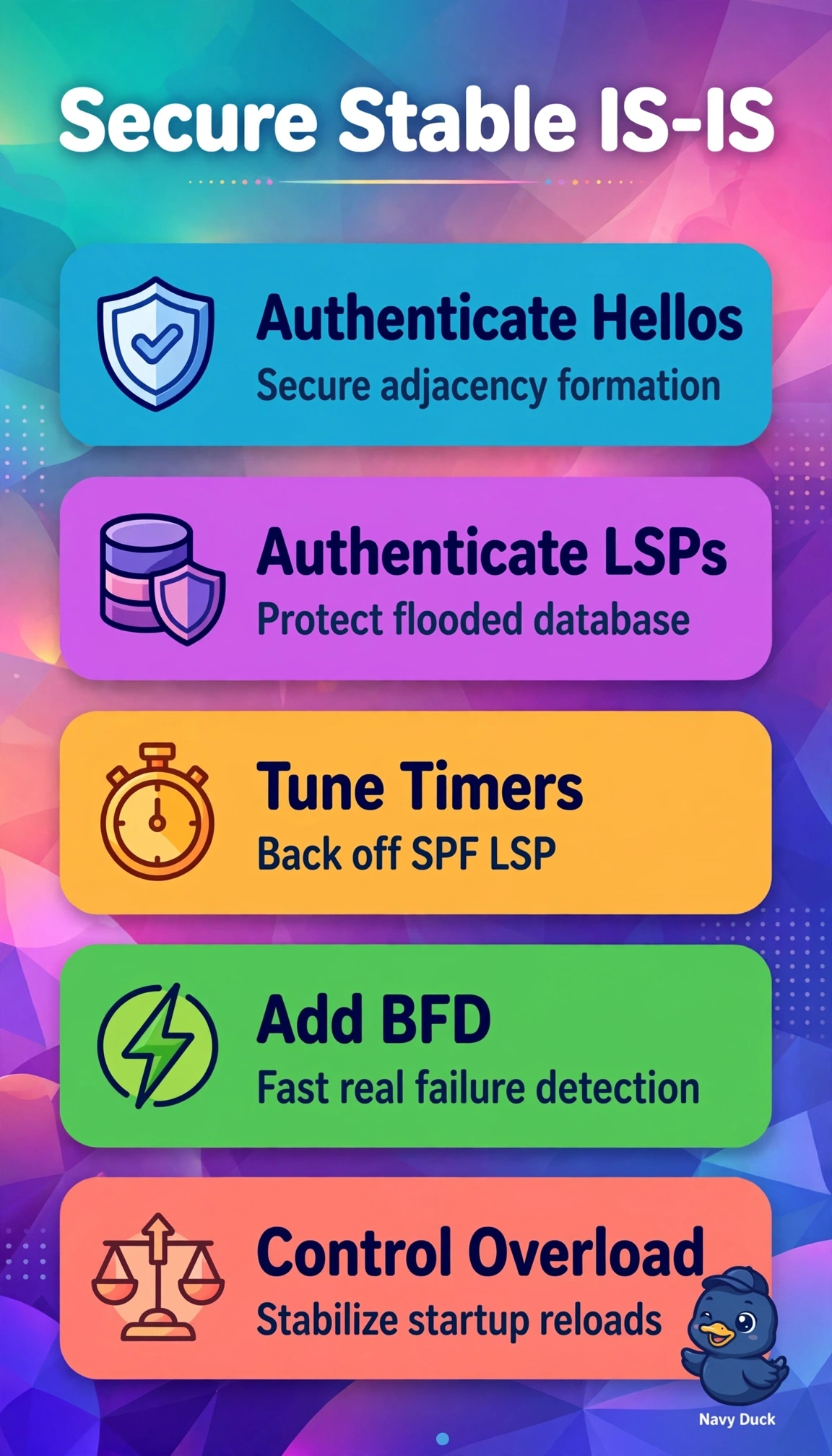
Short Explanation
You want trusted neighbors and calmer reactions to flaps. Authentication proves who is talking while tuned timers and BFD catch real drops quickly. Secure the hellos, smooth the floods.
Full Explanation
Cryptographic interface authentication secures hello adjacency formation against spoofing while LSP and SNP authentication protects flooded database integrity, and stability comes from tuned LSP generation and SPF backoff timers plus overload-bit control during startup plus fast failure detection with BFD so bouncing links are detected quickly without destabilizing the whole domain through excessive flooding. Disabling authentication with very long hellos and passive interfaces everywhere weakens security and slows detection, hiding failures rather than stabilizing them. Domain-only plaintext passwords provide weak protection and aggressive flooding worsens CPU spikes during flaps. Using MD5 everywhere with a flat single level and no mesh or dampening controls may authenticate but sacrifices hierarchy and flood optimization, increasing instability in a large logistics network. For the exam, remember to separate interface authentication from LSP authentication and pair security with timer and BFD tuning, and in practice verify authentication keys match, check SPF run frequency, and confirm BFD sessions track link state.