
A retailer has a hub in Dallas and 120 small stores needing direct voice traffic between stores, dynamic spoke addresses on broadband, and no permanent spoke-to-spoke tunnels to save router memory. Which DMVPN phase and spoke-to-spoke behavior best fits these dynamic-mesh requirements?
Select an answer to reveal the explanation.
Short Explanation
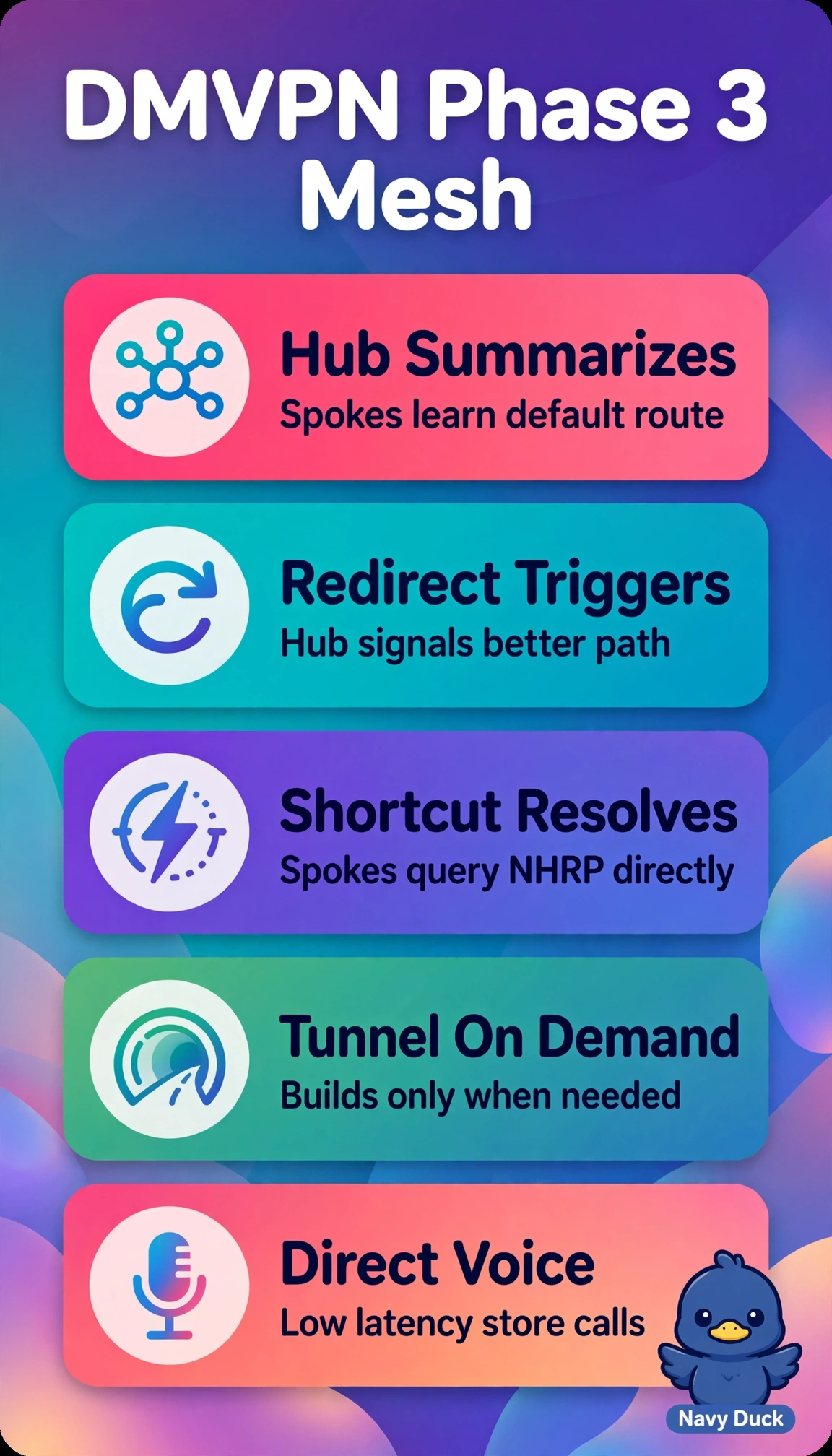
You're chasing direct store-to-store voice without a full mesh tax. Phase 3 lets the hub nudge spokes to build shortcut tunnels only when needed, like a dispatcher connecting callers directly.
Full Explanation
DMVPN Phase 3 uses NHRP redirect at the hub to inform spokes of a better path and NHRP shortcut at the spokes to trigger direct resolution and install a parent-route shortcut, enabling on-demand spoke-to-spoke tunnels with route summarization and centralized policy while conserving memory when idle. Phase 1 with hub-mediated forwarding forces all spoke-to-spoke traffic through the hub because spokes cannot resolve each other directly, which adds latency for voice and hub load. Phase 2 with NHRP resolution does allow direct tunnels but requires spokes to share the same subnet and hold full routing detail without summarization or redirect shortcuts, scaling poorly for 120 summarized sites. Static hub mappings for permanent mesh contradict the memory-saving requirement and defeat NHRP dynamism by maintaining all tunnels continuously. For the exam, remember Phase 1 is hub-and-spoke only, Phase 2 is direct with full routes, Phase 3 is direct with summarization via redirect plus shortcut; in practice verify NHRP mappings and routing shortcut entries after test calls.