
A national broadcaster reports lost SNMP polls and delayed syslog during prime-time congestion on congested WAN edge links, while video contribution traffic dominates bandwidth and management sessions compete as best effort. Which design for prioritizing network management traffic with QoS restores reliable telemetry?
Select an answer to reveal the explanation.
Short Explanation
You are giving the stage crew their own headsets instead of shouting over the crowd. A protected management class guarantees polls and logs survive even when video floods the link.
Full Explanation
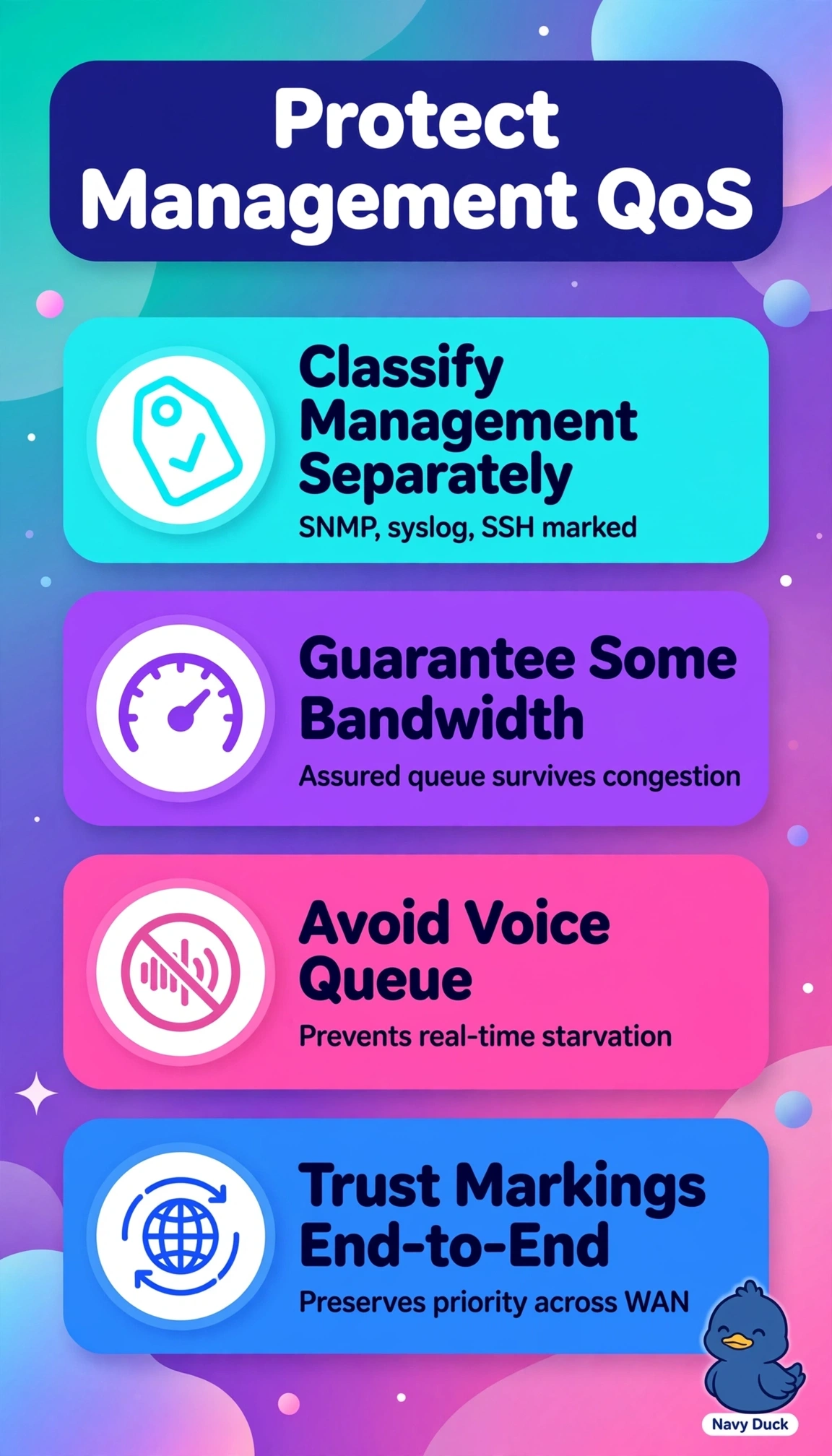
Reliable telemetry during prime-time congestion requires management traffic to be classified and marked for recognition, then placed in its own class with a bandwidth guarantee and preferential queuing at the WAN edge (typically a CBWFQ class, since strict priority is normally reserved for voice) so SNMP polls and syslog are serviced even when video contribution saturates links. The shared-queue design with video fails isolation because merging low-volume critical flows with a bandwidth-dominating flow lets the scheduler serve mainly video, so management still suffers delay and drops despite reservation. The LAN-only design fails scope because QoS helps only where congestion occurs, so guarantees at campus access leave the stated WAN edge bottleneck as best effort and markings may be reset end to end. The strict policer design fails enforcement direction because policing drops excess management packets to protect other classes, reproducing lost polls instead of guaranteeing delivery. The exam caveat is to distinguish separation plus assurance from merely marking, prioritizing elsewhere, or constraining, since only a dedicated assured class at the congested node meets all facts. The practical check is to verify DSCP preservation across the provider edge and track queue drops, SNMP poll success, and syslog delay during peak video periods.