
A retailer with 300 stores uses overlapping 10.0.0.0/8 private IPv4, complex NAT at every merger, and is exhausting addresses for IoT sensors and cameras with cloud migration planned. Growth requires simpler routing and end-to-end reachability. Which addressing strategy using private IPv4, NAT, and IPv6 best supports scalable growth?
Select an answer to reveal the explanation.
Short Explanation
You are outgrowing patchwork fixes and need breathing room. Dual-stack IPv6 for growth with tidy summarization eases pressure, like adding a new area code instead of stacking extensions.
Full Explanation
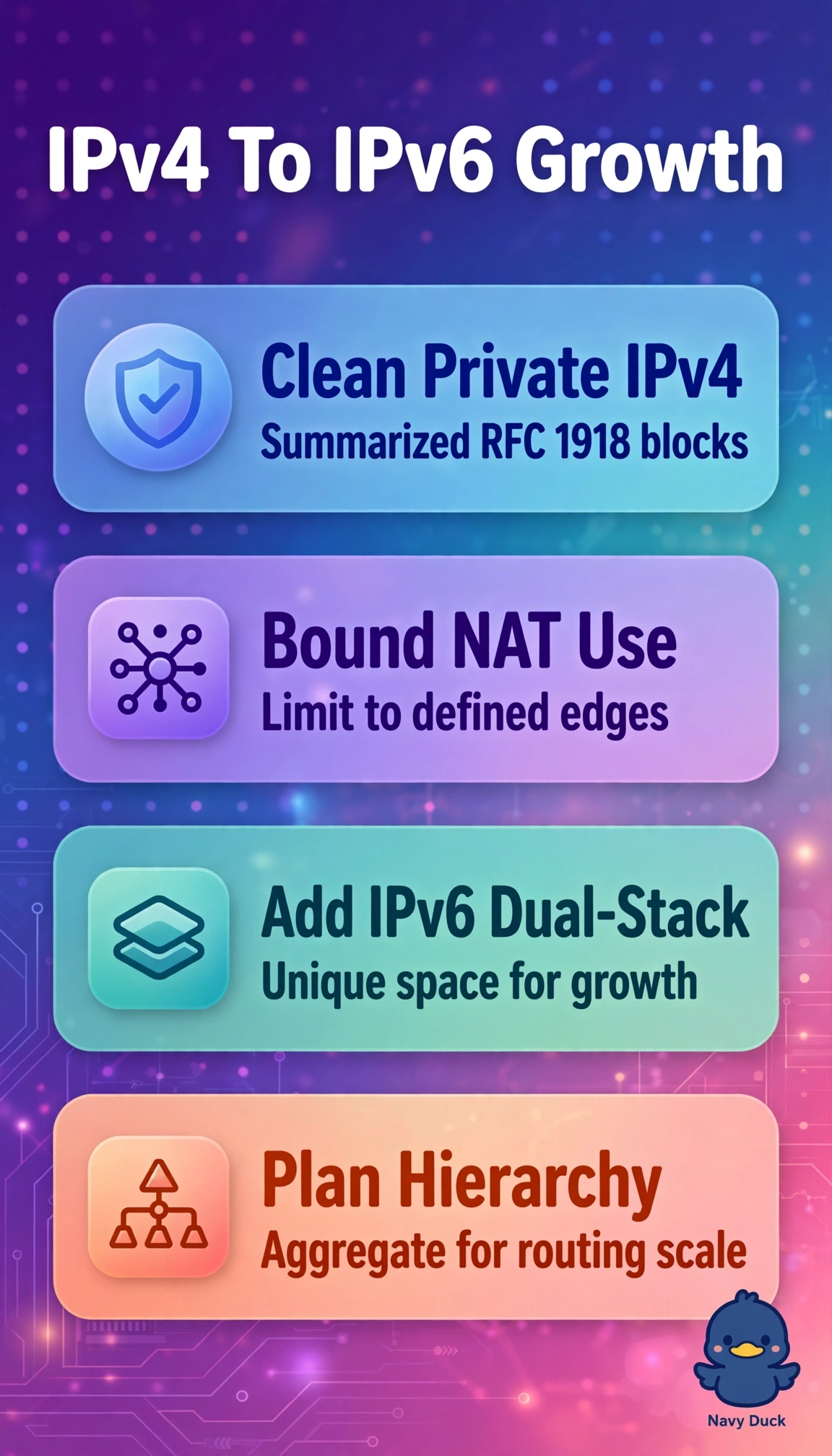
Keeping a cleaned private IPv4 plan with hierarchical summarization and limited NAT at defined boundaries preserves existing services while dual-stack IPv6 provides abundant globally unique space for IoT and cloud without further NAT complexity, which satisfies growth and reachability together. Adding more overlapping IPv4 with expanded NAT fails by concept because it multiplies translation state and troubleshooting burden, even though it postpones renumbering. Migrating all to public IPv4 fails by concept because public IPv4 is scarce and costly and does not scale for thousands of new endpoints, even though it removes NAT. Isolated IPv6 islands with NAT66 fails by concept because it fragments routing and reintroduces translation disadvantages that IPv6 is meant to avoid, even though it limits change. For the exam remember RFC 1918 with disciplined hierarchy plus IPv6 dual-stack is the stable growth path; in practice audit overlaps, plan IPv6 prefix hierarchy, and define where NAT remains versus where it is removed.