
A bank expands EIGRP to remote branches over unstable links and sees stuck-in-active events, rogue route injection risk, and branch routers transiting core traffic. Security mandates neighbor authentication using per-interface credentials rather than one shared secret for the whole network. Which EIGRP authentication and stability design hardens and stabilizes the deployment?
Select an answer to reveal the explanation.
Short Explanation
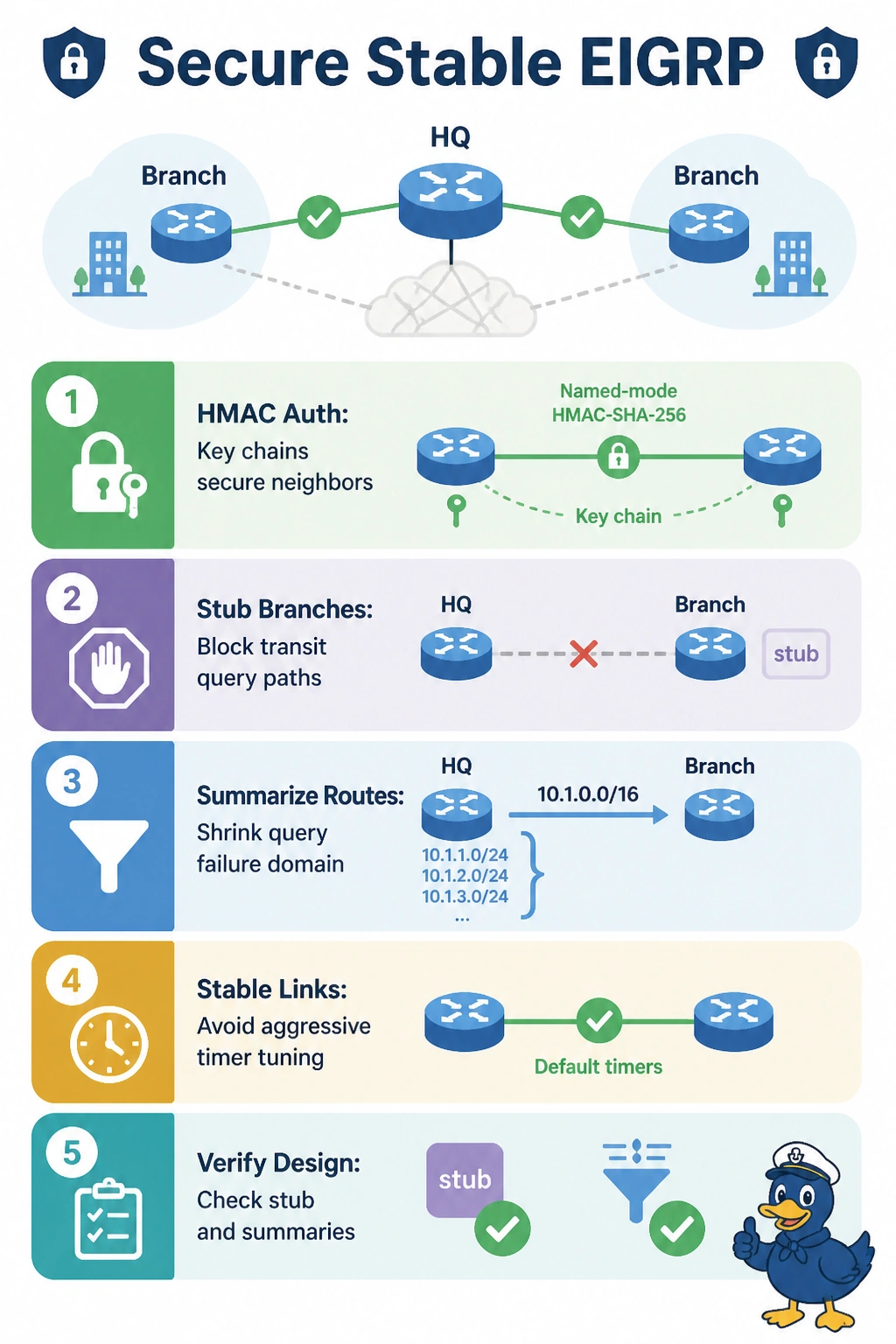
You don't want wobbly branch links shaking your whole core, so you'll fence them off like a gate that can't swing into the house. Pair named-mode HMAC-SHA-256 authentication with stub routing and summaries to cut queries and block spoofed neighbors.
Full Explanation
The correct design works because named-mode HMAC-SHA-256, configured per address-family interface with its own password, cryptographically authenticates EIGRP packets and stops rogue neighbors from injecting routes; EIGRP stub keeps branch routers from becoming transit paths and from being queried for routes they cannot satisfy; and summary aggregation narrows the query domain so unstable links trigger fewer stuck-in-active events and smaller updates. The single-password-everywhere design fails the stated credential requirement: one network-wide secret means any compromised router exposes every adjacency, even though stub and summarization stabilize topology. The full-transit design fails query-propagation: authentication and summarization alone do not stop branches from receiving and forwarding queries, so flaps still expand SIA scope and core traffic can transit constrained branches. The no-summarization design fails aggregation: authentication and stub limit transit but advertising every specific prefix preserves a large topology and query diameter that sustains instability over lossy links. Exam caveat: HMAC-SHA-256 is available only in named mode and is configured with a password under af-interface (key chains apply to MD5), and stub versus summarization both reduce SIA but only stub blocks transit. Practical check: verify with show ip eigrp interfaces detail and show ip eigrp neighbors detail (stub flag), confirm summaries in the topology table, then flap a branch link and confirm no SIA and no transit path.