
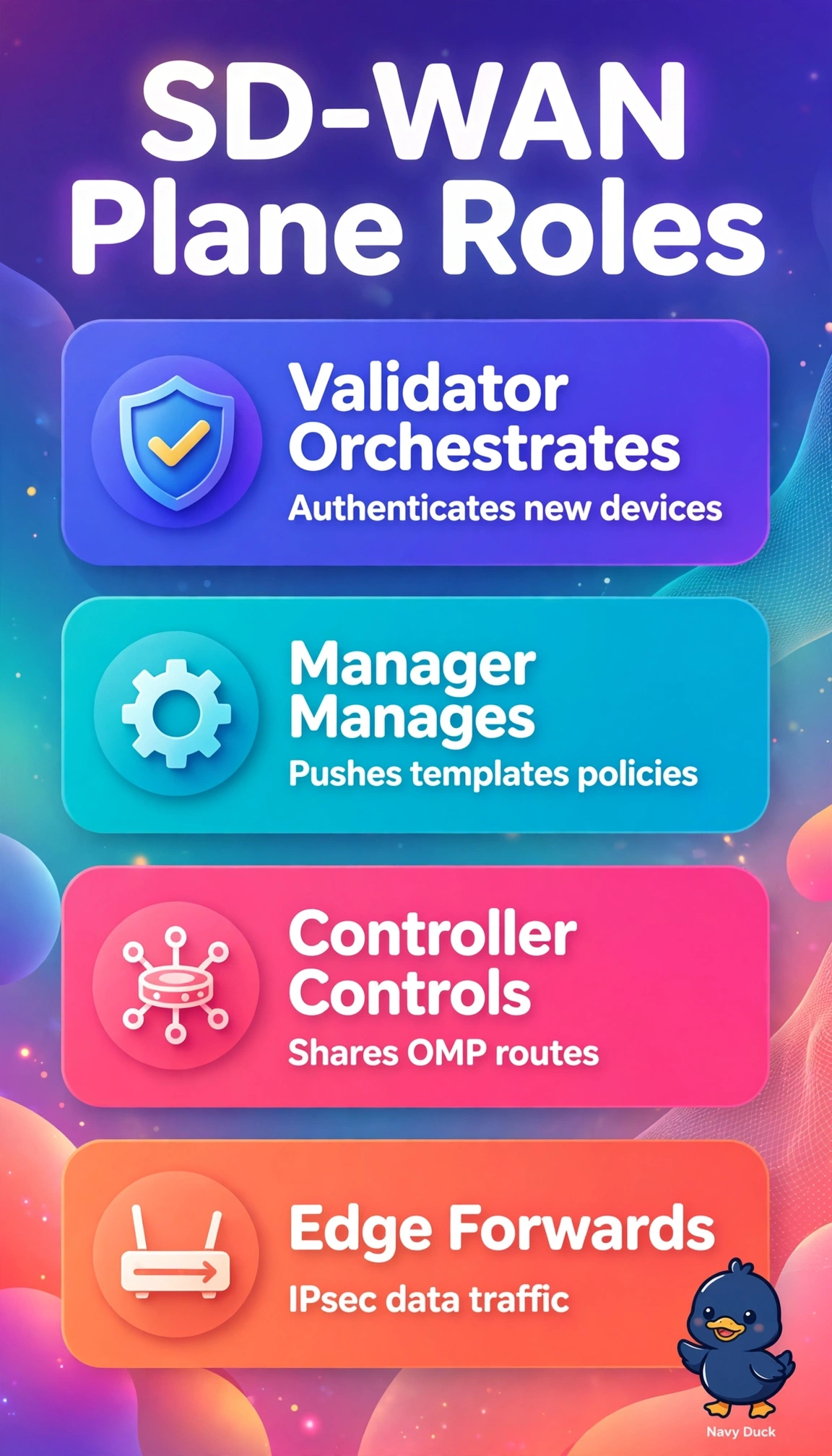
A retail chain with 200 stores is planning Cisco SD-WAN and the architect must assign Validator for initial authentication, Manager for configuration, Controller for route distribution, and WAN Edge for forwarding. The rollout needs zero-touch onboarding and centralized policy. Which SD-WAN plane assignment correctly aligns each component with its primary function?
Select an answer to reveal the explanation.
Short Explanation
You're juggling four managers and need to know who hires, who plans, and who drives. Plane separation keeps onboarding trust apart from routing brains and forwarding muscle so you can scale cleanly.
Full Explanation
Cisco SD-WAN separates functions with Validator in the orchestration plane performing initial authentication and NAT traversal coordination, Manager in the management plane providing centralized configuration and monitoring, Controller in the control plane distributing OMP routes and policy, and WAN Edge in the data plane forwarding application traffic with IPsec. Swapping Manager to trust and Validator to routes fails because Manager never authenticates devices and Validator never participates in OMP. Placing Controller at trust and Validator at configuration fails because Controllers rely on prior Validator authentication and Validators hold no configuration templates. Assigning Validator to route distribution fails because orchestration does not run OMP and management does not establish the initial trust anchor. Exam caveat is to link Validator to orchestration, Manager to management, Controller to control, and Edge to data without blending them. Practical check is to confirm devices authenticate to Validator first, then receive templates from Manager and OMP routes from Controller.