
A manufacturer uses Cisco SD-WAN to connect factories and now needs predictable performance to workloads in two public cloud regions with rapid VPC expansion and centralized policy. Internet VPN to cloud gateways is operationally heavy and inconsistent. Which cloud connectivity design integrates WAN with public cloud regions for scalable automated attachment?
Select an answer to reveal the explanation.
Short Explanation
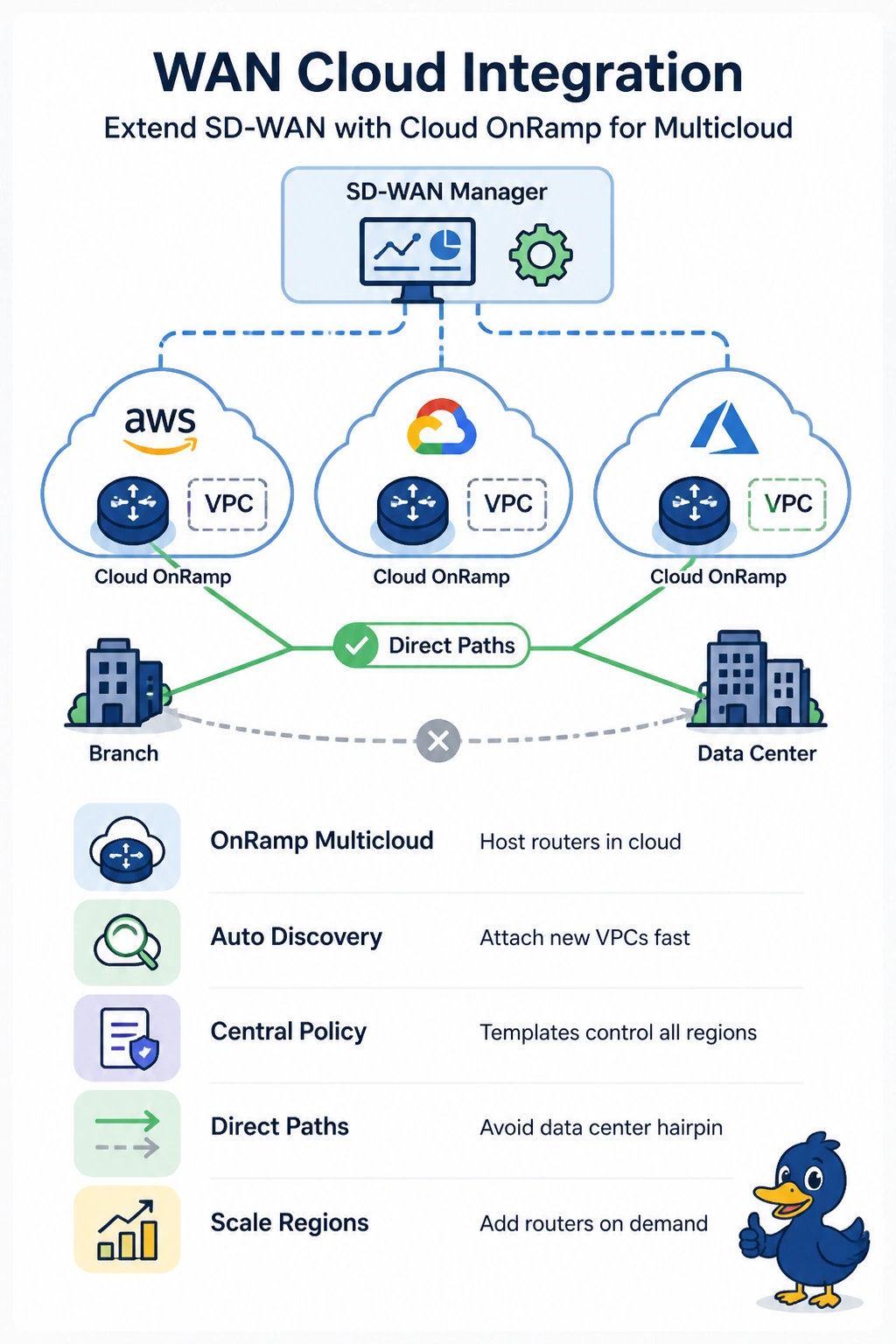
You've got VPCs multiplying faster than you can track, so hand-built VPNs won't keep up. Like opening extra checkout lanes when the store gets busy, your cloud routers can spin up and connect automatically. You'll love Cloud OnRamp for Multicloud because it keeps your policy centralized while new regions attach themselves.
Full Explanation
Cisco Catalyst SD-WAN Cloud OnRamp for Multicloud (the successor to the Cloud OnRamp for IaaS workflow) has SD-WAN Manager build cloud gateways from SD-WAN routers inside cloud regions and attach them to native constructs such as AWS Transit Gateway or Azure Virtual WAN, enabling automated discovery, centralized template policy, and dynamic path selection without per-tunnel manual configuration, which scales as regions expand and preserves performance with direct regional attachment. Building standalone IPsec tunnels from each edge router multiplies operational touch points and lacks centralized control, path optimization, and automated teardown. Backhauling cloud traffic through a central data center adds latency, wastes bandwidth, and defeats direct regional access that cloud workloads expect. Deploying separate MPLS circuits into each cloud region is slow to provision, costly, and does not provide the elastic, automated attachment model that SD-WAN cloud integration delivers. For the exam, associate OnRamp with automated multicloud attachment and policy consistency; in practice verify cloud router placement, transit gateway or virtual WAN design, and segmentation alignment with on-premises VPNs.