
A logistics campus uses routed access with OSPF to distribution where voice and scanners need sub-second rerouting around a failed fiber link. Hello timers alone react too slowly and create false positives when tuned aggressively. Which BFD design for fast failure detection best satisfies rapid yet stable detection?
Select an answer to reveal the explanation.
Short Explanation
You need speed without jittery false alarms on fiber cuts. BFD gives lightweight hellos decoupled from OSPF timers. It's like a steady pulse check separate from long conversations.
Full Explanation
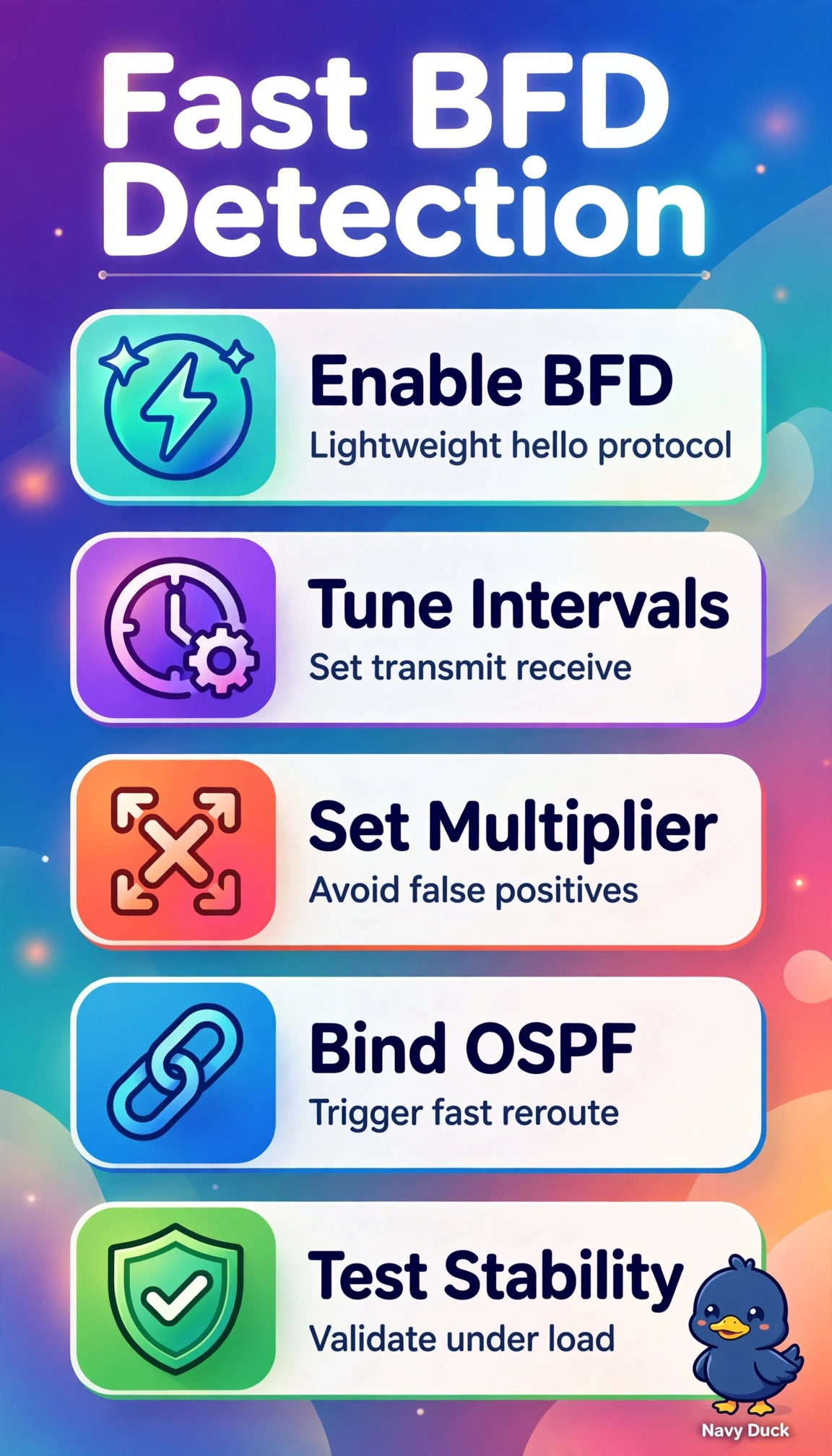
The correct design pairs BFD with OSPF using tuned transmit and receive intervals plus multiplier because BFD provides lightweight sub-second liveness independent of OSPF hello processing, while the multiplier dampens transient loss and avoids false positives from aggressive hello tuning, allowing OSPF to tear down the neighbor and reroute voice and scanner traffic around the failed access-distribution fiber quickly yet stably. Aggressive OSPF hello tuning alone is commonly used for faster convergence but remains tied to control-plane processing and still risks false positives or slow reaction under load, failing the stable fast detection need. BFD with conservative one-second intervals is widely deployed for safe stability but its multi-second detection time cannot meet the stated sub-second voice requirement for the failing link. BFD focused on distribution core transport is a sound hierarchical design for backbone resilience but leaves the critical access-to-distribution fiber protected only by slow hellos, missing the exact failure location. Exam caveat: distinguish BFD mechanism speed from scope and integration, as timers, multiplier, and OSPF linkage must all align with the stated topology and application. Practical check: verify negotiated BFD timers and multiplier on both ends of the access-distribution link, then simulate fiber failure and confirm OSPF neighbor down and traffic reroute within the target window without flapping during congestion.