
A university core uses two chassis switches with dual supervisors and dual power, but failover testing shows brief gateway outages when the first-hop redundancy protocol reconverges. The design team wants deterministic gateway behavior and simpler spanning-tree topology without changing end-host addressing. Which platform abstraction approach removes the need for a separate first-hop redundancy protocol?
Select an answer to reveal the explanation.
Short Explanation
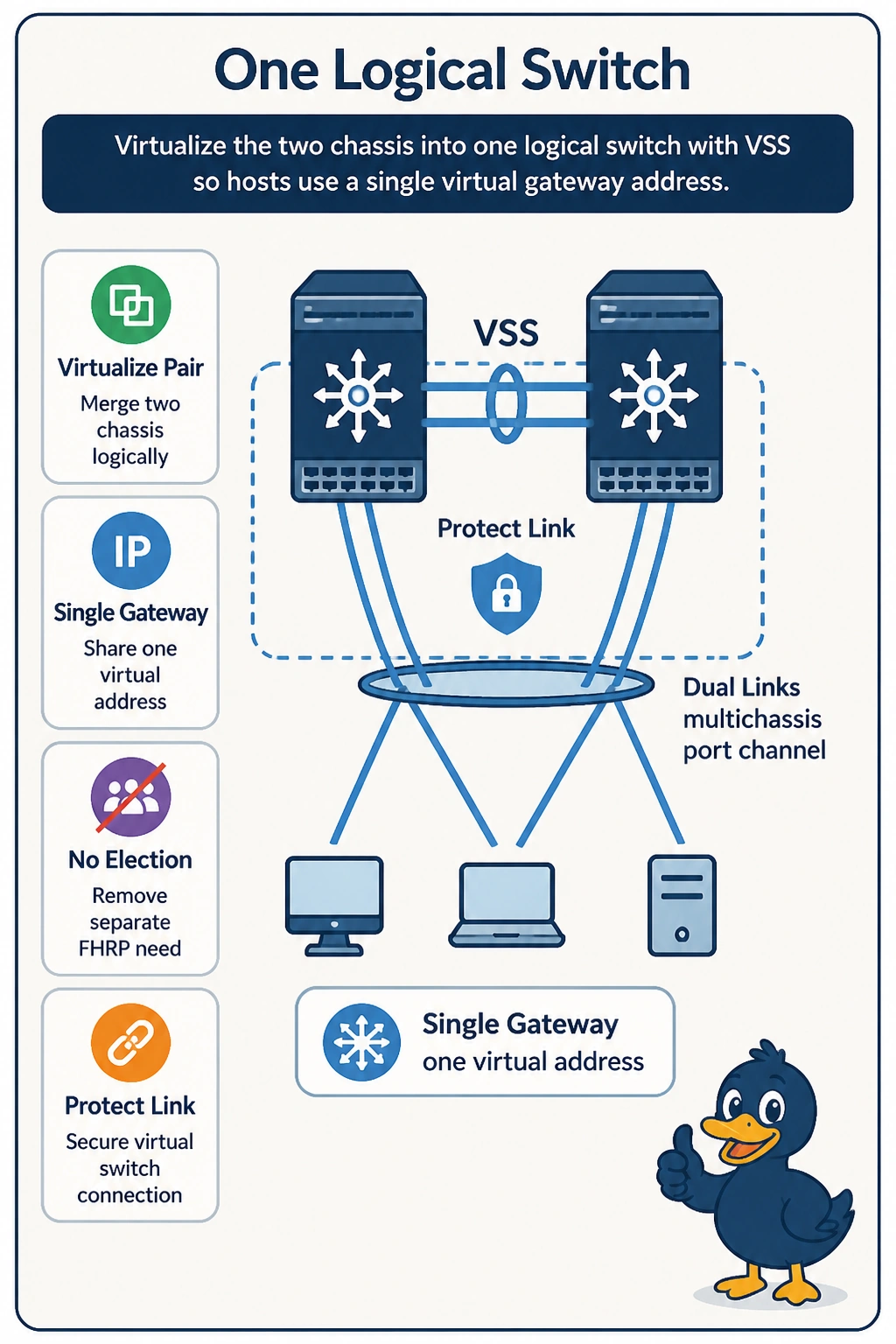
You're merging two conductors into one so the band never misses a beat. Creating a single virtual switch lets both chassis share one gateway without a backup election.
Full Explanation
StackWise Virtual (Catalyst 9000) and VSS (chassis such as Catalyst 6500/6800 and 4500-X) virtualize two physical switches into one logical control and data plane, allowing a single virtual gateway and Multichassis EtherChannel so hosts do not depend on a separate first-hop redundancy election for gateway resilience. Adding another redundancy instance fails by concept because it retains protocol reconvergence and adds complexity without removing the gateway election. Tuning timers over Layer 2 trunks fails by concept because it only speeds detection while preserving dual control planes and spanning-tree boundaries. Using independent gateways with host routing fails by concept because it pushes resilience to endpoints and breaks the requirement for unchanged host behavior and deterministic gateway operation. For the exam, remember virtualization replaces the first-hop election only when the pair acts as one logical device, and verify dual-homed hosts, virtual-switch link redundancy, and software consistency.