
A university deploying 80 identical branch routers as WAN Edges needs reusable interface and VPN settings, needs per-site system values, and must minimize per-device CLI. Which template workflow should you use for building a device template from feature templates and attaching it to devices?
Select an answer to reveal the explanation.
Short Explanation
You're baking one cake mix for eighty cakes with different frosting. Feature plus device templates reuse common pieces while variables handle site differences beautifully.
Full Explanation
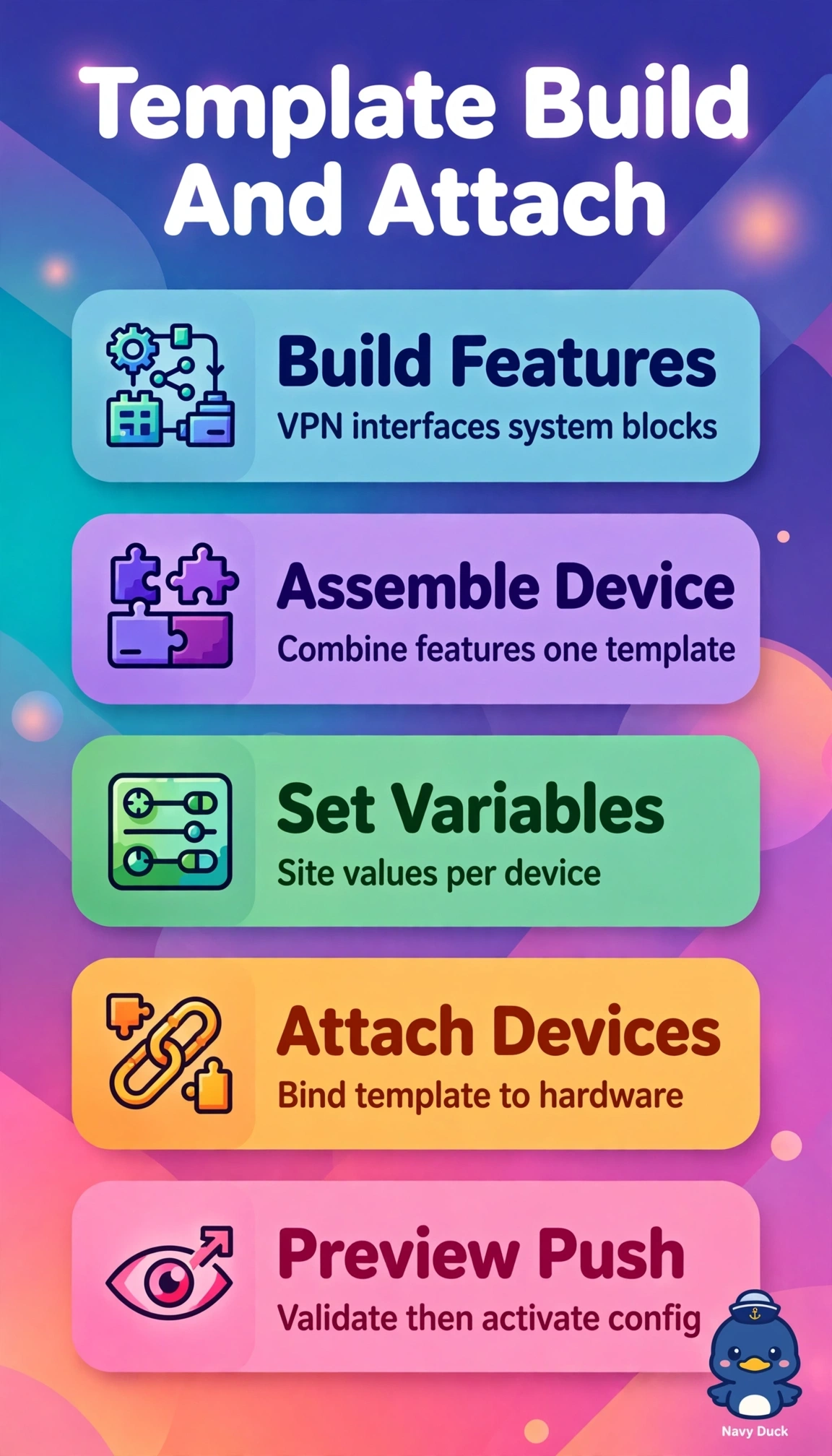
The correct workflow works because shared VPN, interface and system feature templates capture the common branch design once, a single device template assembles them into a deployable model for WAN Edge routers, and device variables supply hostname, site-id, system IP and other per-site values at attach time, which preserves reusability for 80 identical devices while avoiding repetitive CLI. The separate-templates-per-group approach fails on reusability and operational scale because maintaining dedicated VPN and interface models for each site group duplicates identical policy and increases update burden when all branches share the same design, even though variables are still used correctly. The fixed-system-values approach fails on per-site customization because hardcoding system entries inside the template forces every attached router to inherit the same identity and prevents unique addressing, which breaks site-specific requirements despite efficient reuse and attachment. The device-CLI-for-system approach fails on CLI minimization and variable use because handling system differences after attachment with manual CLI reintroduces per-device effort, drift and troubleshooting complexity that variables are intended to eliminate. As an exam caveat, remember that feature templates cannot be attached directly and CLI templates do not replace variables for scalable parameterization, so look for assemble-then-attach-with-variables as the signal. As a practical check, export the variable CSV, verify site-id, hostname and system-IP uniqueness, and preview the attached configuration before pushing to catch missing variables.