
A campus edge router connects OSPF Area 0 on the LAN to service VPN 10, with several campus subnets that must appear in OMP for remote branches while preserving OSPF metric type. Which OSPF and redistribution configuration integrates the campus into the overlay?
Select an answer to reveal the explanation.
Short Explanation
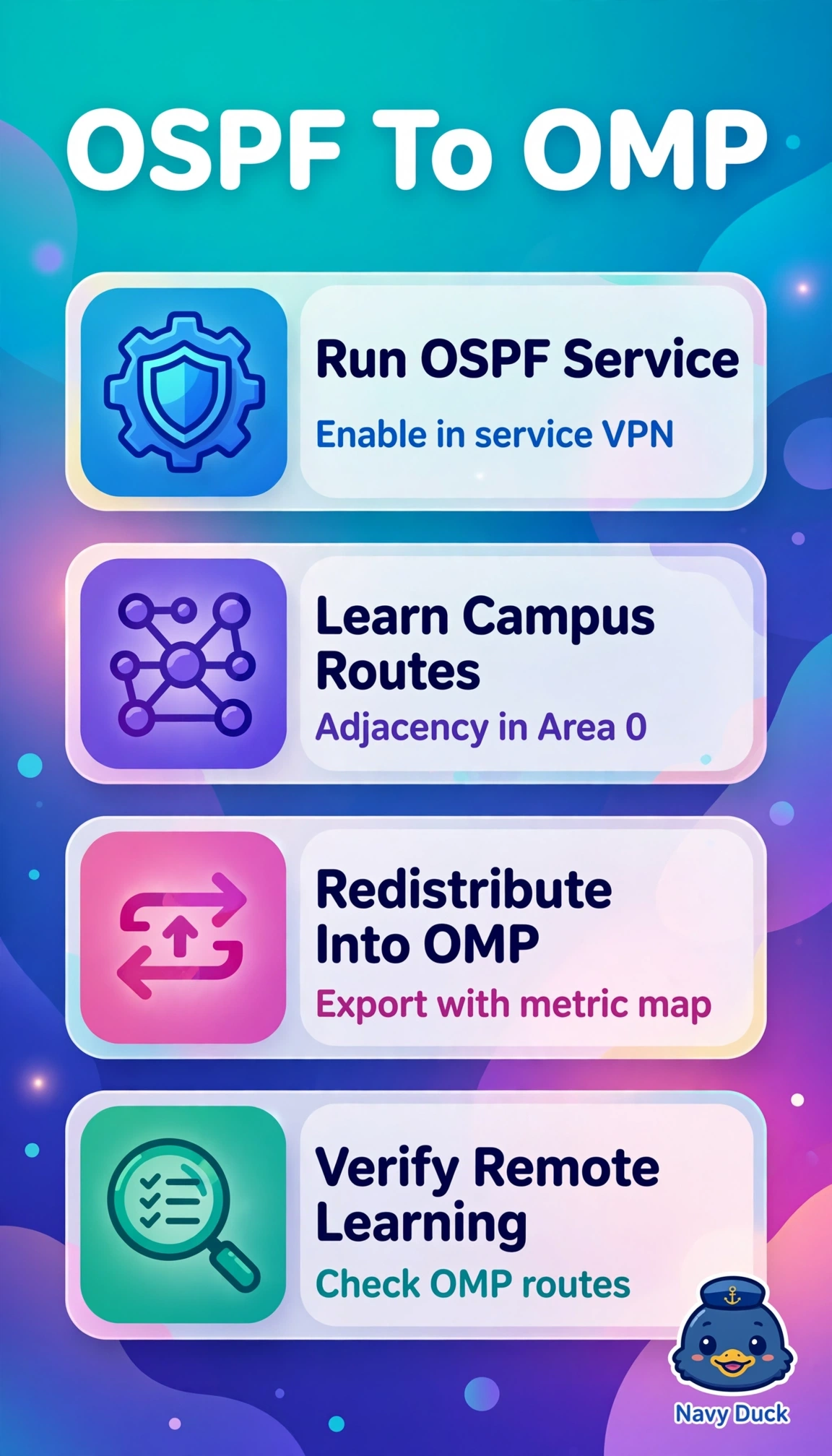
You're importing campus routes into the overlay without losing their OSPF character. Redistribute service-VPN OSPF into OMP redistribution so branches learn them with proper metrics. It's like translating local street names for a national map.
Full Explanation
The campus edge must terminate OSPF Area 0 inside service VPN 10 so LAN LSAs remain in the correct topology, then redistribute OSPF into OMP with metric preservation so remote branches learn the prefixes over the overlay with original E1/E2 type and cost intact for consistent path selection. The variant that redistributes as standard E2 externals without type mapping does establish overlay reachability and is common when metric fidelity does not matter, but it fails the explicit preservation requirement by normalizing everything to E2 and potentially altering preferred exit selection across branches. The variant that redistributes OSPF into BGP for local site advertisement is a sound enterprise pattern for LAN-to-BGP handoff and satisfies Area and VPN placement, but it fails the overlay requirement because local BGP does not inject into OMP and remote branches would never receive the routes. The variant that uses Area 1 with full OMP redistribution and preservation follows best practice for isolating a new site and is widely deployed, but it fails the stated Area 0 continuity fact by introducing an area boundary that changes LSA flooding and backbone adjacency expectations at the campus edge. As an exam caveat, do not equate any successful redistribution with overlay success; verify VPN ID, protocol direction OSPF into OMP, and metric-type handling together because each is independently tested. As a practical check, confirm OSPF neighbors in Area 0 under service VPN 10, then verify OMP routes on a remote branch and on the SD-WAN Controller to confirm the origin protocol and metric are carried in the OMP route.