
A retailer expanding to AWS and Azure needs branch inventory traffic to reach cloud workloads securely, needs consistent segmentation, and must avoid manual IPsec tunnels per VPC. Which multicloud and cloud interconnect integration should you deploy with the SD-WAN fabric?
Select an answer to reveal the explanation.
Short Explanation
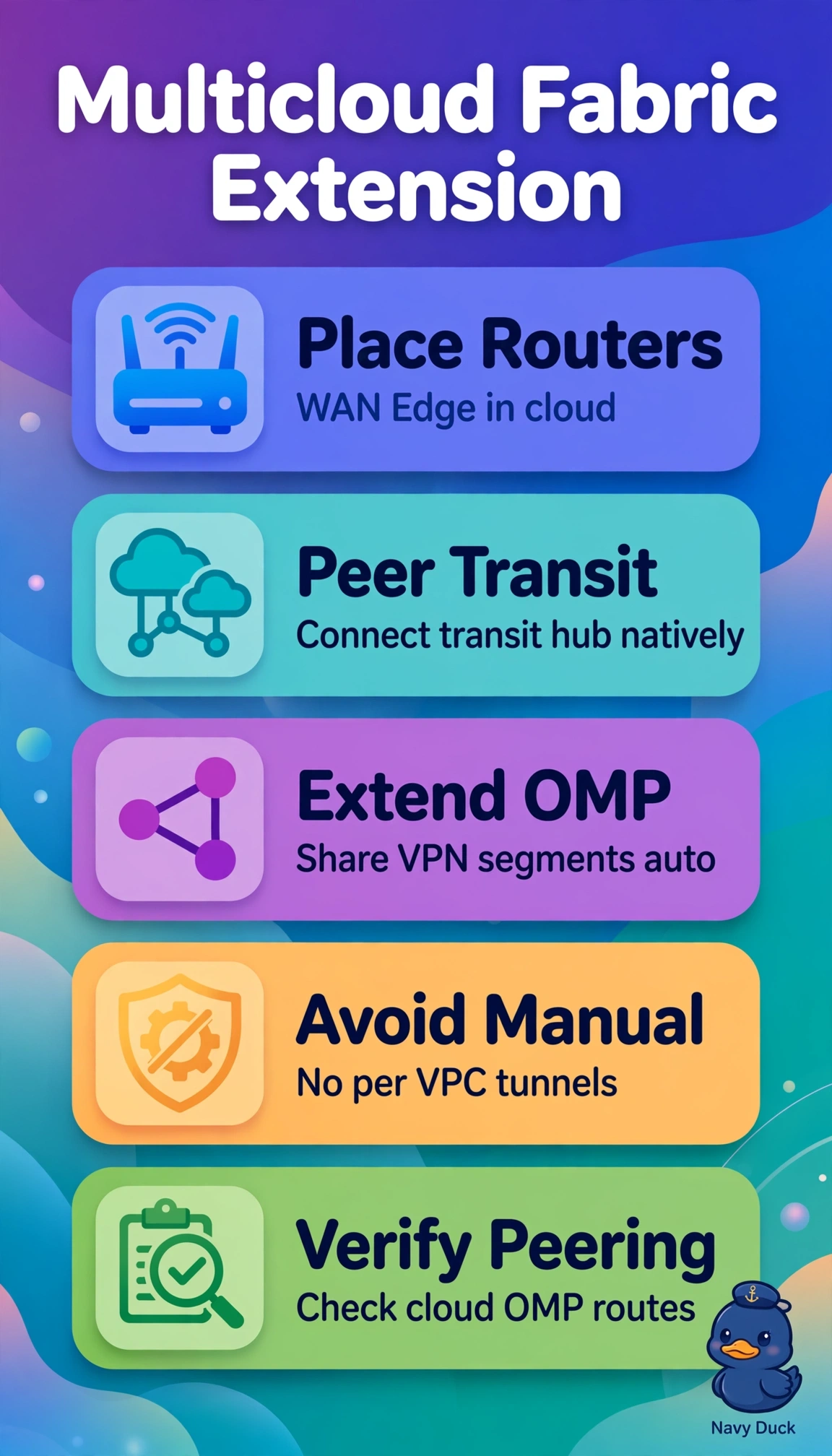
You want your branches and clouds on the same map automatically. Cloud routers join the overlay and peer transit hubs, like adding new stores to your delivery network.
Full Explanation
Multicloud integration instantiates SD-WAN WAN Edge routers inside AWS, Azure, or Google Cloud and peers them to cloud transit gateways and virtual networks, extending OMP, segmentation, and IPsec automation into the cloud. That mechanism makes cloud-hosted WAN Edge routers peered to transit hubs correct because it provides secure auto-connectivity, preserves VPN segmentation, and eliminates per-VPC manual tunnels. Cloud OnRamp for SaaS gateways fails by concept because SaaS optimization selects best exits to SaaS applications, not IaaS VPC peering and transit attachment. Colo VNF clusters fails by concept because colocation hosts shared services near clouds but does not instantiate fabric routers inside hyperscaler networks. Branch GRE with static routing fails by concept because manual tunnels lack OMP automation, segmentation scale, and cloud-native resiliency. Exam caveat is to distinguish OnRamp for IaaS multicloud from OnRamp for SaaS optimization. Practical check is to verify cloud router OMP peering, transit attachments, and VPN-to-VNet mappings.