
An e-commerce company has four equal-cost MPLS and internet transports at large data centers and needs active-active load sharing across all healthy paths, with fast failover if one degrades. OMP has selected multiple equal paths to key prefixes. Which OMP best-path selection and equal-cost multipath behavior enables the load-sharing requirement?
Select an answer to reveal the explanation.
Short Explanation
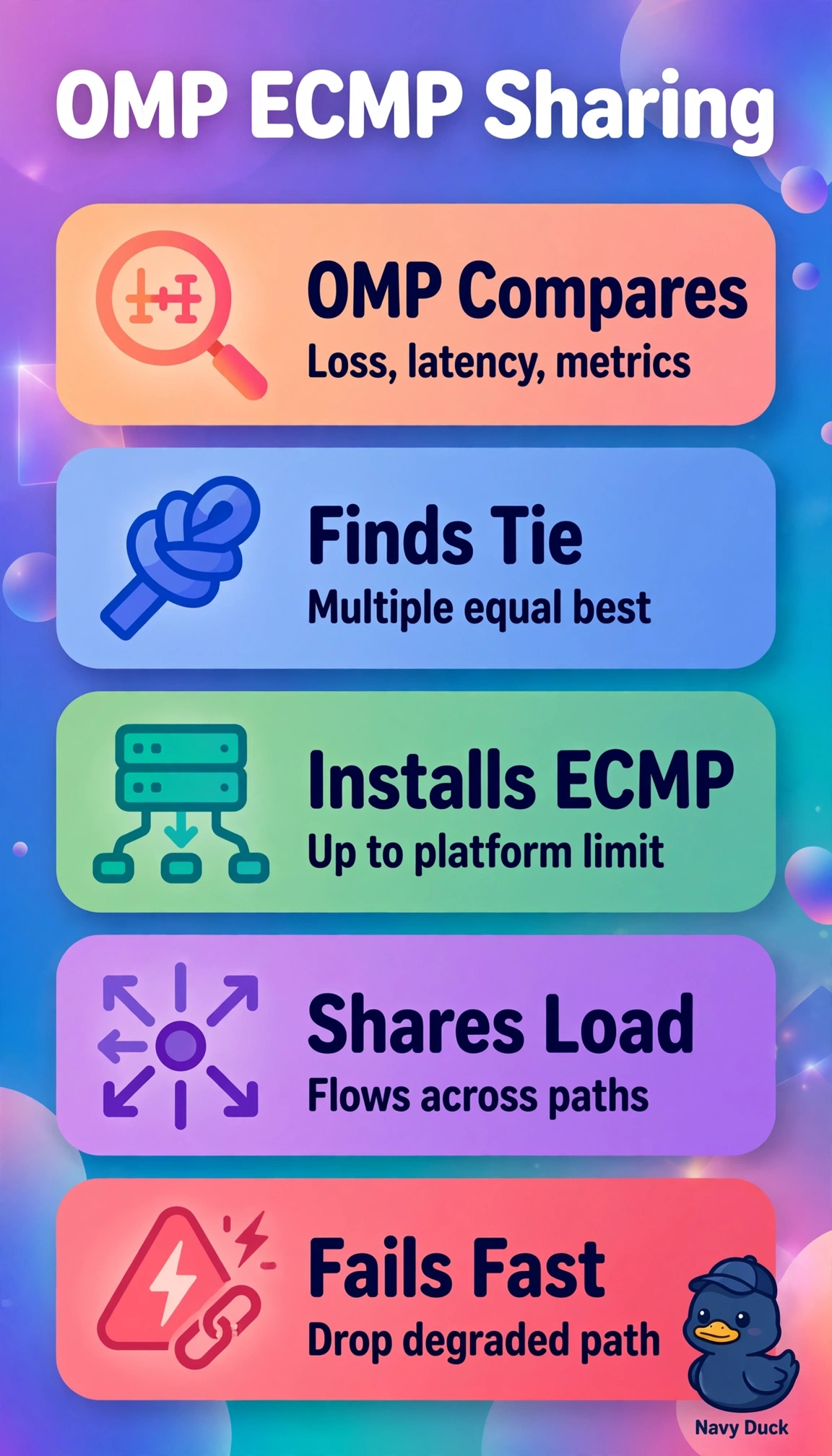
You want all four lanes open, not a single carpool lane. Equal-cost multipath installs multiple OMP best paths up to the limit for sharing. Lose one lane and the rest keep carrying the load.
Full Explanation
OMP runs a best-path algorithm comparing attributes such as route validity, administrative distance, OMP route preference, TLOC preference and origin, and when multiple paths tie for best, the Edge can install several equal-cost OMP routes into its forwarding table subject to the configurable ECMP limit (default 4, up to 16), enabling per-flow load sharing and rapid removal of a degraded path without reconvergence. Electing a single best path and duplicating packets fails because duplication wastes bandwidth and does not provide ECMP forwarding, installing unlimited paths and relying on BGP pruning fails because hardware and OMP enforce finite ECMP limits and BGP does not manage OMP forwarding entries, and forcing lowest TLOC IP with QoS balancing fails because that pins traffic to one transport while QoS only schedules queued packets rather than selecting paths. Exam caveat: distinguish OMP best-path tie-breaking from the ECMP installation limit that controls forwarding scale. Practical check: show OMP routes and forwarding table on the Edge to confirm multiple next hops share the prefix and test failover by impairing one transport.