
A logistics company has one headquarters hub and forty spokes that must communicate only through the hub for inspection, but spokes must still establish data tunnels directly to the hub. Underlay connectivity is full mesh capable. Which control policy construction creates this hub-and-spoke behavior?
Select an answer to reveal the explanation.
Short Explanation
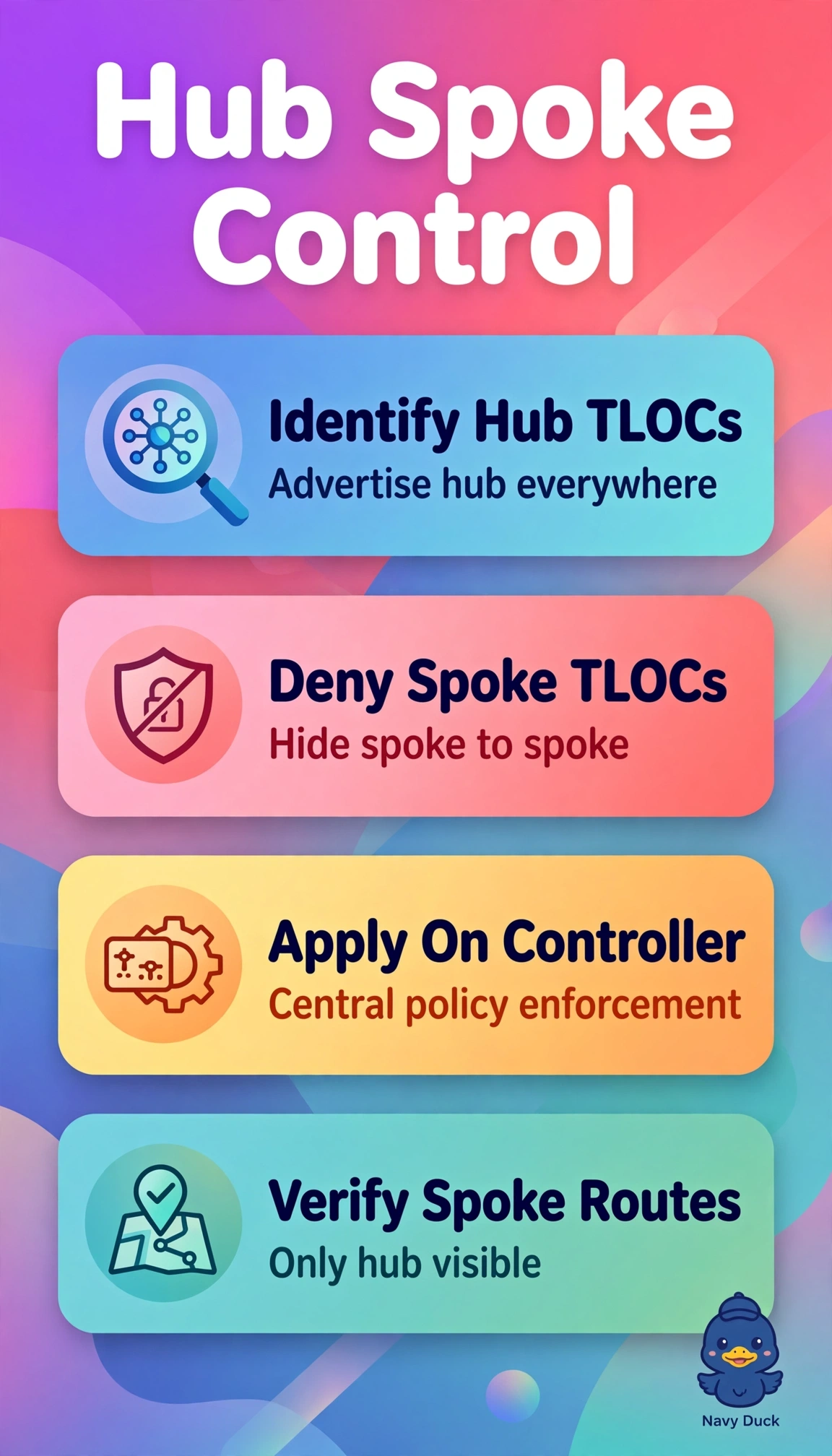
You can make headquarters the only path between spokes by limiting which TLOCs they learn. A centralized control policy lets spokes learn the hub TLOCs without learning one another’s TLOCs. Think of it as listing only the main office address in the directory.
Full Explanation
A centralized control policy creates this hub-and-spoke behavior by controlling TLOC route advertisements: it allows the hub’s TLOCs to be advertised to spokes while preventing spoke-to-spoke TLOC exchange. Spokes therefore learn the hub as their available overlay destination and can establish data tunnels directly to it, even though the underlay supports full-mesh connectivity. Duplicating spoke packets toward the hub with a centralized data policy does not enforce the topology: data policy affects packet forwarding after routes are learned, so it does not hide spoke TLOCs or prevent direct tunnels. A localized access list that blocks LAN subnets from pinging one another filters that specific traffic, but leaves overlay routes and direct tunnels intact; it does not prevent other spoke-to-spoke communication. An AppRoute policy that prefers the hub transport according to latency and packet loss selects paths based on performance rather than restricting which TLOCs spokes can learn, so direct spoke paths may still be used when their SLA is acceptable. Exam caveat: distinguish enforcing topology through TLOC advertisement from preferring a path or filtering particular packets. In practice, after activating the policy, check the OMP TLOCs received by each spoke and confirm that only hub TLOCs are present.