
A retail branch uses dual broadband transports with highly variable throughput during peak hours, and voice in VPN 10 must stay protected while bulk traffic is shaped per tunnel. The design requires shaping that tracks actual path bandwidth instead of a static shaper. Which QoS treatment on the WAN Edge router achieves adaptive per-tunnel shaping for this requirement?
Select an answer to reveal the explanation.
Short Explanation
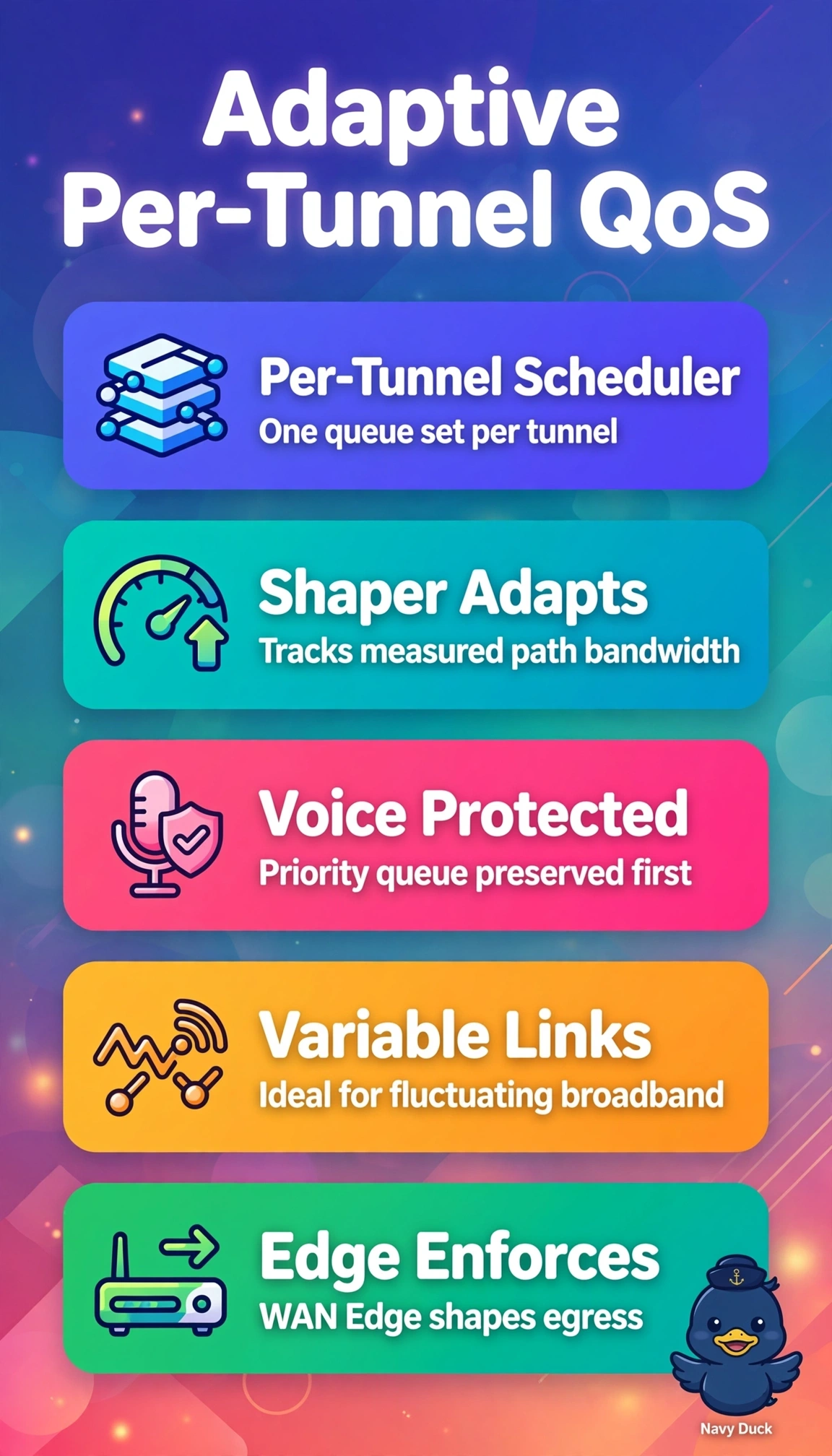
You've got shaky broadband that changes by the minute, so static shapers fall behind fast. Adaptive QoS lets each tunnel learn real bandwidth and reshape on the fly while protecting voice.
Full Explanation
The correct treatment is hierarchical per-tunnel scheduling on WAN Edge transport interfaces with adaptive QoS enabled, giving each tunnel its own parent shaper with child queues for voice in VPN 10 and bulk traffic while adaptive feedback continuously estimates available path bandwidth from loss, delay and throughput and raises or lowers shaper rates without manual reconfiguration, preventing waste from a static under-shaper and tail-drop voice impairment from a static over-shaper on variable broadband. The aggregate-only adaptive proposal fails on granularity because shaping only the physical transport interface provides adaptivity but no per-tunnel isolation, so bulk congestion can still impact voice queuing across dual transports. The LAN-side per-tunnel proposal fails on placement because service-VPN queuing controls LAN egress, not overlay-tunnel contention, so it never governs the broadband bottleneck. The probe-driven proposal fails on mechanism because application-aware routing SLA probes select the healthier path and can steer voice accordingly but do not rewrite shaper rates, whereas adaptive QoS directly adjusts shaping. Exam caveat: distinguish path selection from shaping adaptation — routing changes where packets go, only adaptive shaping changes allowed bits per second per tunnel. Practical check: verify per-tunnel QoS with adaptive QoS on transports, confirm learned rates track peak variability, and test VPN 10 voice during bulk transfer.