
A healthcare network deploys two Validators and two Controllers on premises across data centers for 300 branches. A single controller-site failure must not block new branch onboarding or policy updates. How should the engineer describe WAN Edge use of redundant Validators and Controllers to ensure control-plane resilience?
Select an answer to reveal the explanation.
Short Explanation
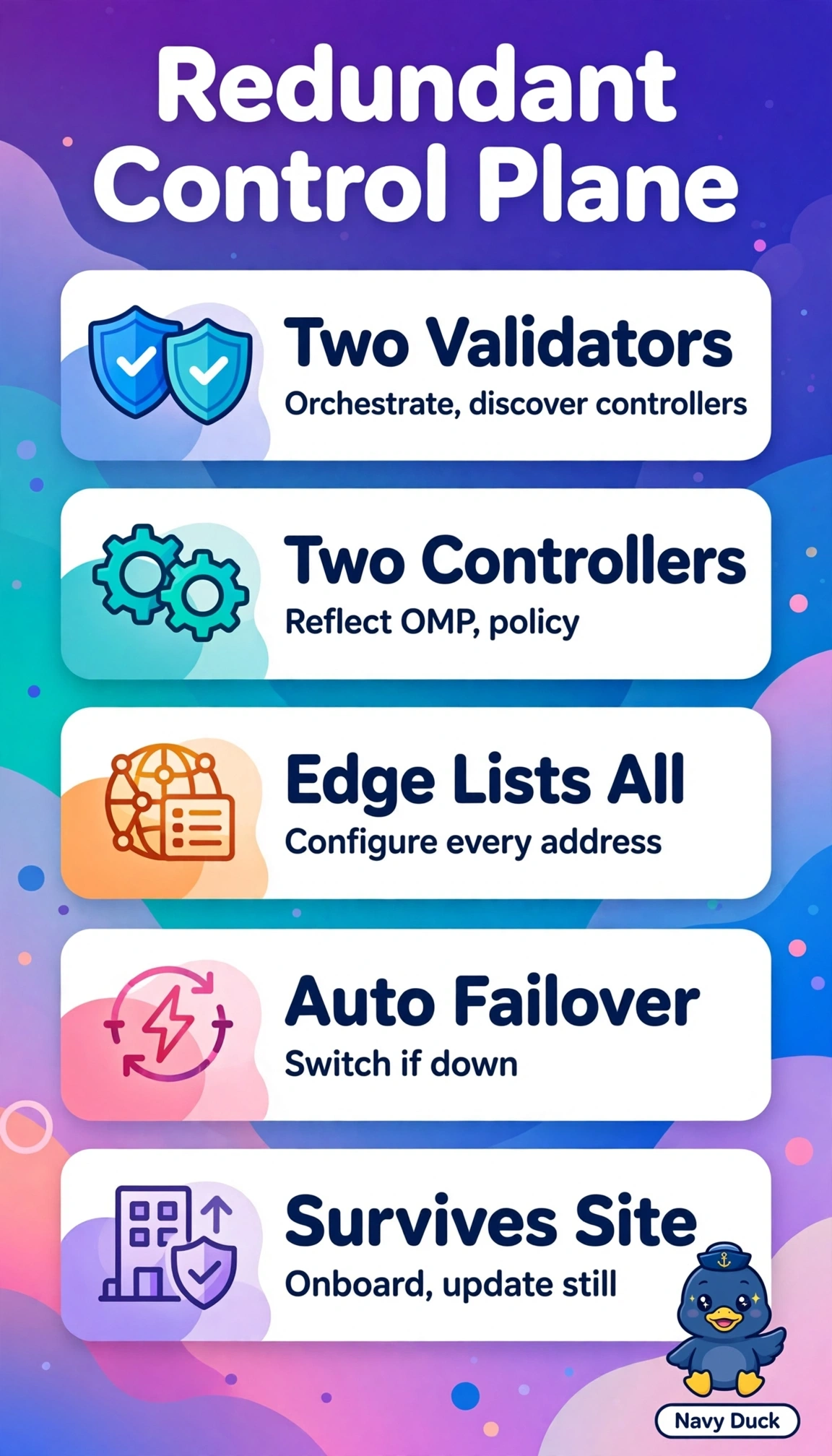
You'll want your edges to know both Validators and both Controllers so you don't lose onboarding or updates if one site goes down. Just like keeping a backup contact in your phone, automatic failover kicks in without missing a beat.
Full Explanation
Resilience comes from role separation, where the SD-WAN Validator, formerly vBond, provides orchestration, NAT traversal and Controller discovery, while the SD-WAN Controller, formerly vSmart, provides OMP route reflection and policy, and WAN Edges are configured with the Validator addresses, authenticate to them, learn the Controller addresses from them, and then build DTLS or TLS control connections to each Controller and fail over automatically (Validator connections are DTLS only). Listing both Validators and both Controllers satisfies onboarding during a site loss because a new Edge can still authenticate and discover a live Controller, and OMP stays up for policy. Using only one of each satisfies simplicity but misses the single-failure requirement because loss of that device blocks discovery or OMP. Using Validators for forwarding and Controllers for DNS misapplies concepts because neither forwards data nor resolves DNS for Edges. Swapping roles fails the concept because Validators do not reflect OMP and Controllers do not orchestrate initial bring-up. For the exam, remember Validators are the first touch for authentication and Controller lists, and in practice verify control connections to all controllers and test onboarding with one site isolated.