
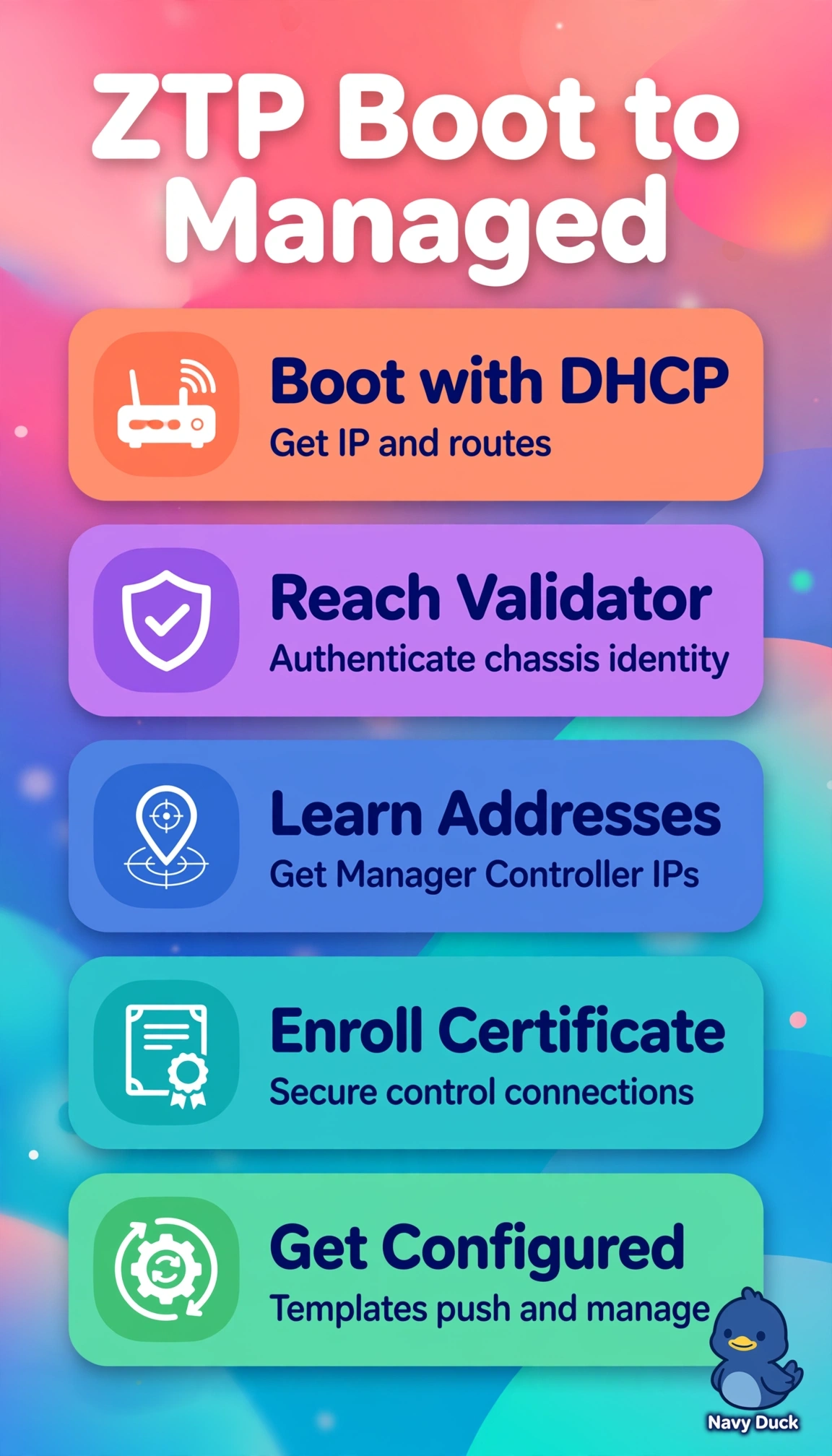
A new retail branch receives a factory-default WAN Edge router with its serial added to Plug and Play Connect and DHCP on Internet transport. The branch needs automatic authentication, controller discovery, certificate enrollment and template attachment with no staging. Which ZTP sequence provisions the router from boot to fully managed state?
Select an answer to reveal the explanation.
Short Explanation
You nailed the chain if you followed the introductions in order. The Validator vouches for identity first, then the orchestration hands off management and control to finish the job.
Full Explanation
Zero-touch provisioning succeeds because each controller has a distinct role executed in order: the factory-default WAN Edge uses DHCP/DNS to reach the SD-WAN Validator (formerly vBond) which authenticates the chassis and organization, then it returns the SD-WAN Manager and SD-WAN Controller addresses so the device can request a certificate, establish control connections to Manager and Controller (DTLS by default, TLS optional), and finally receive templates and OMP routes to become managed. Contacting Manager first fails because an unauthenticated device cannot trust or discover overlay addresses without Validator orchestration and Plug and Play authorization. Building IPsec to Controller first fails because control and certificate enrollment must precede data-plane tunnels, and the Validator is the source of Controller discovery not the reverse. Forming OMP to Manager fails by concept because OMP runs between WAN Edges and Controllers for routing, while Manager uses NETCONF for configuration, so that sequence misplaces protocols and roles. Exam caveat is to distinguish Validator orchestration from Manager configuration and Controller routing, and practical check is to verify serial provisioning in Plug and Play Connect and Validator organization whitelist before dispatch.