
A 200-store retailer uses Microsoft 365 and Salesforce from every branch with dual internet transports and no regional hub. Stores need the lowest latency path with continuous performance probing and automatic best-path selection, while IT wants no extra tunnel hops. Which Cloud OnRamp for SaaS path selection model meets these SaaS performance requirements?
Select an answer to reveal the explanation.
Short Explanation
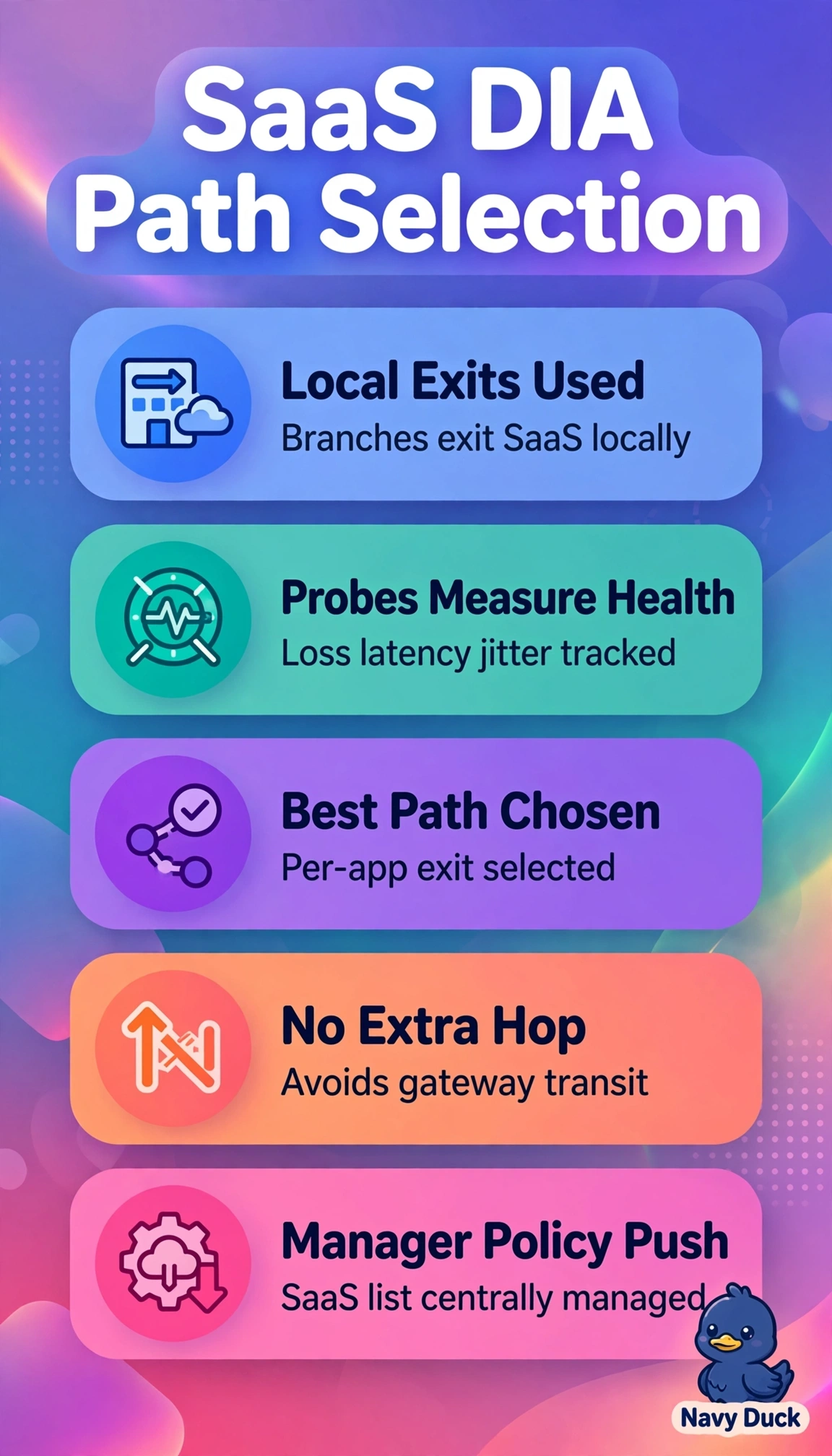
You've got stores that just need the fastest door out, and that's exactly what DIA probing delivers. Your direct-internet-access SaaS path keeps traffic local while cloud probes steer each app to its healthiest exit.
Full Explanation
The correct design is right because Cloud OnRamp for SaaS launches continuous Manager-configured probes to Microsoft 365 and Salesforce from each store over both DIA transports, measures latency, loss and jitter per application, then automatically programs local best-path egress so traffic leaves directly without hub backhaul or extra gateway tunnels. The gateway-probing design fails on architecture because selecting the highest scoring regional gateway still tunnels SaaS flows to a remote hub for egress, adding hops and latency that violates the no-hub, lowest-latency and no-extra-tunnel requirements despite valid probing. The preferred-exit monitoring design fails on automation because it observes both transports yet pins each application to its configured circuit, so degraded performance does not trigger dynamic reselection to the better local path. The load-sharing design fails on path logic because distributing flows across both transports for resiliency and capacity still places sessions on the degraded circuit rather than steering each application to the single probed best exit. As an exam caveat, separate SaaS DIA best-path from Cloud OnRamp for IaaS where a regional gateway is intentional, since distributed SaaS optimization should remain local. As a practical check, confirm in SD-WAN Manager (formerly vManage) the SaaS dashboard scores, selected local exits, DIA NAT and routes, then impair one transport to verify automatic per-application failover.