
A regional retailer with 40 branches runs bulk file transfers and virtual desktops over MPLS and broadband, needs TCP optimization without per-branch appliances, and wants flows automatically distributed across optimization resources. Which AppNav and service-node design best supports App-QoE WAN optimization steering?
Select an answer to reveal the explanation.
Short Explanation
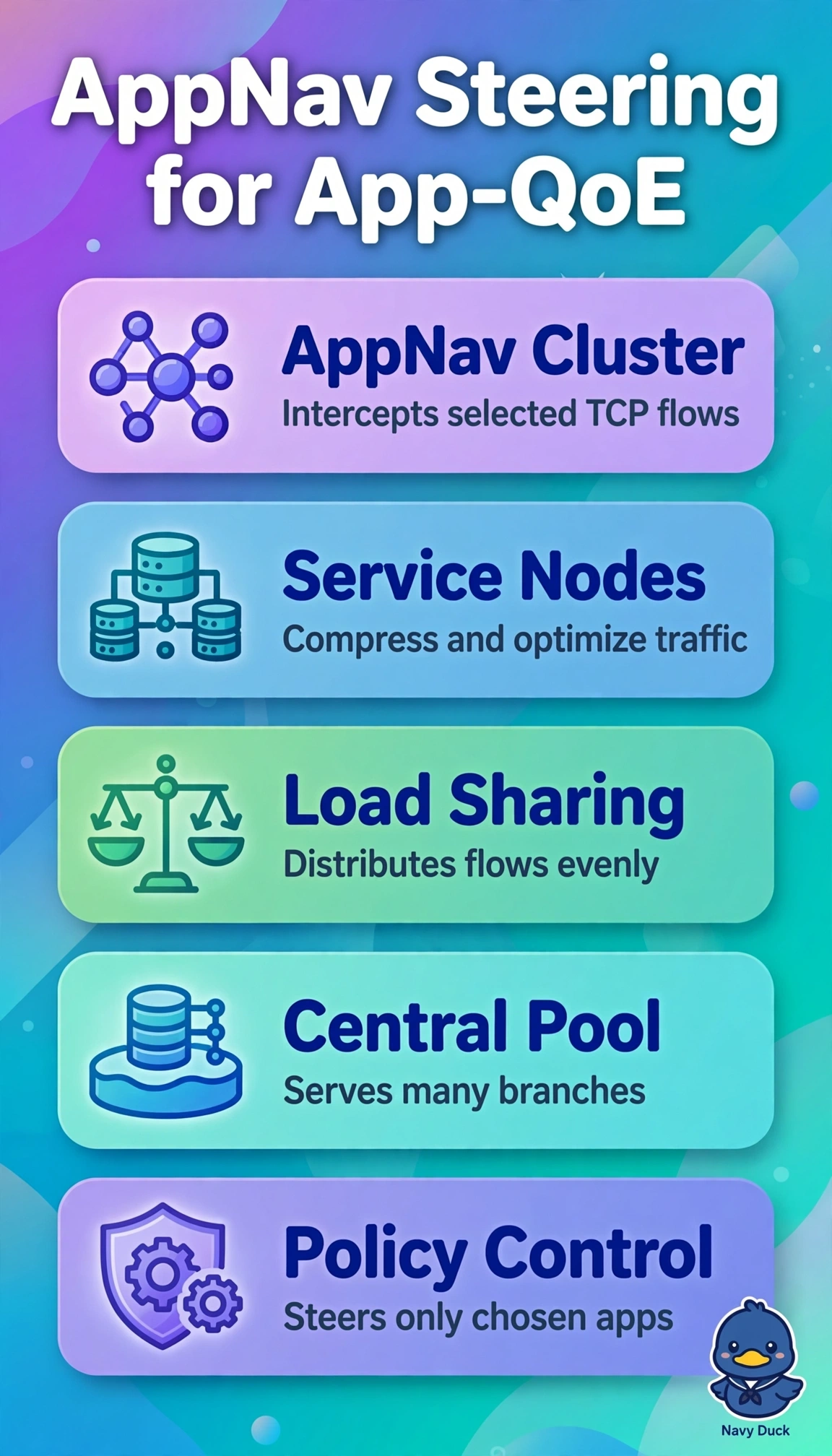
You've got the right instinct to centralize optimization for those branches. An AppNav cluster spreads flows across service-nodes like a smart checkout lane directing shoppers. That pooling avoids per-site boxes while scaling throughput.
Full Explanation
The correct design fits because a central AppNav cluster provides interception plus automatic flow distribution across pooled service nodes that perform TCP optimization, compression and data-redundancy elimination for bulk transfers and virtual desktops, which satisfies hybrid MPLS and broadband steering through App-QoE policy without requiring hardware at any of the 40 branches and scales by adding pooled capacity behind the cluster. The centralized static-policy design fails on distribution by concept because without AppNav control, flows must be manually assigned to specific service nodes so load cannot rebalance automatically, creating hot spots and management overhead as branch demand shifts. The branch-embedded design fails on footprint by concept because integrating service-node functionality into every branch router reintroduces per-site hardware, licensing and maintenance across 40 locations, directly violating the appliance-free requirement even though local TCP handling is technically effective. The WCCP-based design fails on steering by concept because generic network-layer redirection intercepts traffic without SD-WAN awareness of path SLA, application priority or hybrid-transport selection, so it cannot deliver App-QoE driven steering of optimized sessions. As an exam caveat, separate the three roles clearly since AppNav intercepts and load-shares, App-QoE steers by policy and SLA, and only service nodes optimize, with WCCP remaining historically valid but insufficient when App-QoE is specified. As a practical check, confirm AppNav cluster status, pooled service-node health, TCP optimization counters and App-QoE forwarding decisions in monitoring before extending templates to additional branches.