
A retailer needs Zoom to use MPLS only while loss stays under 2% while Office 365 can use Internet, with automatic classification even when ports change. The WAN Edge runs IOS XE with DPI enabled. Which application-aware routing classification meets the dynamic-app requirement?
Select an answer to reveal the explanation.
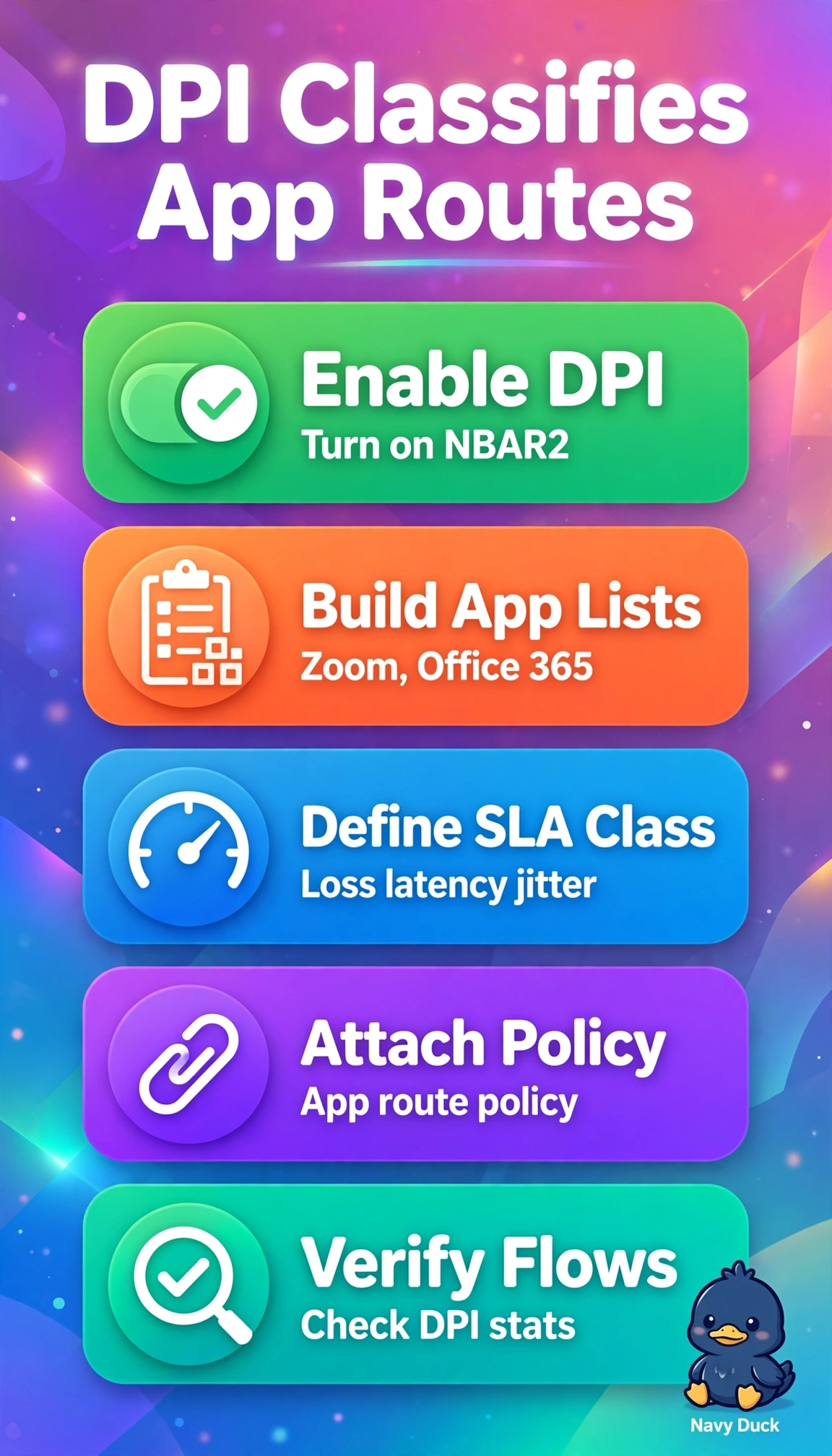
Short Explanation
Ports lie, but behavior doesn't. Let NBAR2 DPI recognize the apps themselves and your SLA policy can route Zoom differently from Office 365.
Full Explanation
Application-aware routing matches on applications rather than raw prefixes, so defining application lists backed by NBAR2 deep packet inspection lets the edge classify Zoom and Office 365 dynamically despite port or IP changes and then apply distinct SLA classes for loss, latency and jitter with backup paths. Using prefix lists fails by concept because static IP subnets for SaaS change frequently and cannot reliably identify applications without DPI signatures. Using TLOC lists fails by concept because TLOC lists select transports as actions, not match criteria for which application traffic is being measured. Using community lists fails by concept because BGP communities tag routes for control policy, not Layer-7 application identity for SLA measurement. Exam caveat: enable DPI and verify applications are recognized before attaching SLA, and practical check in SD-WAN Manager is to view DPI flows and app-route statistics to confirm Zoom hits the MPLS SLA class.