
A bank migration team standardizes 80 branches with feature templates in SD-WAN Manager but needs per-site OSPF timers and a syslog tweak not exposed in any feature template field. Change control requires reusable structured config with rollback via templates. Which template strategy should the engineer choose to deliver the standardized branch configuration?
Select an answer to reveal the explanation.
Short Explanation
Smart catch — you keep structure without losing flexibility. Feature templates remain your recipe base while the add-on is the spice packet, so remember add-on handling.
Full Explanation
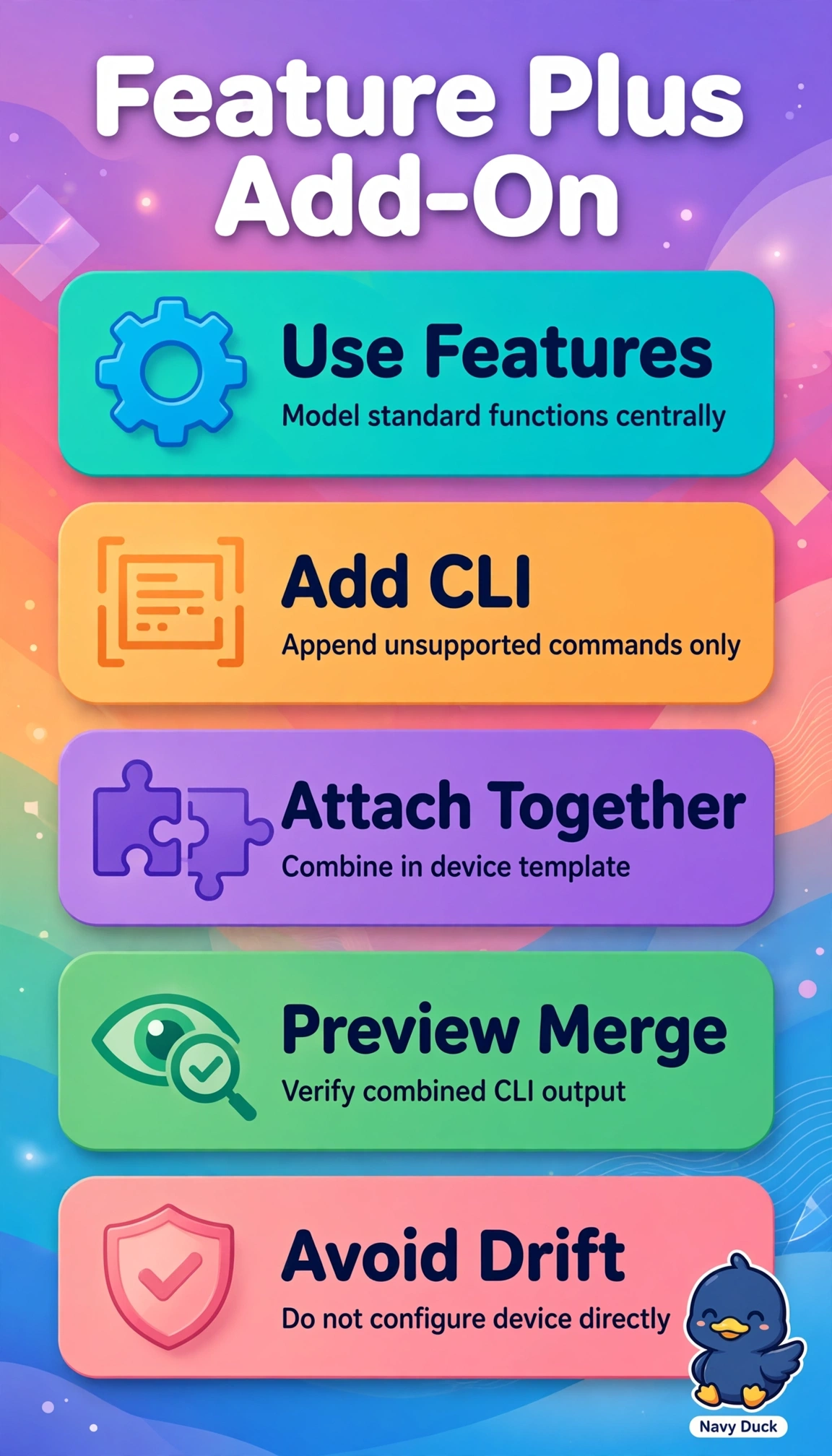
The correct strategy preserves the standardized device template built from reusable feature templates for common branch functions while delivering unsupported OSPF timers and syslog tweaks through a CLI add-on template attached to the same device template, keeping deployment structured, consistent across 80 sites, versioned in SD-WAN Manager and reversible by detaching or reverting templates. The variable-based approach fails because device-template variables can only customize fields already modeled in a feature template and cannot inject entirely new CLI, so per-site values have nowhere to bind despite remaining reusable. The device CLI template approach fails because it is a monolithic replacement for a feature-based device template rather than an additive complement, sacrificing modular reuse and forcing full CLI maintenance instead of extending the standard model. The operational-update approach fails because live maintenance changes create unmanaged drift without structured reuse or template-driven rollback required by change control. For the exam, remember that only the CLI add-on coexists with feature templates, while device CLI stands alone. As a practical check, preview merged configuration in SD-WAN Manager, validate timers and syslog in lab, then confirm detach restores baseline before scaling.