
A clinic edge has patient VLAN 10 needing Internet via SD-WAN overlay and printer VLAN 20 staying local, but users report VLAN 10 cannot reach the fabric while underlay to the ISP is up. Service VPN 10 and transport VPN 0 exist with correct DIA policy. Which underlay-overlay routing linkage most likely restores VLAN 10 forwarding into the fabric?
Select an answer to reveal the explanation.
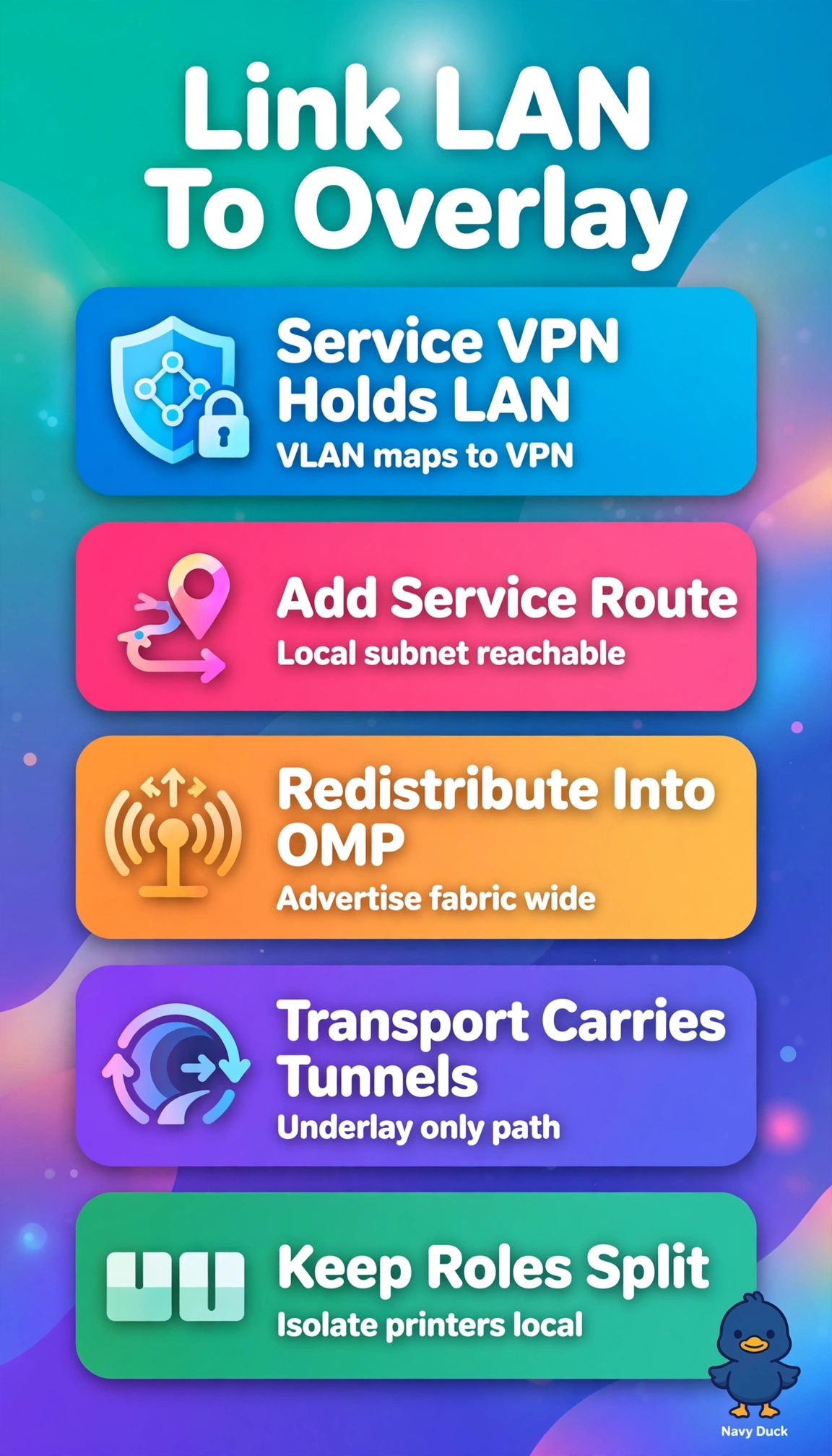
Short Explanation
Your LAN road isn't connected to the SD-WAN on-ramp yet, so traffic can't merge. Service VPN routing injects local subnets into OMP so the fabric learns them.
Full Explanation
Service-side subnets live in service VPNs and must have connected or static routes that are redistributed into Overlay Management Protocol so SD-WAN Controller (formerly vSmart) advertises them fabric-wide, while transport VPN 0 carries only underlay next hops for TLOCs and tunnel establishment, keeping underlay and overlay roles separated. Moving user VLANs to transport VPN 0 mixes service traffic with underlay and breaks VPN isolation and policy, leaving the VPN without routes means OMP has nothing to advertise so remote peers never learn the prefix despite BFD health, and merging printers with clinical traffic violates segmentation and advertising service prefixes to the ISP underlay leaks internal routes. For the exam remember service VPN plus OMP redistribution equals overlay reachability and transport VPN equals underlay connectivity, and check with show sdwan omp routes and service VPN routing tables on SD-WAN Manager (formerly vManage) to confirm advertisement.