
A distributor owns IOS XE routers capable of SD-WAN that currently run traditional routing with EIGRP and ZBFW, and IT wants to migrate selected sites to SD-WAN without replacing hardware. Some sites must stay traditional. Which mode distinction guides migration of IOS XE SD-WAN-capable routers?
Select an answer to reveal the explanation.
Short Explanation
You're deciding whether the same box works for the fabric or flies solo. Controller-mode hands control to your SD-WAN brains, autonomous keeps it classic.
Full Explanation
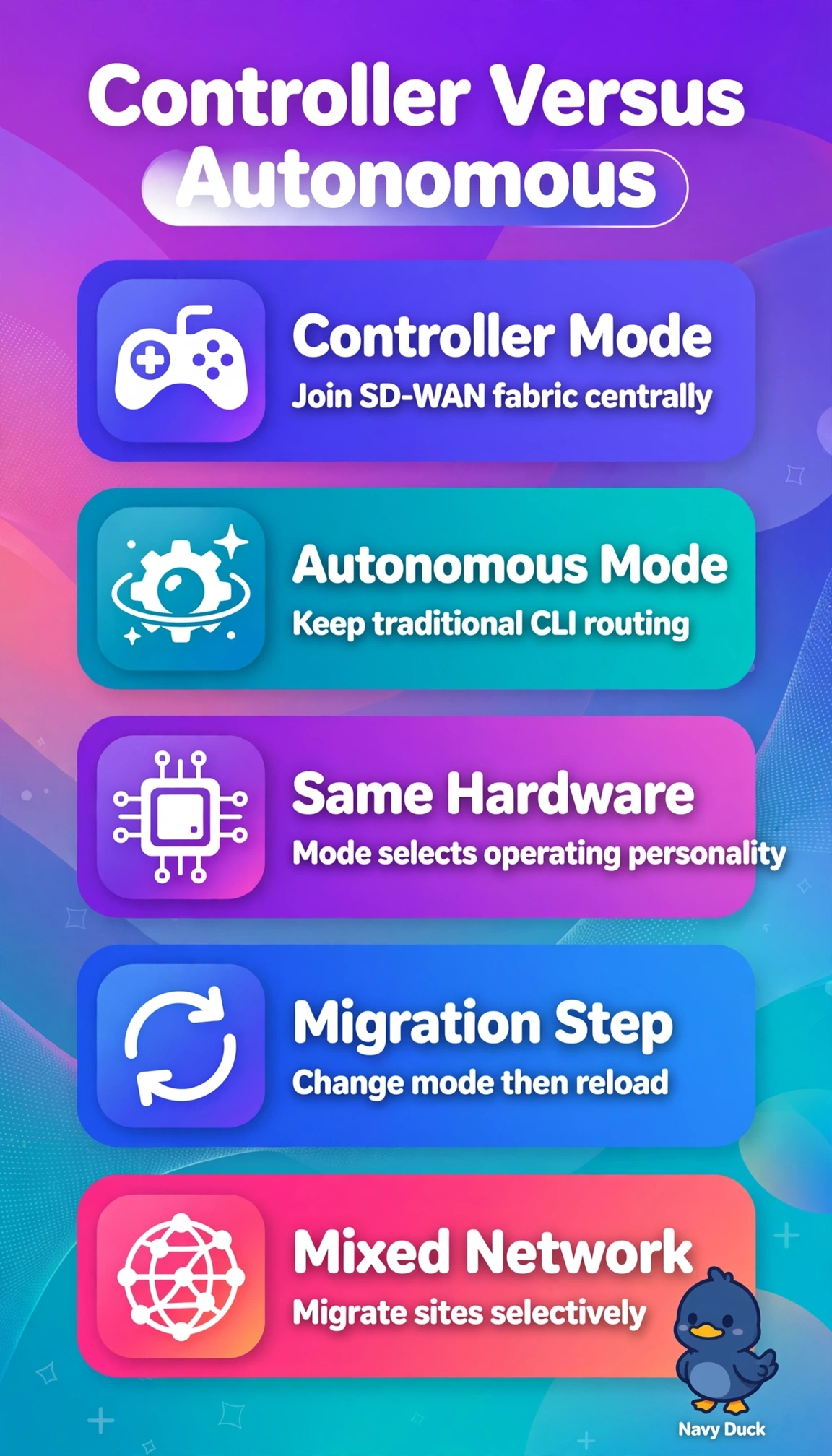
The correct distinction is that capable IOS XE routers run exclusively in controller mode to join controllers and receive centralized policy, or in autonomous mode with traditional CLI for EIGRP, ZBFW and local routing, allowing selective software-based migration without hardware replacement. The concept of joining the fabric in controller mode while retaining EIGRP and ZBFW CLI verbatim fails because authority shifts to templates and centralized policy, so legacy constructs must be rebuilt as SD-WAN policy rather than persisting unchanged. The concept of enabling overlay while staying in autonomous mode without conversion fails because autonomous devices cannot establish OMP sessions and secure control connections or participate in overlay routing, so preserving local CLI precludes fabric membership. The concept of running both modes concurrently to phase services while keeping EIGRP intact fails because mode is mutually exclusive per device and requires conversion with reload, not simultaneous operation. Exam caveat is to separate inventory visibility from authenticated fabric membership needing valid certificates, matching organization name and controller reachability, since centralized security applies only after conversion. Practical check is to confirm platform support, code version, licensing and controller connectivity, back up autonomous configurations, then verify OMP peers and control connections on migrated sites while confirming EIGRP neighbors and zone pairs remain stable on retained sites.