
A branch WAN Edge has MPLS on ge0/0 and broadband on ge0/1, both in VPN 0. MPLS must carry private TLOC with GRE, broadband must carry public TLOC with IPsec, and only HTTPS and SSH may terminate on the broadband interface. Which transport interface configuration meets the encapsulation and service requirement?
Select an answer to reveal the explanation.
Short Explanation
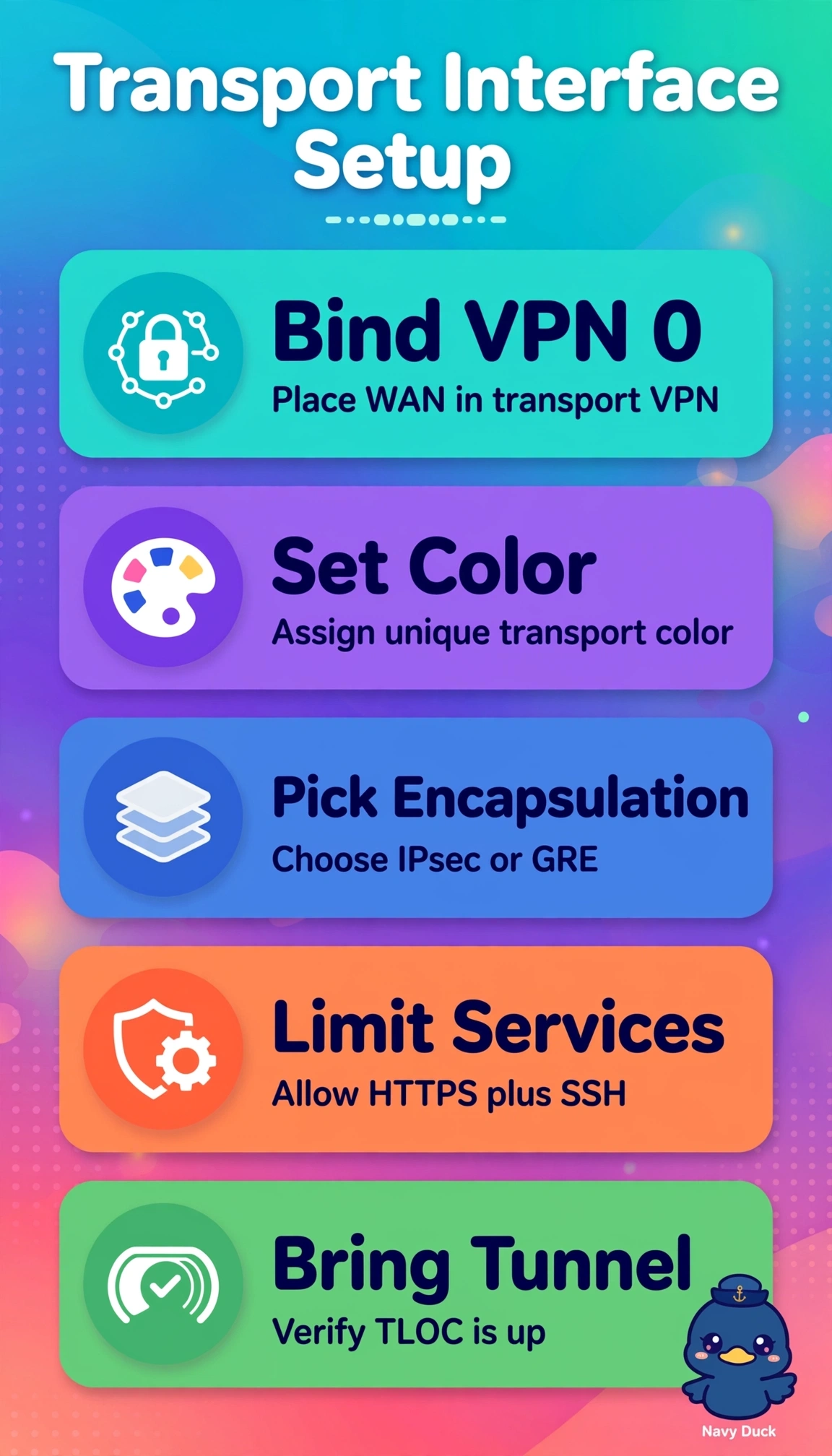
You separated the moving parts well. Color plus encapsulation defines each path, while allowed services locks the door except for management you approve.
Full Explanation
Transport interfaces in VPN 0 require a tunnel-interface with a color identifying the transport type and encapsulation selecting IPsec or GRE to form the TLOC, and the interface-level allowed services list constrains which management protocols can terminate on that interface for hardening without affecting transit traffic. Identical colors and encapsulations fails by concept because OMP and the data plane cannot distinguish MPLS from broadband for SLA, policy, and encapsulation handling, causing tunnel formation errors. Switched interfaces without tunnel encapsulation fails because no TLOC or IPsec/GRE overlay forms, so the port cannot join the SD-WAN fabric. Enabling a DHCP server instead of allowed services fails because it provides addressing to LAN clients rather than controlling terminating management access. For the exam, remember color plus encapsulation builds the TLOC and allowed services hardens termination, and in practice verify tunnel status, encapsulation, and reachability of HTTPS and SSH only on the intended interface.