
A retail chain must connect 150 branches to Zscaler and Cisco Umbrella SIGs quickly, enforce consistent IKE parameters, and let operations audit tunnels centrally. Engineers debate portal automation versus CLI. Which statement correctly contrasts automated SIG tunnel creation versus manual configuration?
Select an answer to reveal the explanation.
Short Explanation
You’re balancing speed and consistency against configuring each branch by hand. Automation is like using a cookie cutter instead of shaping every cookie yourself.
Full Explanation
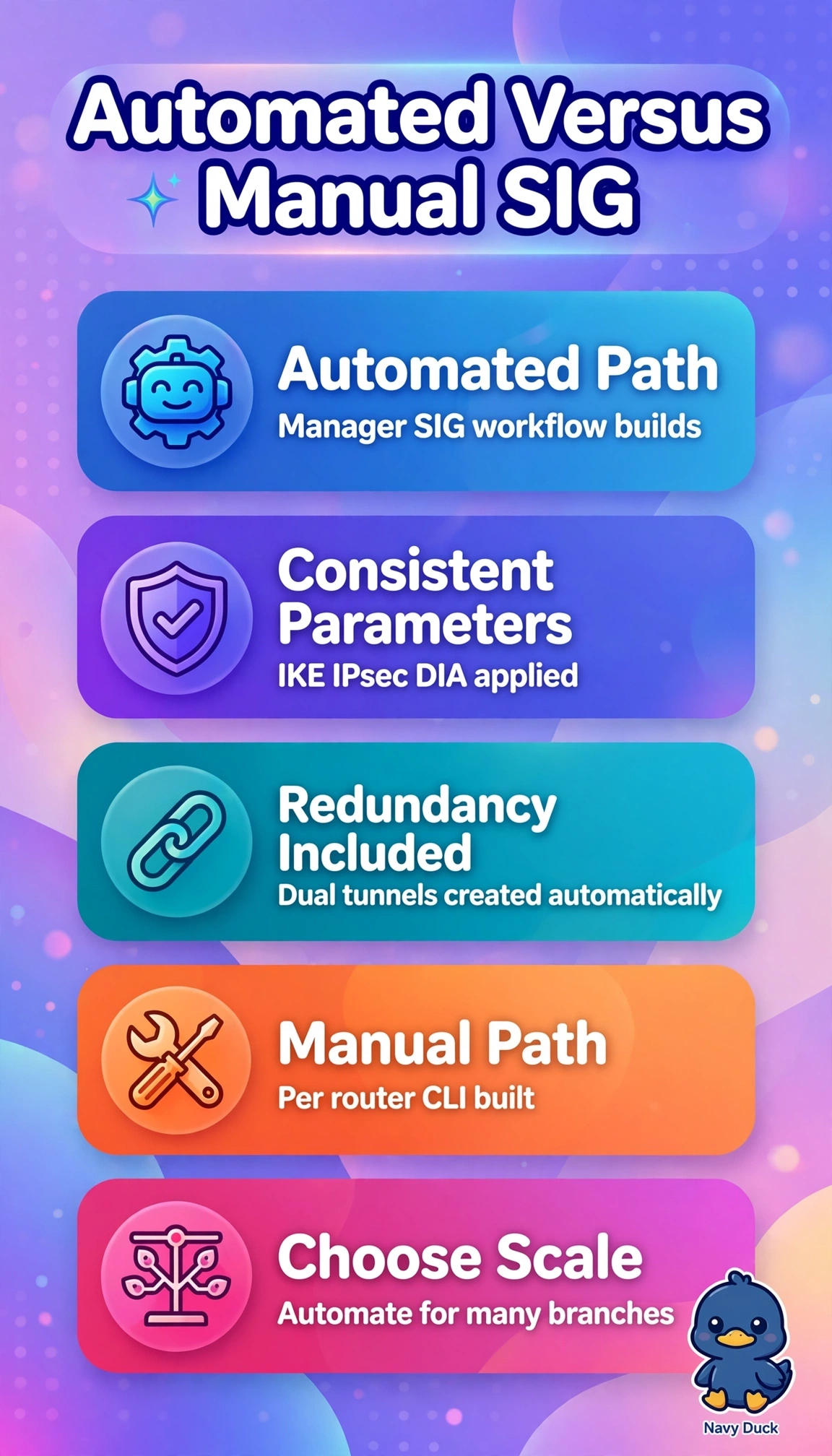
The SD-WAN Manager SIG workflow uses centralized credentials, data-center definitions, and feature templates to provision redundant IPsec tunnels to both Zscaler and Cisco Umbrella with uniform IKEv2 parameters. This supports rapid rollout to 150 branches, consistent settings, and central tunnel auditing; manual configuration instead requires per-router CLI for crypto, peers, and routing, making it slower and more prone to drift at scale. Automating redundant IPsec only to Zscaler while configuring Umbrella manually does not provide automated, consistent connectivity to both providers. Automating redundant GRE tunnels to both SIGs may redirect traffic, but GRE does not use IKE negotiation, so it cannot meet the IKE-parameter requirement. Automating only primary IPsec tunnels and manually tuning failover leaves redundancy outside the workflow and reintroduces delay and inconsistency. As an exam caveat, distinguish redundant IPsec with IKE consistency and central auditing from GRE, primary-only tunnels, or automation limited to one provider. As a practical check, verify in SD-WAN Manager that both tunnels per branch are up, IKE proposals match, endpoints are correct for both providers, and centralized IPsec events are visible before closing deployment.