
A logistics firm must keep regulated warehouse prefixes off the internet transport by matching site lists, specific prefixes, and TLOC characteristics in a centralized control policy. The architect must choose match criteria and resulting set actions. Which control-policy match-and-set combination correctly uses site lists, prefix lists and TLOCs?
Select an answer to reveal the explanation.
Short Explanation
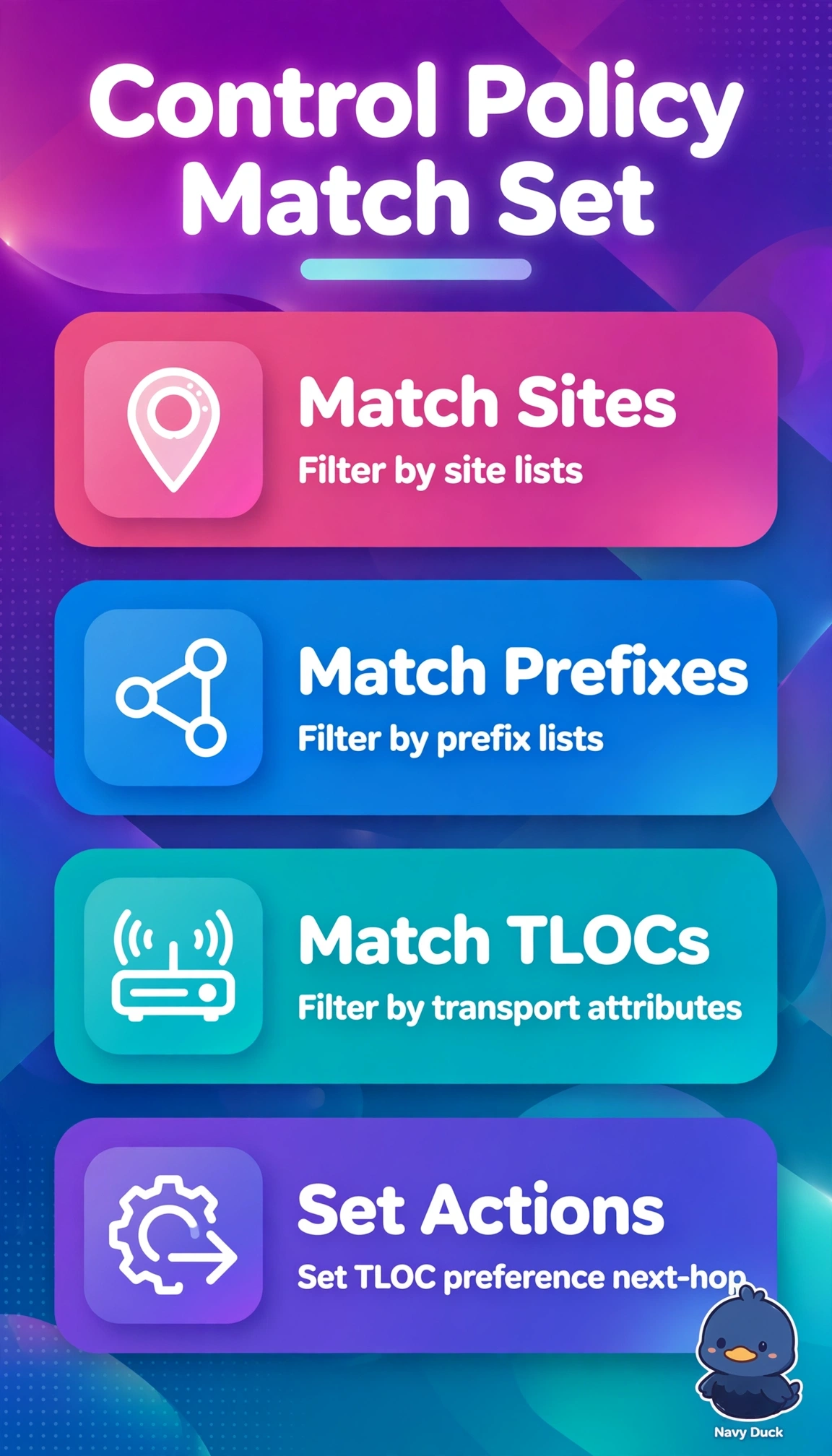
You're steering routes before they spread, not policing packets afterward. Control policy lets you match site lists, prefix lists, and TLOC characteristics, then set TLOC, TLOC action, or preference to keep regulated prefixes off internet transport. You can distinguish that from setting BGP-style attributes or tags alone, or matching VPN IDs instead of TLOC characteristics.
Full Explanation
The correct combination uses site lists, prefix lists, and TLOC attributes to identify the regulated warehouse routes and their candidate transports in centralized control policy. Setting TLOC, TLOC action, or preference then gives you an actionable way to steer those routes away from internet transport. Matching site lists and OMP route prefixes but setting only BGP community, origin, and local preference can influence route attributes or ranking, but it does not provide the TLOC-specific control needed to exclude an internet transport. Matching site and prefix lists with VPN IDs, then setting TLOC, preference, and service chaining, uses VPN membership rather than TLOC characteristics to distinguish the transports; the match may therefore fail to isolate the relevant TLOC. Matching site lists, prefix lists, and TLOCs but setting only tag, community, and OMP origin identifies the routes but does not apply the listed TLOC steering action. Exam caveat: centralized control policy changes OMP route and TLOC advertisements; centralized data policy acts on packets, while localized policy applies on a device. As a practical check, preview the policy in SD-WAN Manager and verify that the site-list, prefix-list, and TLOC matches select the intended routes, then confirm in OMP routes that the regulated prefixes use only the permitted TLOCs with the expected preference.