
A regional hub aggregates 40 branches with dual transport and needs high aggregate throughput, redundant power and diverse WAN interface capacity, while small stores need only a compact branch router. Which edge selection best satisfies the hub throughput and resiliency needs for this design?
Select an answer to reveal the explanation.
Short Explanation
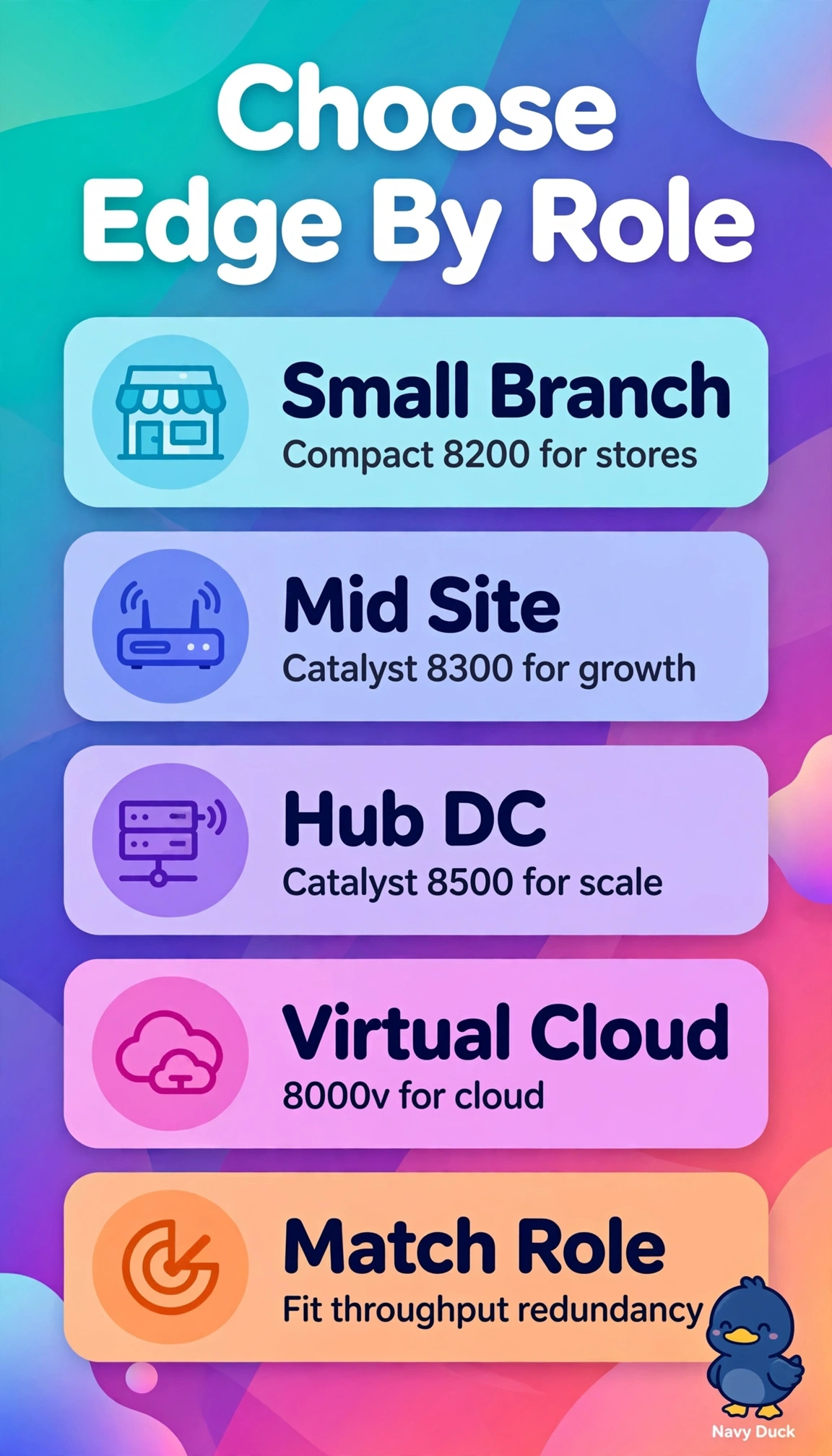
You’re sizing like a pro by matching capability to the job. The aggregation platform, Catalyst 8500, handles hub loads and resilience—like choosing a delivery van over a bike for bulk hauls.
Full Explanation
The regional hub must aggregate traffic from 40 branches, provide hardware resilience with redundant power, and terminate dual transports through diverse WAN interfaces. The Catalyst 8500 aggregation platform best fits this role, providing high throughput and redundancy, while compact routers suit small stores. A Catalyst 8200 compact branch router can serve small and mid-size branches with dual transport, but its forwarding and session capacity is not suited to the hub’s aggregate load and growth needs. A Catalyst 9500 high-throughput core switch can provide line-rate LAN switching and redundant power, but it is a campus core switch, not a WAN Edge platform for terminating diverse WAN transports and overlay tunnels. A Catalyst 8000V virtual router offers flexible virtual or cloud aggregation, but relies on a hypervisor host and does not itself provide the dedicated hardware power redundancy or deterministic WAN interface capacity required here. Exam caveat: do not equate LAN switching capacity or virtual-router throughput with purpose-built WAN aggregation; match throughput, power redundancy, and transport termination to the hub role rather than the branch role. Practical check: verify aggregate throughput for 40 sites, confirm dual power supplies and suitable WAN interface modules, and validate scale before finalizing the hub selection.