
A logistics site prioritizes voice, warehouse scanning, and bulk file sync over one 100-Mbps Internet circuit with congestion at peak hours. The design needs classification, queuing, and scheduling on egress. Which QoS treatment on the WAN Edge should the engineer configure for application-aware queuing?
Select an answer to reveal the explanation.
Short Explanation
You're giving each app its own lane and on-ramp order. Class maps plus a policy-map schedule egress queues fairly under load. It's like airport boarding groups that keep first-class and standby orderly.
Full Explanation
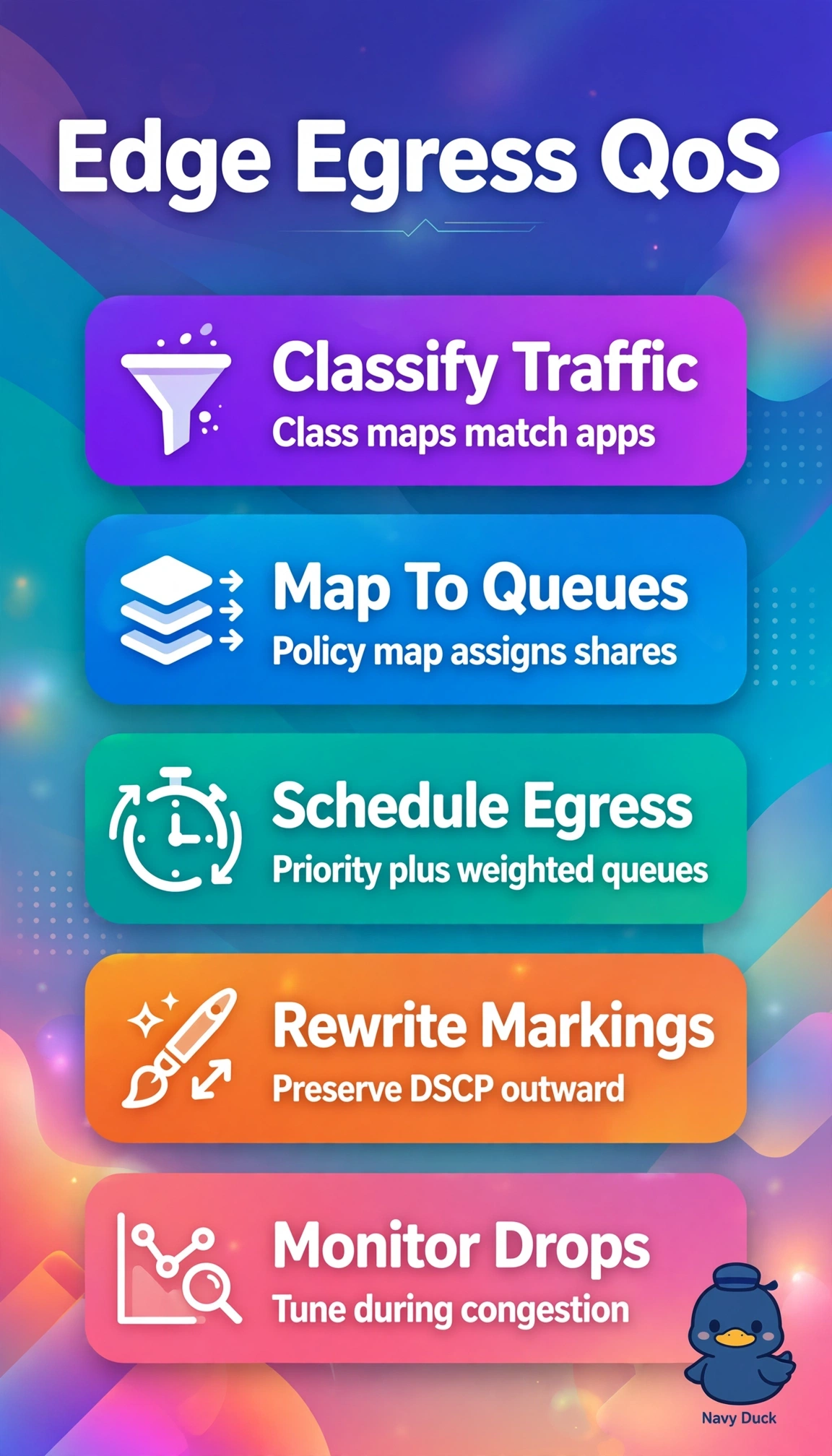
WAN Edge egress QoS follows a modular model where class maps classify voice, signaling, critical data and best effort using DSCP or application matches, a queuing policy map assigns each class bandwidth percentages, queue depths and rewrite behavior, and the policy is applied outbound on the transport interface so the scheduler services low-latency queues first while sharing remaining capacity, which directly addresses congestion on a single circuit. Using access lists with a route map and ingress policers fails by function because route maps influence routing decisions and ingress policing only drops excess, neither provides egress queuing and weighted scheduling. Using community lists with control policy and tunnel shapers fails because communities and TLOC preference steer OMP path selection rather than per-class queuing, and shaping alone does not classify and schedule multiple queues. Using prefix lists with app-route SLA probes fails because app-route selects best paths based on loss, latency and jitter and does not implement class-based queuing or rewrite on the egress interface. Exam caveat: QoS queuing uses class map plus policy map on egress, path selection uses app-route and data policy. Practical check: apply the queuing policy outbound on the transport interface and monitor queue drops per forwarding class during peak.