
An MSP must onboard 200 retail WAN Edge routers with reusable VPN, interface, and routing blocks that assemble differently per store size, plus a guided deployment workflow with configuration preview. Which modeling choice best contrasts configuration groups and feature profiles with legacy device templates?
Select an answer to reveal the explanation.
Short Explanation
Scaling to hundreds demands building blocks! You will love snapping reusable profiles together instead of cloning giants, with configuration groups keeping it tidy. Small changes then ripple cleanly and safely.
Full Explanation
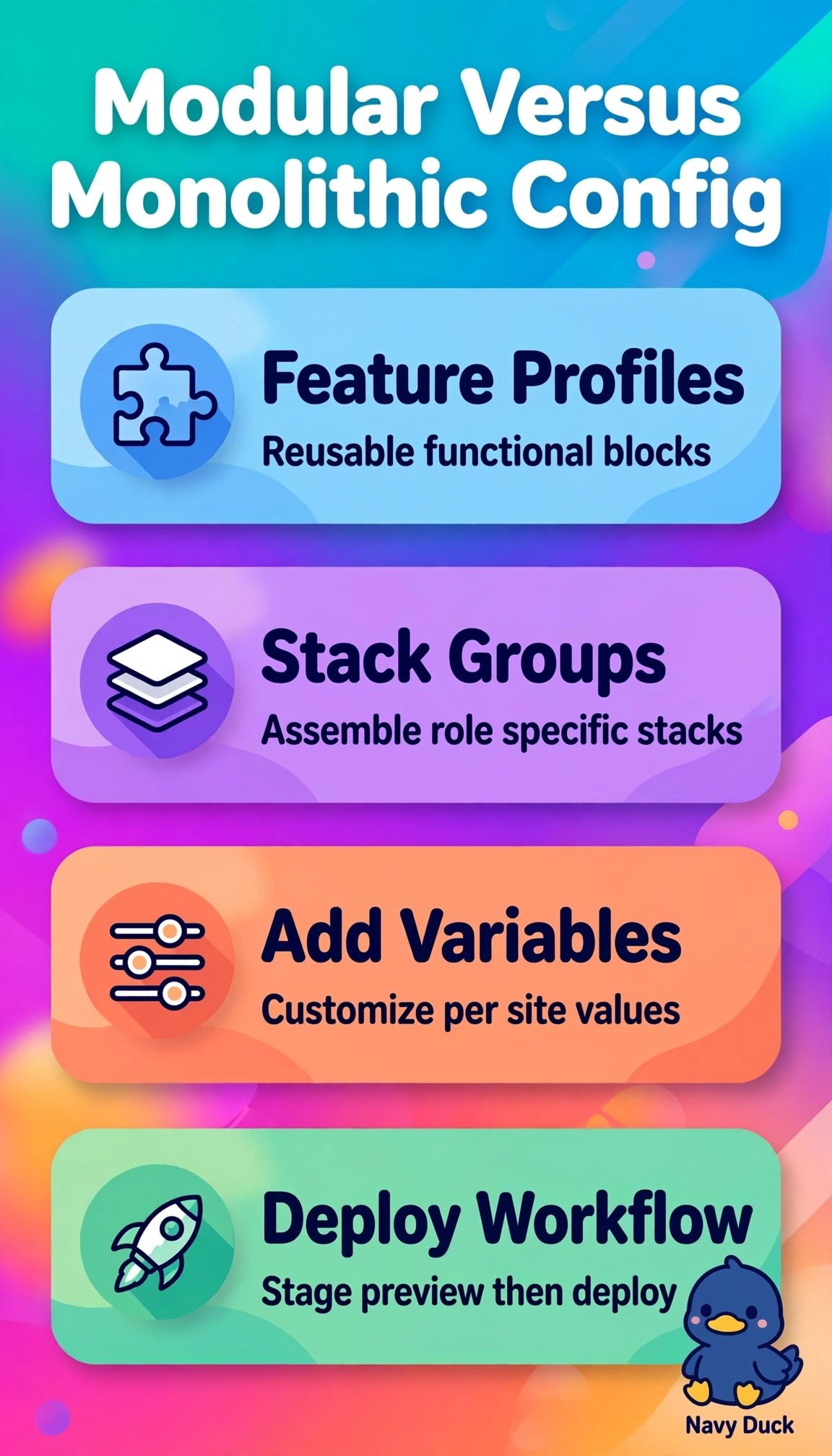
Configuration groups paired with modular feature profiles are correct because they decompose VPN, interface, and routing intent into reusable building blocks that can be stacked and recombined for small, medium, and large store variants while supporting a guided deployment workflow with validation and configuration preview, which directly contrasts with rigid monolithic CLI device templates that require duplication for every variation. The standardized uniform profile approach fails on modularity by concept because applying one identical stack to all sites satisfies reuse and workflow but prevents per-store-size assembly and customization that the scenario explicitly requires. The centralized policy plus legacy template approach fails on unified device modeling by concept because controller policy correctly handles overlay routing and VPN control yet leaves interfaces and system functions in monolithic CLI templates, so it does not replace the device configuration model as asked. The simultaneous deployment without workflow approach fails on operations by concept because it provides the right modular modeling but omits the required guided, staged workflow with configuration preview, leaving 200-site onboarding without a chance to review changes first. For exam caveat, distinguish where intent lives: feature profiles model device configuration, controller policy models fabric-wide routing and security intent, and device templates represent legacy CLI packaging that the question asks to move beyond. As a practical check, verify profile parcel reuse across at least two store profiles, confirm variable mapping for per-site addresses, and validate a staged rollout with configuration preview and diff in lab before onboarding the full retail fleet.