
A global fabric with 800 WAN Edges uses two SD-WAN Controllers in the US and one in EMEA with controller groups per region. The design must survive a controller loss without control-plane churn and keep regional affinity. Which control-plane scale and redundancy approach preserves stability with regional affinity?
Select an answer to reveal the explanation.
Short Explanation
You keep things calm by letting edges prefer home controllers but fail over gracefully. Regional affinity with grouped peering balances load without flapping.
Full Explanation
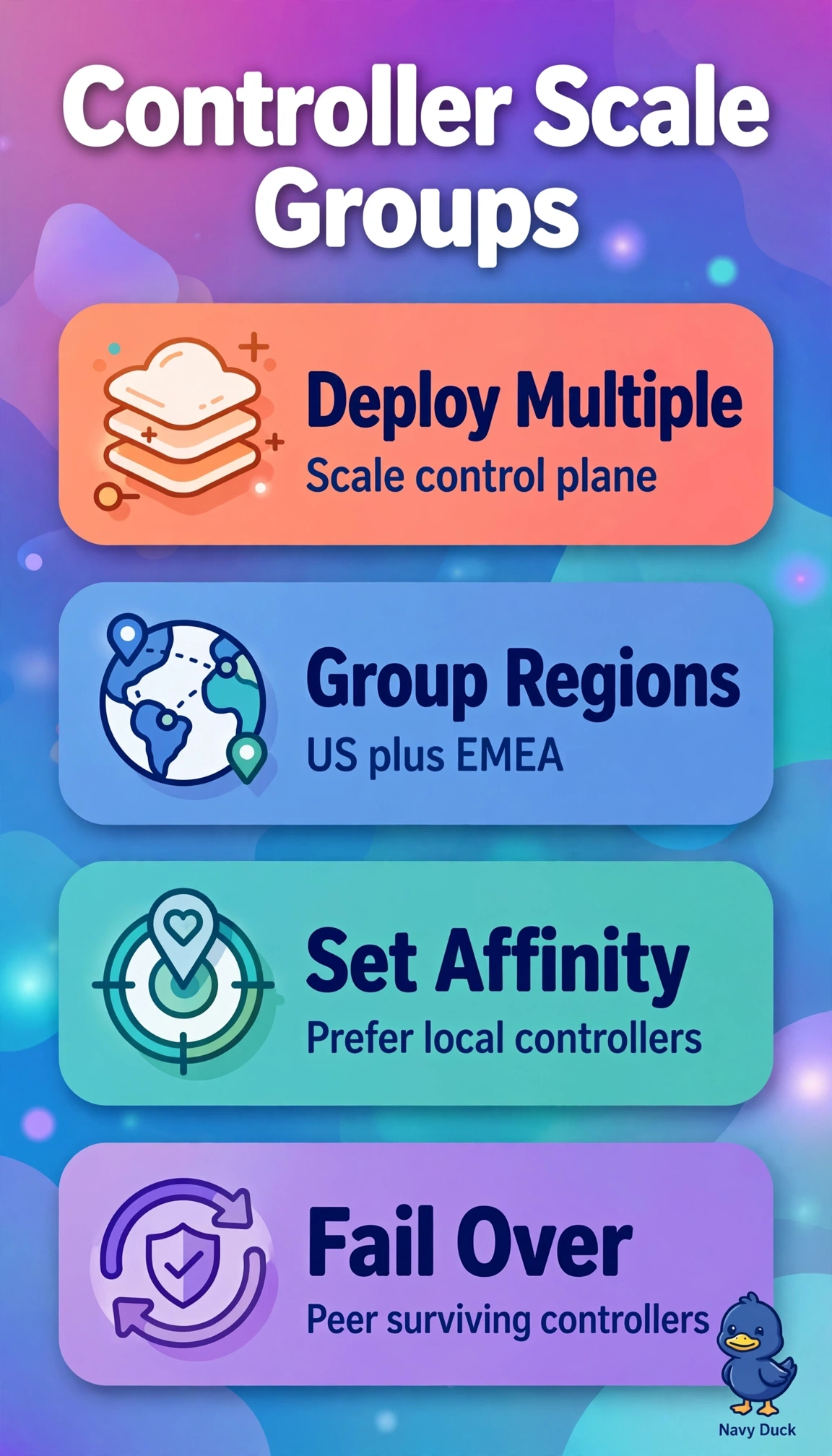
The control plane scales horizontally with multiple SD-WAN Controllers, formerly vSmart, where WAN Edges establish OMP sessions to configured controllers and controller groups with affinity steer edges to preferred regional controllers while still permitting failover to others without withdrawing all routes. The correct approach configures distinct controller groups for US and EMEA with affinity so edges prefer local controllers but maintain OMP to survivors if one fails, preserving prefix stability. A single controller creates a single point of failure and scale bottleneck, forcing all edges to all controllers ignores affinity and increases unnecessary OMP churn across regions, and centralizing all controllers in one site defeats geographic redundancy regardless of underlay ECMP. Exam caveat is that the SD-WAN Validator, formerly vBond, orchestrates initial controller discovery but does not carry OMP, and a practical check is to verify OMP peers and controller-group assignments on SD-WAN Manager and test controller loss.