
A branch cEdge has Internet transport in VPN 0 and LAN subnets in VPN 10 with OMP running to the fabric. Users need Internet-bound traffic steered centrally while intra-VPN routes stay isolated and service routes redistribute correctly. Which data-plane routing design correctly links the service side to the overlay?
Select an answer to reveal the explanation.
Short Explanation
You nailed the classic handoff if you kept VPN 0 and VPN 10 separate. Central NAT plus redistribution into OMP is the glue that moves LAN prefixes into the fabric.
Full Explanation
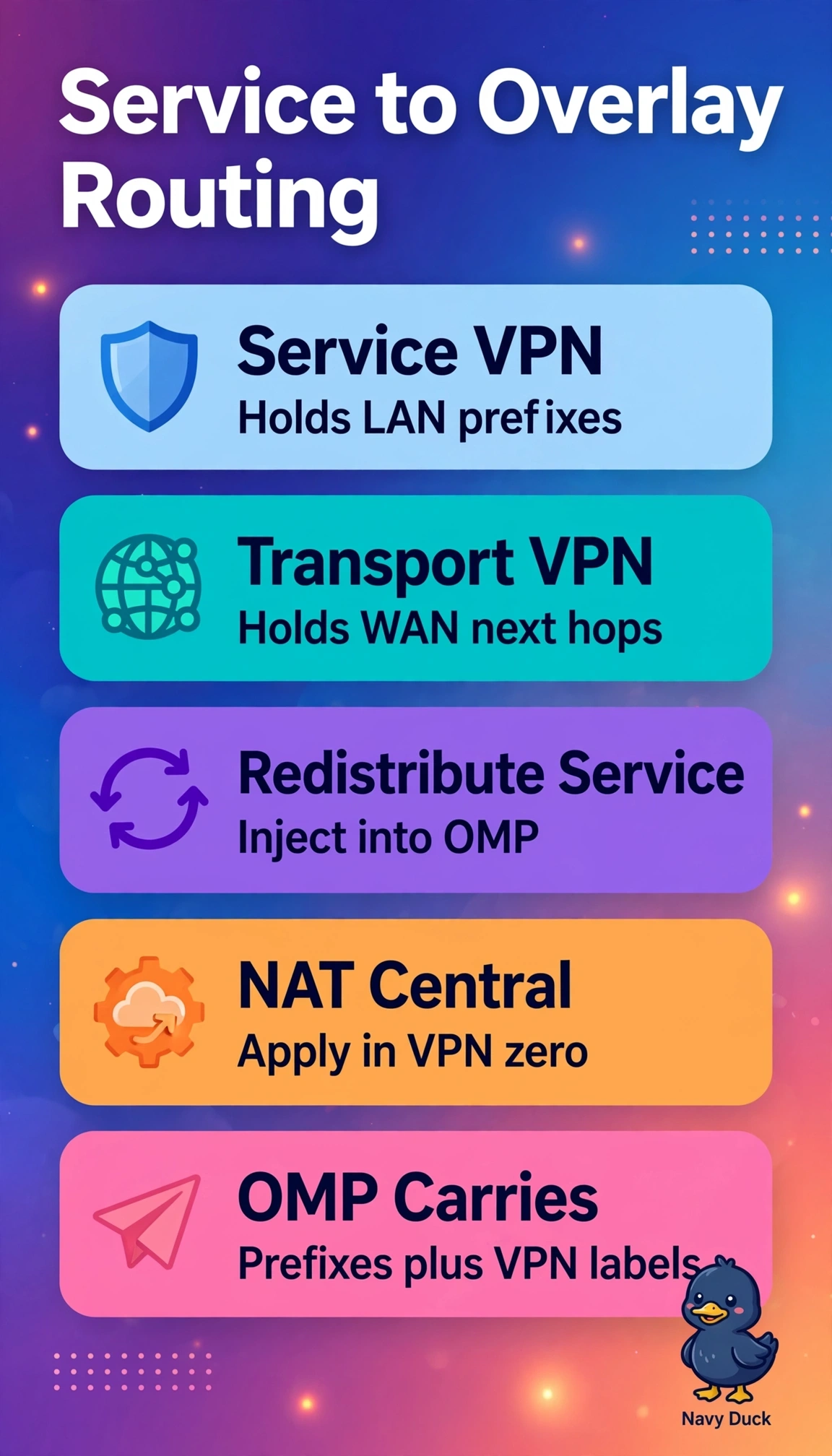
Service-side VPNs such as VPN 10 hold LAN prefixes while transport VPN 0 holds WAN underlay next hops and IPsec tunnel endpoints, with OMP as the overlay routing protocol that carries service prefixes, TLOCs and VPN context between WAN Edge routers and the SD-WAN Controller, formerly vSmart. The correct design keeps that separation by applying NAT in VPN 0 for centralized Internet exit and redistributing connected or static service routes from VPN 10 into OMP so remote edges learn them with correct VPN labels. Redistributing OMP into service OSPF in the wrong direction or enabling NAT in the service VPN breaks isolation and exit policy, MP-BGP in VPN 0 does not replace OMP for overlay service advertisement, and disabling redistribution leaves remote sites without LAN reachability because underlay OSPF never carries overlay VPN prefixes. Exam caveat is that VPN 0 and VPN 512 are reserved and never redistributed like service VPNs, and a practical check is to verify routes on SD-WAN Manager, formerly vManage, and with show sdwan omp routes on the edge.