
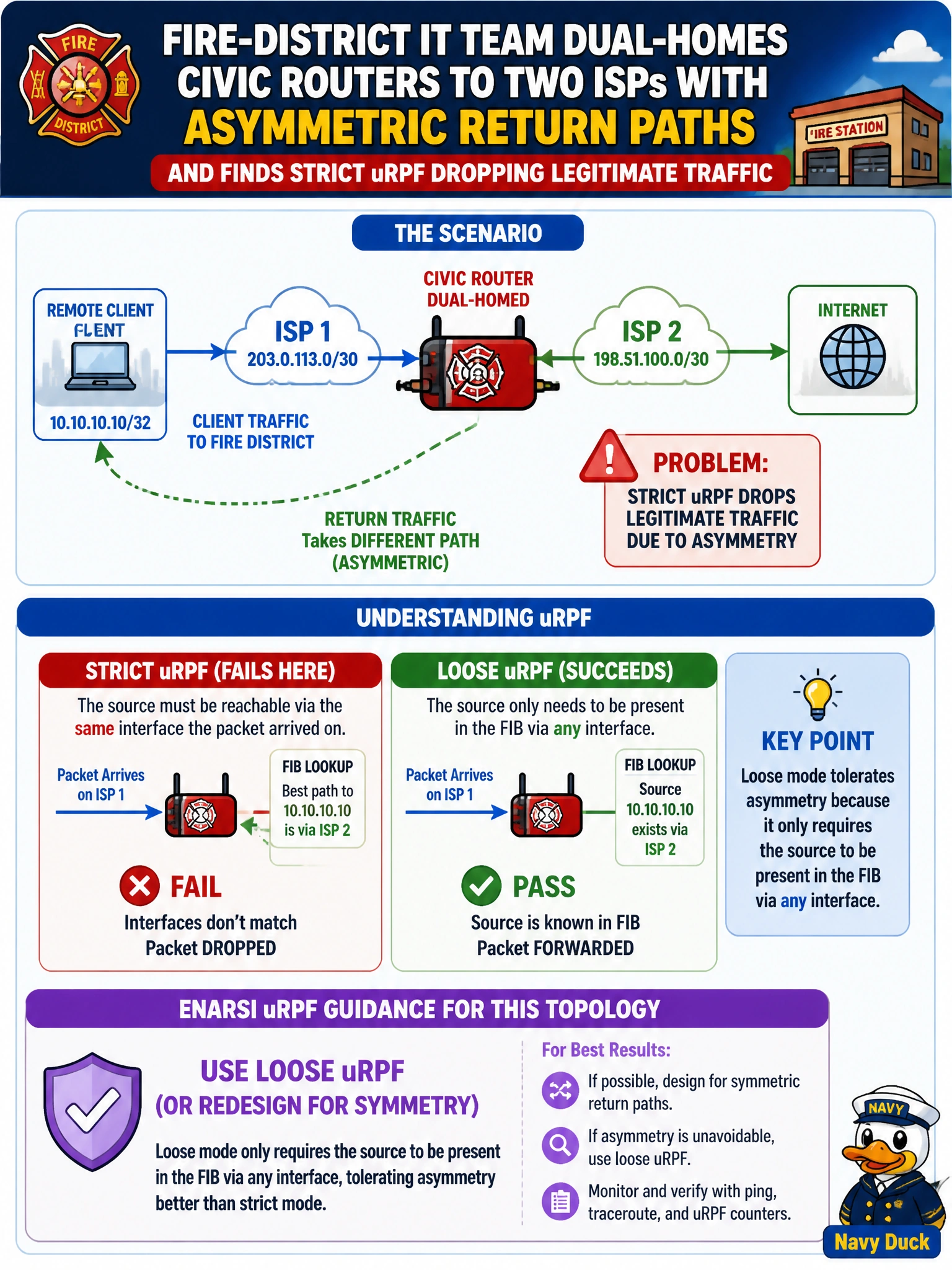
A fire-district IT team dual-homes civic routers to two ISPs with asymmetric return paths and finds strict uRPF dropping legitimate traffic. Which adjustment matches ENARSI uRPF guidance for that topology?
Select an answer to reveal the explanation.
Short Explanation
Asymmetric ISP paths are like leaving through the front door and coming home through the garage. Strict uRPF freaks out; loose mode mainly asks whether your address is in the map at all.
Full Explanation
When a fire-district IT team dual-homes civic routers to two ISPs with asymmetric return paths and finds strict uRPF dropping legitimate traffic, the adjustment that matches ENARSI uRPF guidance is to use loose uRPF (or redesign for symmetry). Loose mode only requires the source to be present in the FIB via any interface, which tolerates asymmetry better than strict mode's same-interface requirement. The correct adjustment works because asymmetric multi-homing commonly receives packets on one ISP link for sources whose best reverse path points out the other. Keeping strict uRPF and disabling the FIB so all packets pass RPF automatically fails because disabling the FIB is not a valid RPF fix and would break normal forwarding. Replacing uRPF with BGP confederations fails conceptually: confederations change AS hierarchy for iBGP scaling; they do not eliminate the need for reverse-path checks or fix strict-mode drops under asymmetry. Enabling strict uRPF on both ISP links and relying on IP SLA to rewrite source addresses fails because IP SLA does not rewrite packet sources to satisfy RPF, and strict mode on both asymmetric links perpetuates the problem. Exam caveat: loose mode is more permissive—spoofed sources that exist somewhere in the FIB may pass—so pair it with edge ACLs denying bogons/internal space as layered civic defense. Operational check: confirm asymmetry with path tracing, switch the affected ISP edges to loose uRPF (reachable-via any), retest legitimate dual-homed flows, and retain anti-spoof ACLs plus drop visibility.